 how-to
Get Fair Trade-In Value: A Guide
Table of Contents
- How Trade-In Value Is Calculated
- Key Factors Influencing Your Vehicle Appraisal
- Online Trade-In Appraisal Tools vs. In-Person Evaluations
- How to Prepare Your Car for Trade-In
- Negotiating Your Trade-In Value
- Trade-In Tax Credit and Sales Tax Benefits
- Private Sale vs. Dealership Trade-In Comparison
- Steps to Complete Your Trade-In
- Frequently Asked Questions
Last Updated: September 2, 2026
How Trade-In Value Is Calculated
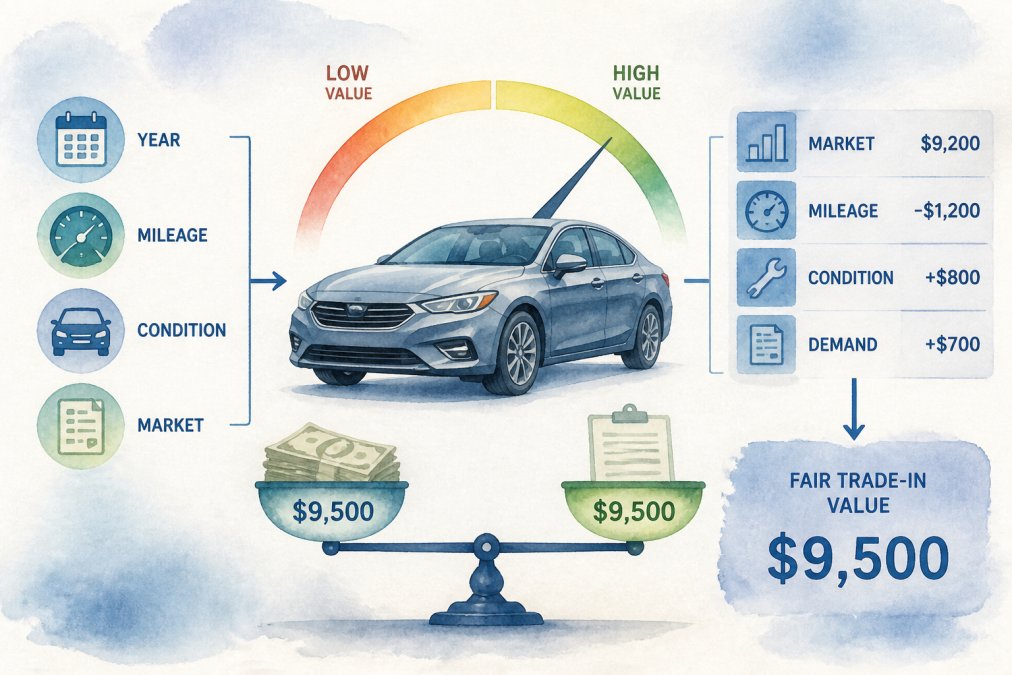
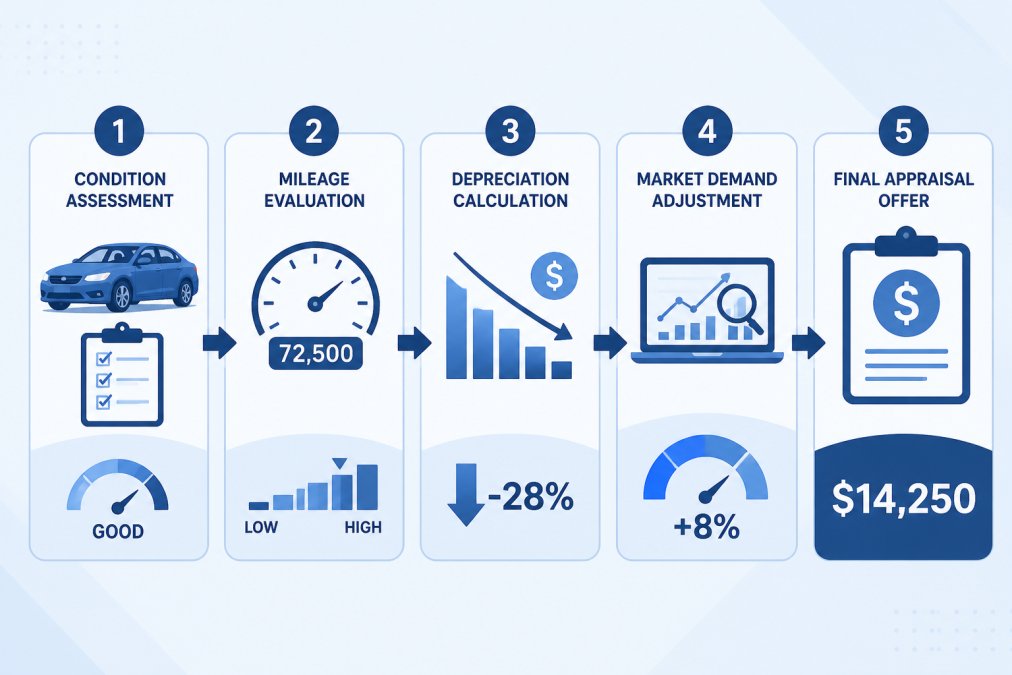
Trade-in value is determined through a systematic appraisal process combining vehicle condition assessment, market demand analysis, and depreciation calculations. The foundation starts with fair market value, what a willing buyer would pay a willing seller under normal market conditions, ensuring offers remain competitive and realistic.
Market demand and depreciation
Market demand directly influences your vehicle's worth. A popular sedan in high demand commands stronger trade-in allowance than an unpopular model with identical mileage and condition. Seasonal factors matter too; trucks and SUVs see increased demand during certain times of year, shifting appraisal values accordingly.
Depreciation is the predictable decline in vehicle value over time. Most vehicles lose significant value in the first few years, with rates varying by make and model (peer-reviewed research). An appraisal accounts for this depreciation curve, explaining why two vehicles of the same age and mileage might receive different offers, some models hold value better due to reliability reputation and market positioning.
Vehicle condition and mileage impact
Physical condition directly affects appraisal value. Appraisers inspect for exterior damage, interior wear, mechanical issues, and accident history. A vehicle with clean history and minimal cosmetic damage receives higher trade-in value than one showing neglect or collision damage.
Mileage serves as a primary wear indicator, though the relationship isn't always linear. A vehicle with 80,000 miles in excellent condition might appraise higher than one with 60,000 miles showing poor maintenance (the FTC). Detailed service records prove that high mileage doesn't necessarily mean high failure risk.
Key Factors Influencing Your Vehicle Appraisal
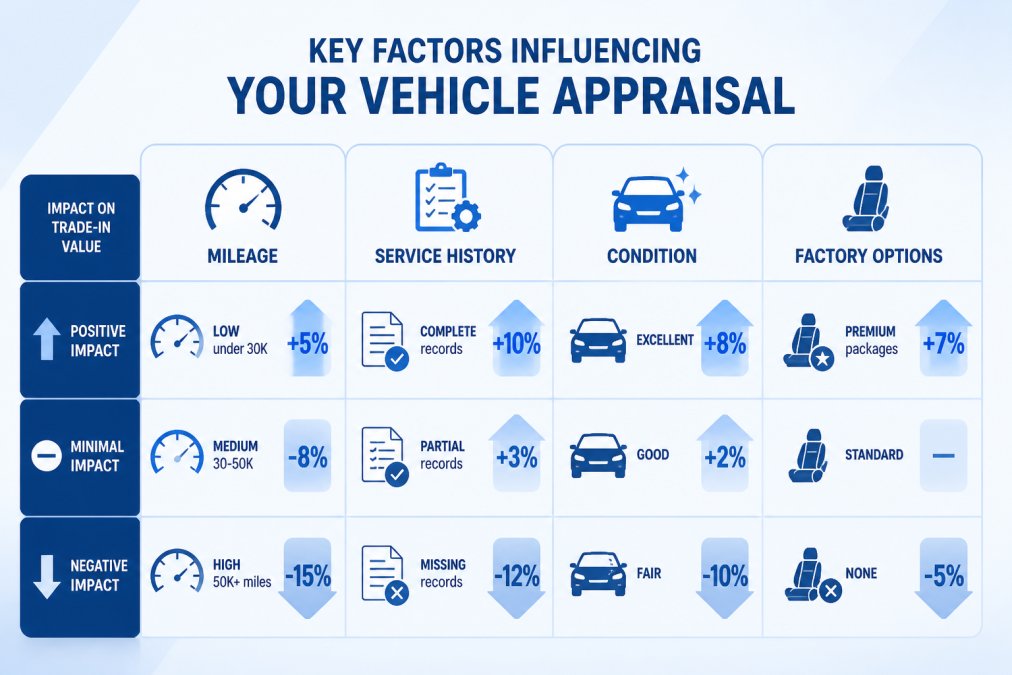
Several specific factors shape whether your appraisal comes in strong or weak. Understanding these elements helps you maximize trade-in value and prepare strategically.
Service history and maintenance records
A complete service history is invaluable during appraisal. Regular oil changes, scheduled maintenance, and timely repairs demonstrate responsible ownership and give appraisers confidence in mechanical systems, translating directly into higher trade-in value.
Missing or incomplete records create uncertainty. Appraisers cannot verify critical maintenance was performed, so they assume potential hidden problems and lower the appraisal accordingly. Gather all service records, digital or dealership, before your appraisal appointment.
Trim level, factory options, and curb appeal
Higher trim levels command stronger trade-in allowance because they included more features and better materials. Factory options like leather seating, advanced infotainment, or all-wheel drive add measurable value compared to standard equipment.
Curb appeal matters more than many realize. A freshly washed and detailed vehicle creates a positive first impression that can influence the appraiser's perception and result in a modestly higher appraisal.
Online Trade-In Appraisal Tools vs. In-Person Evaluations
Online appraisal tools offer convenience and speed, generating instant estimates based on make, model, year, mileage, and condition rating. They're useful for quick ballpark figures when shopping for your next vehicle.
In-person evaluations provide accuracy online tools cannot match. A qualified appraiser physically inspects your vehicle, assesses actual condition, checks for hidden damage, verifies vehicle history against the physical vehicle, and evaluates maintenance quality. This hands-on inspection catches issues algorithms miss.
For most accurate trade-in value, use online tools as a starting point, then follow up with in-person appraisal. AutoSport USA offers both online trade-in appraisal tools and in-person evaluations, allowing you to compare estimates and understand how your vehicle's actual condition affects the final offer.
How to Prepare Your Car for Trade-In
Preparing your vehicle strategically before appraisal can result in measurably better trade-in value. The process focuses on presenting your vehicle in its best light and providing documentation supporting a higher appraisal.
Cleaning, detailing, and minor repairs
Start with thorough cleaning: wash and wax the exterior, clean windows inside and out, vacuum the interior, and wipe down all surfaces. A clean vehicle signals proper maintenance to the appraiser.
Address minor cosmetic issues that are inexpensive to fix, cracked windshield, non-functioning light, obvious scratches, or torn upholstery. These small fixes often cost less than the trade-in value they add. Skip major repairs; if your transmission is failing or engine needs significant work, repair costs will likely exceed the trade-in value increase.
Gathering documentation and vehicle history
Compile all service records, maintenance receipts, and warranty documentation from all shops where work was performed. Obtain your vehicle history report before appraisal using Carfax or AutoCheck. Review carefully and be prepared to discuss any items that appear. A clean history report significantly supports stronger trade-in value.
Prepare your vehicle's title and registration. Having these documents ready demonstrates organization and speeds the appraisal process. If there's a lien, understand the payoff amount.
Negotiating Your Trade-In Value
Receiving an appraisal offer is not the end of negotiation, it's the beginning. Many buyers accept the first offer without discussion, leaving money on the table.
Arrive at appraisal with realistic expectations. Research comparable vehicles online using market pricing resources. Know the approximate range your vehicle should command based on year, mileage, and condition.
When you receive an offer, ask the appraiser to explain the valuation. Understand which factors reduced the offer and which supported it. If you disagree with specific assessments, discuss them respectfully.
If the offer seems low, request a second appraisal from another dealership to compare. Ask whether addressing specific issues would increase trade-in value. You can also choose to sell privately, though this requires more effort.
Dealerships may have flexibility to adjust trade-in offers if it means securing your business on the vehicle purchase. Negotiate respectfully with documentation supporting your position.
Trade-In Tax Credit and Sales Tax Benefits
Understanding how trade-in values interact with sales tax is crucial for calculating your true financial benefit.
How the sales tax deduction works
When you trade in a vehicle, the trade-in allowance is typically deducted from the new vehicle's purchase price before sales tax is calculated. You pay sales tax only on the net amount, the new vehicle's price minus your trade-in value.
For example, purchasing a $25,000 vehicle with an $8,000 trade-in means you pay sales tax on $17,000 rather than $25,000. At typical sales tax rates, this results in hundreds of dollars in savings. Negotiating aggressively for fair trade-in value directly reduces your tax obligation.
Handling negative equity
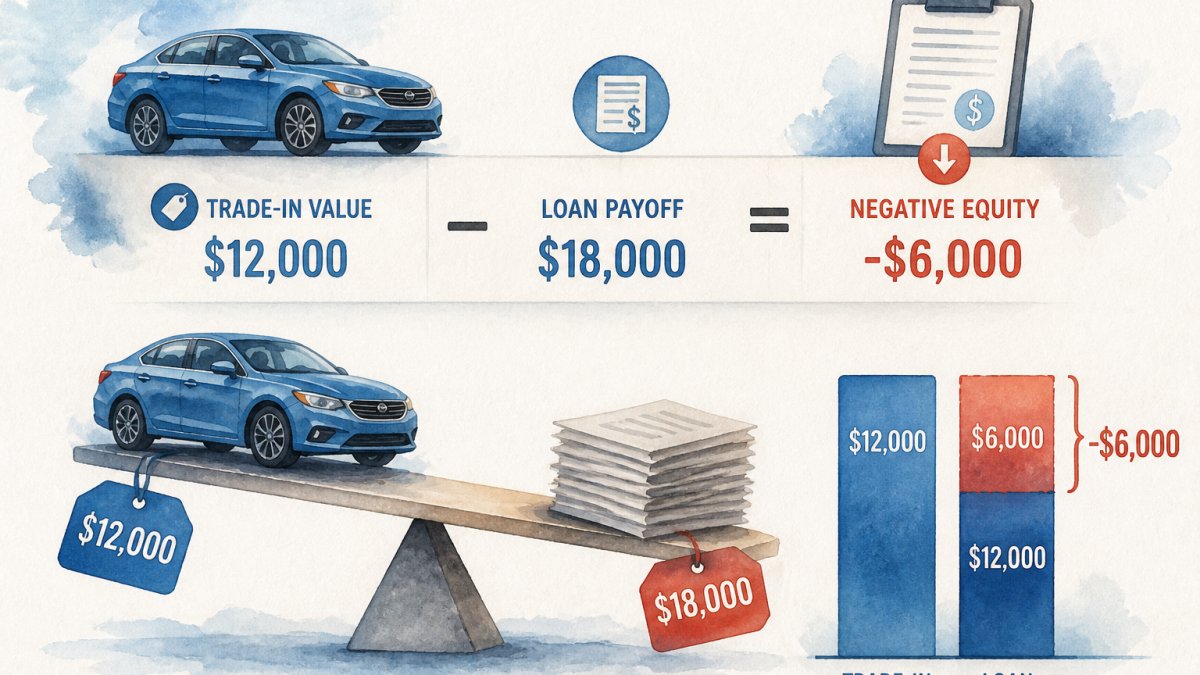
Negative equity occurs when you owe more on your current vehicle loan than its trade-in value. If you owe $10,000 on a vehicle appraising for $7,000, you have $3,000 negative equity.
Dealerships can roll negative equity into a new loan, but this creates long-term problems: you finance a depreciating asset on top of your new vehicle, starting your new loan already underwater and extending payoff timelines.
Better strategies exist. Pay down negative equity out of pocket before trading in. Delay trade-in until your vehicle's value rises relative to loan balance. Sell privately, which often yields higher proceeds than trade-in. AutoSport USA can discuss these options and help determine which approach makes financial sense.
Private Sale vs. Dealership Trade-In Comparison
Deciding whether to trade in or sell privately requires weighing convenience against potential financial gain.
A dealership trade-in offers simplicity and speed. Appraise your vehicle, receive an offer, and complete the transaction as part of your new vehicle purchase in one location. You don't advertise, negotiate with strangers, or manage logistics. For many owners, this convenience justifies accepting a slightly lower trade-in value.
A private sale typically yields higher proceeds than dealership trade-in. You control asking price, market strategically, and negotiate directly with buyers. However, private sales require significant effort: photographing, writing listings, responding to inquiries, scheduling viewings, negotiating with multiple buyers, and managing title transfer independently. They also carry risk regarding payment security and fraud.
For most owners, the decision depends on time availability and comfort with sales process. If you value convenience, dealership trade-in makes sense. If you have time and want to maximize proceeds, private sale offers higher potential returns. AutoSport USA provides fair trade-in appraisal helping you compare against private sale expectations.
Steps to Complete Your Trade-In
Once you've negotiated fair trade-in value and decided to proceed, the transaction involves several specific steps.
Title transfer and lien payoff
The title transfer is the legal process of moving vehicle ownership from your name to the dealership. Any lien must be paid off first. If you're financing, the lender holds the title as collateral. The dealership coordinates with your lender to pay off the loan balance using trade-in proceeds, then obtains the title for transfer.
This process typically happens automatically. The dealership coordinates with your lender, ensuring payoff is processed and title is transferred properly. You'll sign the title over to the dealership, completing the legal transfer. Verify the dealership has obtained the title before leaving.
If you own your vehicle outright with no lien, sign the title over to the dealership and the transfer is complete. Receive a receipt confirming the dealership received the signed title.
Review final paperwork carefully to ensure all figures match your negotiated agreement. Address any discrepancies before signing.
Getting a fair trade-in value requires understanding how appraisals work, preparing your vehicle strategically, and negotiating confidently. The process demands research, documentation, and clear communication about your vehicle's actual condition and market value. AutoSport USA provides comprehensive appraisal services and transparent guidance throughout the trade-in process, helping you maximize your vehicle's value while securing your next vehicle purchase. Apply Online to get started with a fair trade-in appraisal today.
| Step | Key Action | Timeline |
|---|---|---|
| Research | Gather service records and obtain vehicle history report | 1-2 days |
| Preparation | Clean vehicle, address minor repairs, organize documentation | 1-3 days |
| Appraisal | Schedule and complete in-person evaluation | Same day |
| Negotiation | Review offer, discuss valuation, compare alternatives | 1-2 days |
| Agreement | Finalize trade-in value and new vehicle purchase terms | Same day |
| Transfer | Sign title, process lien payoff, complete paperwork | Same day |
Frequently Asked Questions
Does a trade-in reduce sales tax in my state?
Yes. Most states allow you to deduct your trade-in allowance from the purchase price of your new vehicle before calculating sales tax. This means you only pay tax on the difference between the new car's price and your trade-in value. For example, if you buy a $25,000 vehicle and trade in a car valued at $8,000, you typically pay sales tax only on the $17,000 difference. This sales tax deduction can save you hundreds of dollars. Always confirm the exact rules with your state's motor vehicle agency, as regulations vary.
How is trade-in value calculated for used vehicles?
Trade-in value depends on several factors: the vehicle's age, mileage, condition, service history, market demand for that make and model, and current depreciation trends. Appraisers inspect the car's exterior, interior, mechanical systems, and review its vehicle history report via VIN lookup. They compare your vehicle to similar models selling at retail value and wholesale value to determine fair market value. Trim level and factory options also influence the final appraisal. Most dealerships use industry guides and real-time market data to establish an accurate trade-in allowance.
Can I negotiate my trade-in offer at a dealership?
Yes. Your trade-in value is not fixed. If you believe the initial offer is too low, you can negotiate by presenting a vehicle history report, maintenance records, and comparable market listings for similar vehicles. Getting multiple appraisals from different dealerships gives you leverage. Be prepared to explain any recent repairs or upgrades you've made. However, understand that dealers factor in reconditioning costs when making offers. A reasonable negotiation can often increase your trade-in allowance by a few hundred dollars, but unrealistic expectations won't move the needle.
What should I do if I have negative equity in my current vehicle?
Negative equity occurs when you owe more on your car loan than the vehicle is worth. If this happens, you have three options: pay the difference out of pocket at trade-in, roll the negative equity into your new loan (increasing monthly payments), or explore selling privately to pay off the loan first. Rolling negative equity into a new loan is risky because you'll owe more than the new car's value from day one. The best approach is to pay down your existing loan before trading in, or wait until equity improves. Some dealers offer programs to help, but always understand the full financial impact before proceeding.
This article was written using GrandRanker