 how-to
Getting Auto Financing With Bad Credit: A Step-by-Step Guide
Table of Contents
- What Is a Bad Credit Auto Loan?
- Bad Credit Car Loan Requirements You Need to Know
- Getting Pre-Approved for a Car Loan With Bad Credit
- The Role of a Down Payment in Bad Credit Auto Financing
- Understanding Interest Rates and Annual Percentage Rate
- Spotting Predatory Lenders vs. Legitimate Bad Credit Auto Lenders
- Building Your Credit After Getting Financed
- Frequently Asked Questions
Last Updated: August 30, 2026
What Is a Bad Credit Auto Loan?
A bad credit auto loan is financing for a vehicle purchased by someone with a credit score below 620, typically classified as subprime financing. Unlike traditional auto loans from banks, subprime auto loans come from specialized lenders, buy-here-pay-here dealerships, or credit unions that accept higher default risk in exchange for elevated interest rates. Subprime lenders evaluate applications beyond credit scores, considering employment history, income stability, and down payment amount.
Most subprime auto loans carry interest rates between 12% and 29%, depending on your credit profile and the lender's risk assessment (consumerfinance.gov). Understanding what separates a bad credit auto loan from prime financing helps you navigate the process strategically.
Bad Credit Car Loan Requirements You Need to Know
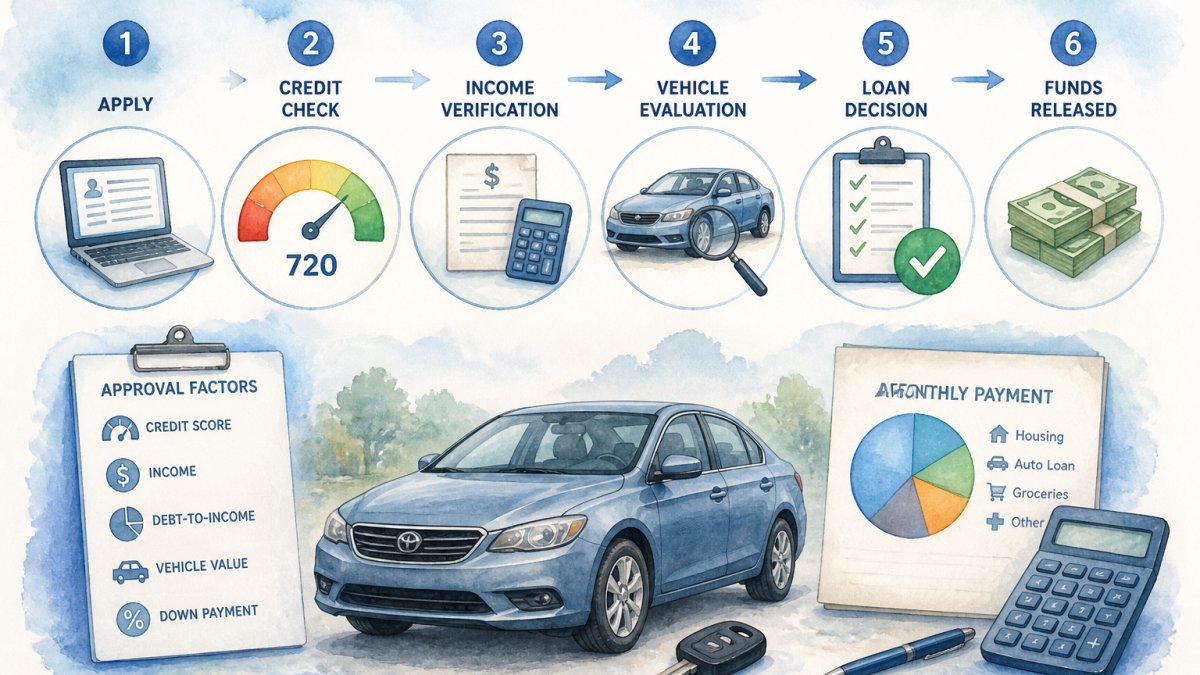
Getting auto financing with bad credit requires meeting specific lender criteria that differ significantly from prime lending standards. Most subprime lenders focus less on your credit score alone and more on a combination of factors that demonstrate you can make monthly payments reliably.
Credit Score Thresholds and What Lenders Look For
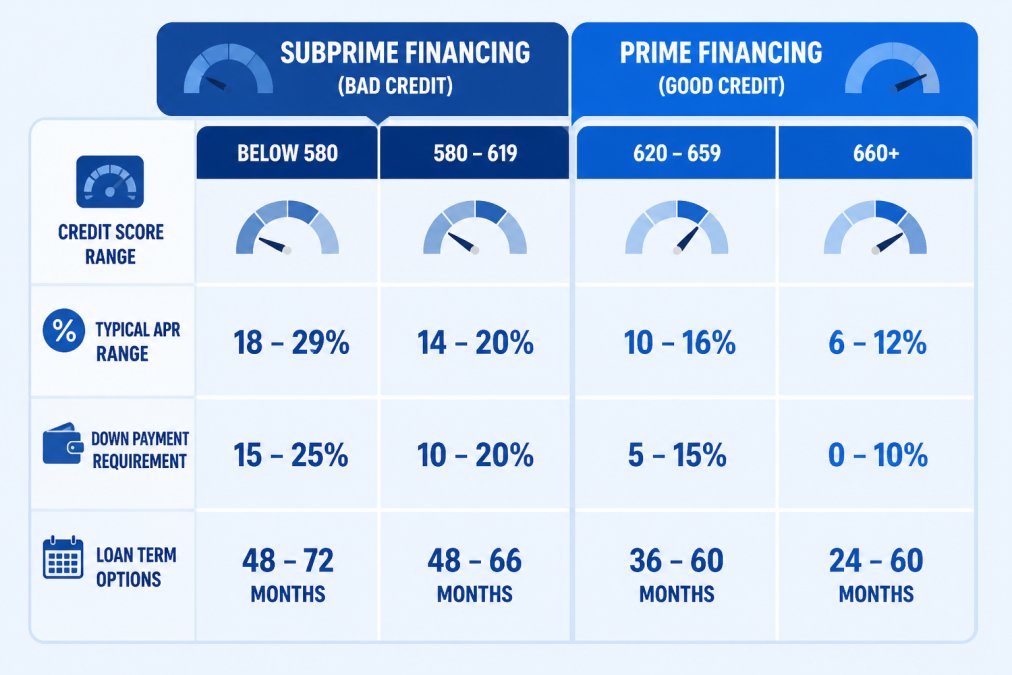
Most subprime auto lenders will work with credit scores as low as 500, though the lower your score, the higher your interest rate will be (experian.com). Lenders typically segment borrowers into ranges: below 580 (deep subprime), 580-619 (subprime), and 620-659 (near-prime). Each tier carries different APR expectations and down payment requirements.
Beyond the number itself, lenders examine what caused your credit damage. A recent bankruptcy looks worse than one from seven years ago. Multiple late payments in the last six months signal ongoing financial stress, while a single missed payment from three years ago followed by consistent on-time payments tells a different story. Lenders want to see the trajectory of your credit behavior, not just the current score.
Your credit report also reveals payment patterns. Lenders see whether you've managed installment loans before (car loans, personal loans) or only revolving credit (credit cards). Someone with a history of managing car payments, even with late payments, looks less risky than someone with no installment loan history at all.
Debt-to-Income Ratio and Employment Verification
Your debt-to-income ratio (DTI) is critical. This measures your total monthly debt payments divided by your gross monthly income. Most lenders want to see a DTI below 50% (federalreserve.gov). If you earn $3,000 monthly and carry $1,200 in existing debt payments, adding a $600 car payment brings you to 60% DTI, which many lenders will decline.
Employment verification matters because it proves income stability. Lenders want to see that you've been employed for at least six months, ideally longer. Self-employed borrowers need two years of tax returns to prove income consistency. Some lenders will work with borrowers on unemployment benefits or disability income, though this varies by lender.
Getting Pre-Approved for a Car Loan With Bad Credit
Pre-approval is one of the most misunderstood steps in getting auto financing with bad credit. Understanding what pre-approval actually means protects you from wasting time or damaging your credit further.
Soft Inquiries vs. Hard Inquiries: What's the Difference?
A soft inquiry checks your credit without affecting your credit score. Many online lenders offer pre-approval using soft inquiries, which means you can shop multiple lenders without damage. A hard inquiry happens when a lender formally reviews your credit report as part of an actual application and does lower your credit score slightly, typically by 5-10 points per inquiry. Multiple hard inquiries within 14 days usually count as a single inquiry for credit scoring purposes.
Start with soft inquiries to understand what lenders might offer, then submit hard inquiry applications only to lenders you're serious about. Never let a dealership run unlimited hard inquiries on your credit without your explicit permission.
What Pre-Approval Actually Tells You
Pre-approval means a lender has reviewed your financial situation and indicated they're willing to finance you up to a certain amount at an estimated interest rate. The word "estimated" is crucial. Pre-approval is not a guarantee, it's conditional on verification of employment, final credit check, and vehicle inspection.
Getting auto financing with bad credit means your pre-approval is even more conditional than someone with good credit. A lender might pre-approve you for up to $15,000 at 18% APR, but that rate assumes you choose a vehicle that meets their lending criteria. If you select a vehicle that's too old, has too many miles, or is in poor condition, they may reduce the loan amount or increase the rate.
The Role of a Down Payment in Bad Credit Auto Financing
A down payment is often the most powerful lever you have when getting auto financing with bad credit. It immediately reduces the lender's risk and can lower your interest rate substantially.
How Much Down Payment Do You Need?
Most subprime lenders require a down payment between 10% and 20% of the vehicle's purchase price. Some lenders will go as low as 5% if your employment is stable and your DTI is manageable. The relationship between down payment size and interest rate is direct. A borrower with a 580 credit score putting 5% down might face 22% APR, while the same borrower putting 20% down could qualify for 16% APR. Over a 60-month loan, that 6-point difference saves thousands in interest.
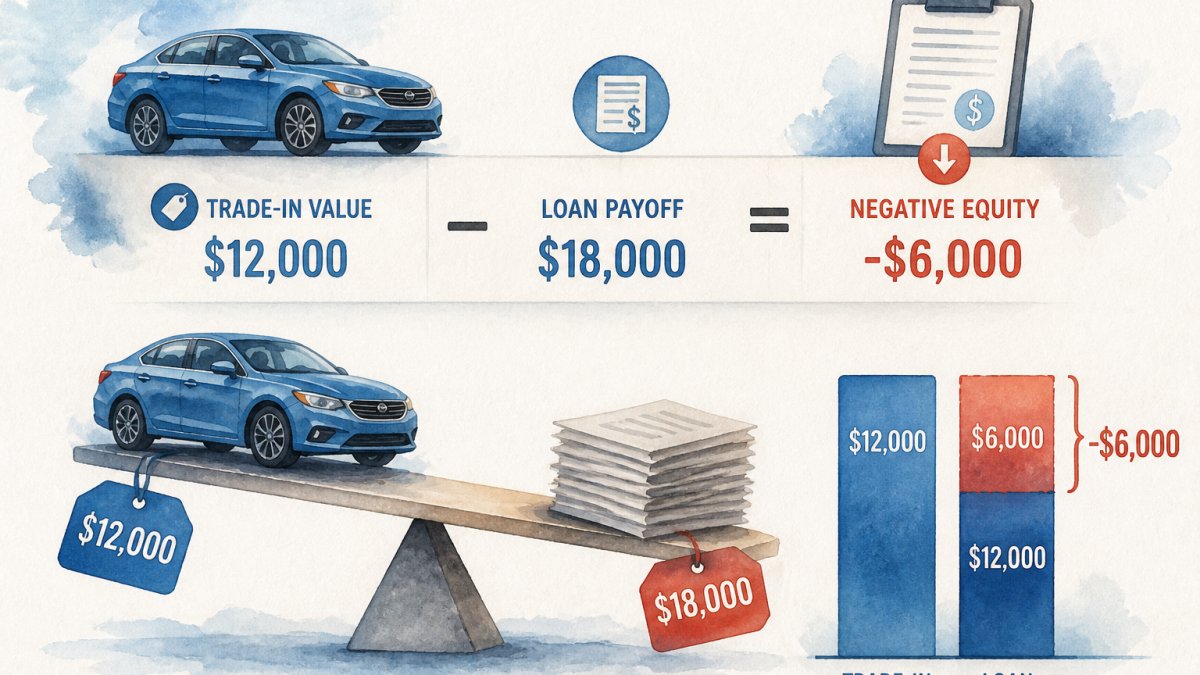
Your down payment can come from savings, a trade-in vehicle, or a combination of both. If you're trading in a vehicle with equity, that equity counts toward your down payment.
Using an Auto Loan Down Payment Calculator
An auto loan down payment calculator helps you model different scenarios before you commit. You input the vehicle price, your down payment amount, the loan term, and the estimated APR. The calculator shows your monthly payment and total interest paid over the life of the loan.
This tool is essential for getting auto financing with bad credit because it shows the real cost of different choices. A $1,000 difference in down payment might reduce your monthly payment by $30-40, but more importantly, it could lower your APR by 2-3 points, saving you thousands overall.
Understanding Interest Rates and Annual Percentage Rate
Interest rates are where getting auto financing with bad credit becomes expensive. The annual percentage rate (APR) is the true cost of borrowing, including interest plus all fees expressed as a yearly percentage.
Your APR is determined by several factors: credit score, down payment size, loan term, vehicle age and value, and the lender's risk appetite. A 580 credit score with 10% down on a 2022 vehicle might get 19% APR, while a 650 score with 20% down on the same vehicle could get 12% APR. Loan term length also affects your rate. A 36-month loan typically carries a lower rate than a 72-month loan because the lender's risk period is shorter, though the monthly payment is higher.
Many borrowers focus on keeping the monthly payment low and ignore the APR. A $400 monthly payment at 8% APR is far better than a $350 payment at 22% APR. The real measure is total cost, not payment size.
Spotting Predatory Lenders vs. Legitimate Bad Credit Auto Lenders
Not all lenders offering getting auto financing with bad credit are created equal. Some operate ethically within subprime lending; others use predatory practices designed to trap borrowers in cycles of debt and repossession.
Red Flags That Signal a Predatory Lender
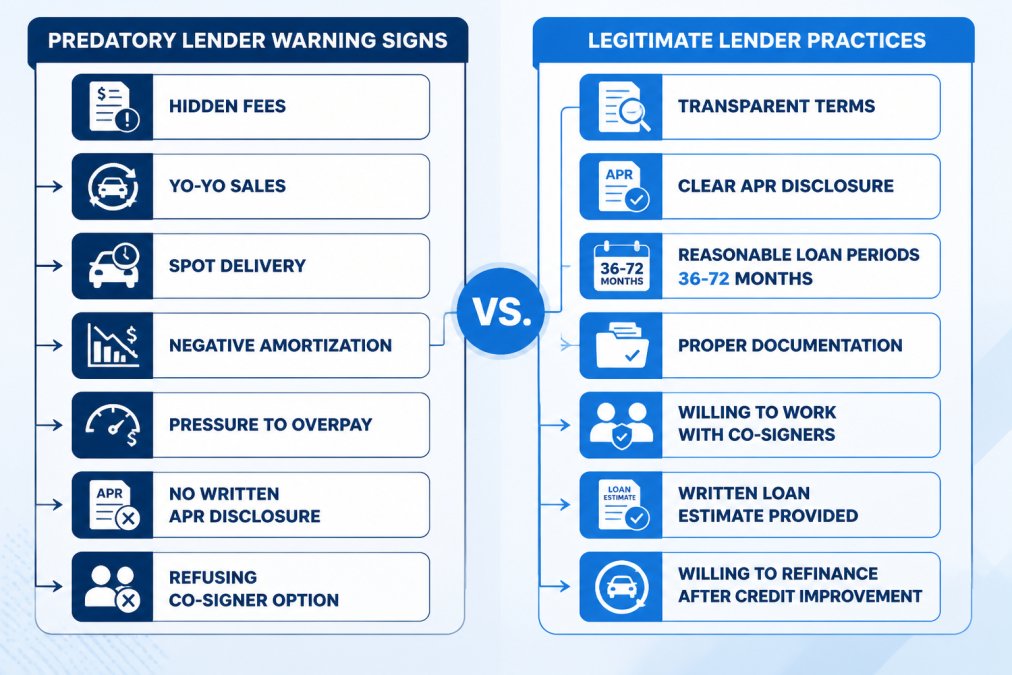
Predatory lenders use specific tactics that legitimate lenders avoid. Yo-yo sales occur when you drive off the lot and take the car home, but the dealer later claims the financing fell through and demands you return the vehicle or renegotiate at a higher rate. Hidden fees are another major red flag. Legitimate lenders disclose all fees upfront: documentation fees, registration transfer fees, gap insurance, extended warranties.
Spot delivery is when you take the vehicle before financing is finalized. Legitimate lenders rarely do this; predatory lenders do it frequently because they know some deals will fall through. Negative amortization is when your loan balance actually grows instead of shrinking. This happens when your monthly payment doesn't cover the full interest owed. Pressure tactics like "This rate is only good today" or "I need your decision in the next hour" are also predatory.
What Legitimate Lenders Do Differently
Legitimate subprime lenders operate transparently. They provide written Loan Estimates that show the exact APR, monthly payment, total interest, and all fees. They're willing to work with co-signers because they understand it reduces risk. They also discuss refinancing, knowing that subprime borrowers often improve their credit within 12-24 months of on-time payments.
Legitimate lenders perform proper vehicle inspections and set reasonable loan-to-value ratios. They won't finance a 15-year-old vehicle with 180,000 miles for $12,000 because they know the vehicle won't last the loan term.
Building Your Credit After Getting Financed
Getting auto financing with bad credit is just the beginning. The real opportunity is using that loan to rebuild your credit. An auto loan is one of the most effective credit-building tools available because it's an installment loan, which demonstrates your ability to manage larger, structured debt.
On-Time Payments and Credit Use
Every on-time payment reports to all three credit bureaus and improves your credit score. A single missed payment can drop your score 100+ points; conversely, 24 consecutive on-time payments can raise your score 50-100 points.
Set up automatic payments from your bank account to ensure you never miss a due date. Many lenders offer small rate discounts (0.25% to 0.5%) for automatic payments. Credit use on revolving accounts (credit cards) also matters. Keep balances below 30% of your credit limit and ideally pay them off monthly. Your credit mix matters too, an auto loan plus credit cards creates a diverse credit profile that scores better than relying on one type of credit.
Refinancing to Lower Your Rate Once Your Score Improves
After 12-24 months of on-time payments, your credit score typically improves enough to qualify for a lower rate. Refinancing replaces your existing loan with a new one at better terms. If you got a 19% APR initially and your score improves to 640+, you might refinance at 12-14% APR.
Refinancing a $12,000 loan from 19% to 12% APR saves you roughly $1,200 in interest over the remaining loan term. Refinancing also gives you the opportunity to shorten the loan term. If you originally financed for 72 months, you might refinance for 48 months once your credit improves.
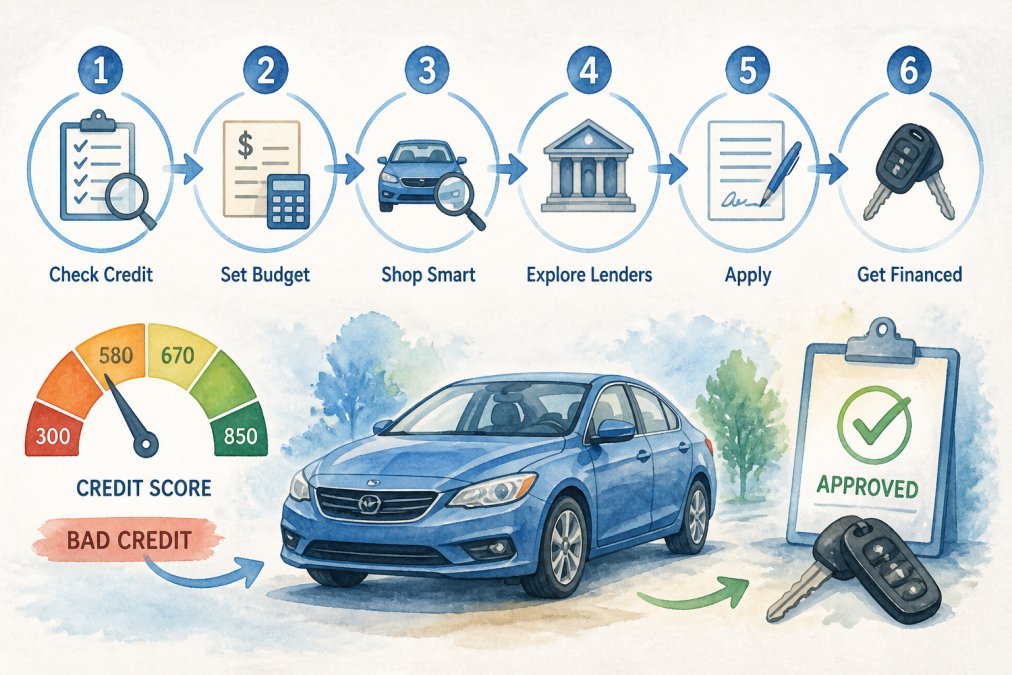
Getting auto financing with bad credit requires strategy, but it's absolutely achievable. The key is understanding what lenders evaluate, avoiding predatory operations, and committing to on-time payments that rebuild your credit. Your credit score isn't permanent; it's a reflection of your recent financial behavior. By making consistent payments on an auto loan, you're actively rewriting your financial story.
AutoSport USA offers a diverse inventory of quality used vehicles in Toms River, NJ, catering to a wide range of driving needs and preferences. We are dedicated to helping you find the perfect vehicle while providing a seamless shopping experience, including online financing tools and trade-in valuations. Whether you are looking for a reliable sedan, a spacious SUV, or a rugged truck, our team is here to help you get top value for your investment. Apply online today to get started with pre-approval.
Frequently Asked Questions
Q: Can I get approved for an auto loan with a 500 credit score?
A: Yes, approval is possible with a 500 credit score, though you'll face higher interest rates and stricter requirements. Most subprime lenders work with scores as low as 500-550, but you'll typically need a larger down payment (15-20%), proof of stable income, and possibly a co-signer. Expect APRs between 15-29% depending on the lender and loan term. Pre-approval lets you see your actual rate before committing.
Q: What's the difference between getting pre-approved for a car loan with bad credit versus a regular loan?
A: Pre-approval with bad credit involves a review of your financial situation and may include a hard inquiry into your credit report to verify your income and debt-to-income ratio. You'll receive a specific loan amount and APR estimate. The process is faster than traditional financing but locks in your rate for a limited time (usually 30-45 days). Bad credit pre-approval may require a co-signer or higher down payment than prime borrowers need.
Q: How much down payment do I need for a bad credit auto loan?
A: Most bad credit auto loans require 10-20% down, though some lenders accept as little as 5% with a co-signer. Use an auto loan down payment calculator to estimate your monthly payment at different down payment amounts. A larger down payment reduces your loan amount, lowers your monthly payment, and improves your approval odds. If you have trade-in equity, that counts toward your down payment.
Q: What are the main red flags of a predatory auto lender?
A: Watch for lenders who pressure you into 'spot delivery' (taking the car before financing is finalized), offer rates that seem artificially low, use yo-yo sales tactics (calling you back after approval to renegotiate), or bury fees in fine print. Legitimate lenders provide clear APR disclosures upfront, transparent payment schedules, and reasonable loan terms. Always read the full contract before signing.
This article was written using GrandRanker