 listicle
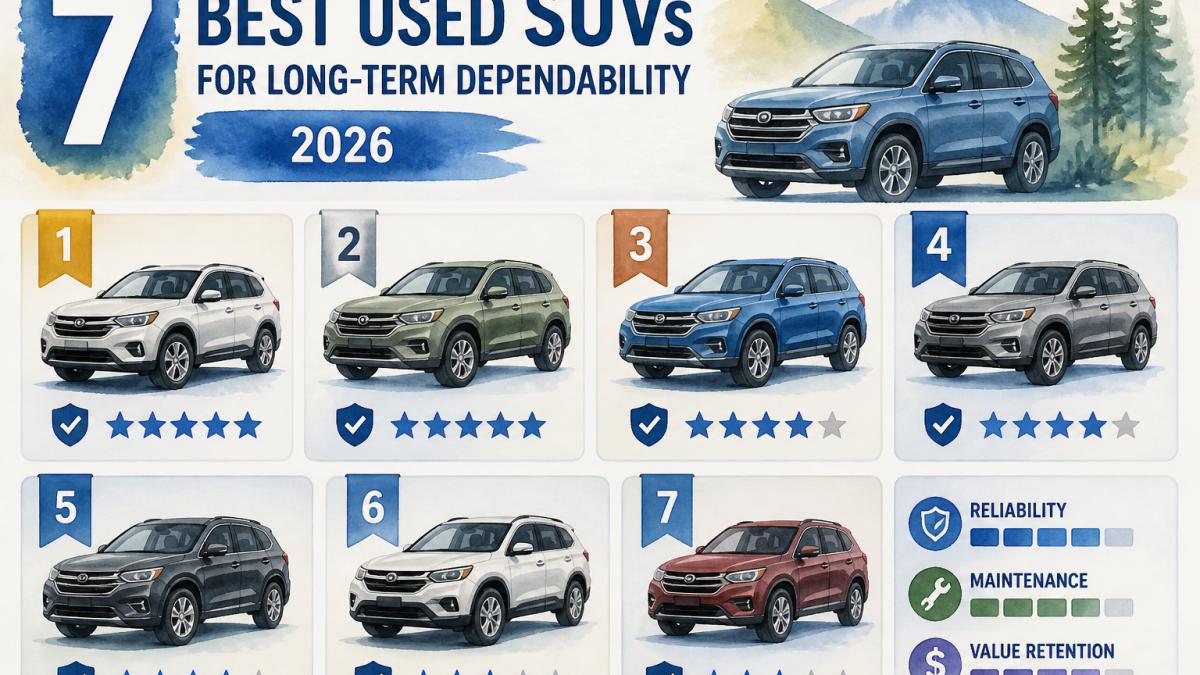
7 Best Used SUVs for Long-Term Dependability 2026
Table of Contents
- Quick Comparison: Top Used SUVs by Reliability and Cost of Ownership
- How We Evaluated Long-Term Dependability
- 1. Toyota RAV4: The Dependability Standard
- 2. Honda CR-V: Spacious Reliability for Daily Commuting
- 3. Subaru Forester: All-Wheel Drive Durability
- 4. Honda Pilot, Lexus NX, Acura RDX, and Hyundai Santa Fe
- Used Car Pre-Purchase Inspection Tips for High-Mileage SUVs
- Used SUV Maintenance Checklist for Long-Term Ownership
- Frequently Asked Questions
Last Updated: September 29, 2026
Quick Comparison: Top Used SUVs by Reliability and Cost of Ownership
When shopping for a used SUV, reliability matters more than flashy features. This guide to the 7 best used SUVs for long-term dependability 2026 presents vehicles with proven track records for durability, manageable maintenance costs, and strong resale value, representing your safest bets for vehicles lasting well beyond 100,000 miles.
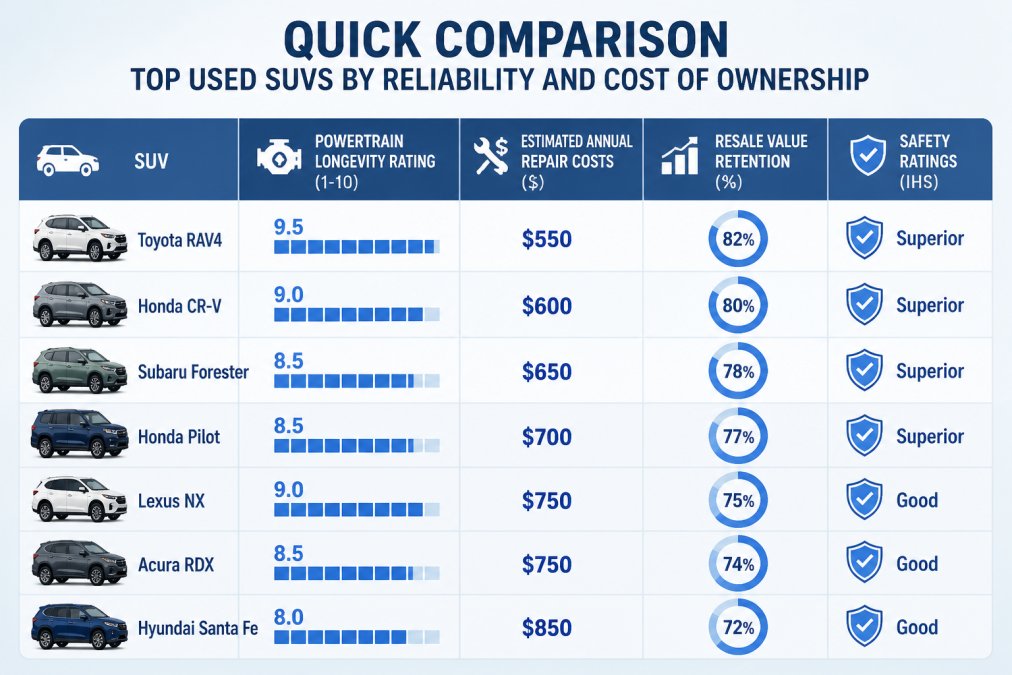
| SUV Model | Powertrain Longevity | Annual Repair Cost | Resale Value | Best For |
|---|---|---|---|---|
| Toyota RAV4 | Excellent | Low | High | Long-term ownership |
| Honda CR-V | Excellent | Low | High | Daily commuting |
| Subaru Forester | Excellent | Moderate | High | All-weather driving |
| Honda Pilot | Excellent | Moderate | High | Large families |
| Lexus NX | Excellent | Moderate-High | High | Luxury seekers |
| Acura RDX | Excellent | Moderate-High | Moderate | Performance focus |
| Hyundai Santa Fe | Good | Moderate | Moderate | Budget-conscious buyers |
How We Evaluated Long-Term Dependability
Evaluating the best used SUVs for long-term dependability 2026 requires examining actual ownership costs and model-specific failure points. We focused on four factors: powertrain longevity across 100,000+ miles, real-world repair costs from owners and repair shops, common failure patterns by model year, and resale value retention.
Powertrain Longevity Assessment Toyota's 2.5L four-cylinder engine in the RAV4 routinely reaches 200,000+ miles with routine maintenance, while some Subaru CVT transmissions show elevated failure rates between 80,000-120,000 miles on certain model years. These distinctions matter far more than generic ratings.
Real-World Repair Cost Analysis A Toyota RAV4 owner can expect roughly $500-$800 annually in maintenance and repairs at 100,000+ miles; a Lexus NX owner should budget $1,000-$1,400 due to premium parts; a Hyundai Santa Fe typically costs $700-$1,100. These ranges include routine maintenance plus age-related repairs. Transmission fluid flushes at 60,000 miles cost $100-$200 but prevent $3,000-$5,000 transmission failures.
Model-Year-Specific Failure Patterns Reliability varies across production runs. Honda Pilot 2009-2012 had higher transmission issues than 2013+ models; Subaru Forester 2010-2016 CVT transmissions showed elevated failure rates versus 2017+ models; Acura RDX 2007-2012 had power steering issues resolved in 2013+. Knowing these patterns helps buyers avoid problem years.
Resale Value Retention A Toyota RAV4 typically retains 70-80% of its used purchase price after three years; a Hyundai Santa Fe retains 55-65%. Higher retention indicates lower depreciation risk and stronger market demand.
1. Toyota RAV4: The Dependability Standard
The Toyota RAV4 sets the benchmark for used SUV reliability. Owners report trouble-free ownership well beyond 150,000 miles, with many reaching 200,000+ miles with routine maintenance. The RAV4's powertrain longevity stems from Toyota's philosophy of building simple, proven systems refined over decades.
The RAV4 stands out for low ownership costs: inexpensive, widely available parts and predictable repair expenses. The hybrid powertrain option delivers better fuel efficiency without sacrificing reliability.
High demand keeps used RAV4 prices elevated, though the premium often pays for itself through lower repair bills and stronger resale value.
2. Honda CR-V: Spacious Reliability for Daily Commuting
The Honda CR-V combines practical interior space with Honda's mechanical dependability. The engine and transmission reach 200,000 miles with routine maintenance, with strong safety ratings and consistent longevity across model years.
For families and daily commuters, the CR-V's spacious cargo area and passenger capacity exceed smaller compact SUVs. Fuel efficiency is solid: expect 25-28 mpg on highways depending on model year and drivetrain.
Honda parts are affordable, and dealer support is strong nationwide. The CR-V holds its value well in the used market, making it a smart financial choice for buyers planning to sell or trade in within five years.
3. Subaru Forester: All-Wheel Drive Durability
The Subaru Forester delivers standard all-wheel drive on every model, a feature that commands premium pricing new but becomes a bargain used. The symmetrical AWD system provides superior traction in snow, rain, and rough terrain without the fuel penalty of some competitors.
Safety is a Forester strength: top crash-test marks and standard driver-assist features on recent models. Visibility is excellent thanks to the boxy design and large windows.
The Forester's CVT transmission is divisive: some love the smooth acceleration; others find it unnatural. Test drive before committing. Maintenance costs run slightly higher than the RAV4 or CR-V, but powertrain durability remains strong.
4. Honda Pilot, Lexus NX, Acura RDX, and Hyundai Santa Fe
The Honda Pilot is the three-row answer for large families. Its V6 engine is renowned for mechanical endurance, accommodating seven passengers comfortably. Reliability remains exceptional despite lower fuel economy than smaller SUVs.
The Lexus NX brings luxury refinement and Toyota's engineering into a premium package. Build quality is exceptional, with reliability mirroring its parent company. Higher maintenance costs and premium parts pricing are tradeoffs for luxury appointments.
The Acura RDX offers performance-oriented handling without sacrificing reliability. The powertrain is strong, appealing to enthusiasts seeking dependability with sportiness. Annual repair costs run moderate to high, reflecting premium brand positioning.
The Hyundai Santa Fe represents strong value in the midsize three-row segment.
Used Car Pre-Purchase Inspection Tips for High-Mileage SUVs
A thorough pre-purchase inspection reveals problems that online listings and test drives cannot. For high-mileage vehicles (80,000+ miles), focus on powertrain and suspension, the two systems most likely to fail and most expensive to repair.
Used SUV Maintenance Checklist for Long-Term Ownership
A preventative maintenance schedule keeps repair costs manageable and powertrain longevity high.
Every 3,000-5,000 Miles
- Oil and filter changes (synthetic oil extends intervals to 7,500-10,000 miles)
- Visual fluid level checks (coolant, transmission, brake fluid, power steering)
Every 15,000-30,000 Miles
- Rotate tires to ensure even wear
- Inspect brake pads and rotors for wear
- Check battery condition and terminals
Every 30,000-50,000 Miles
- Replace engine air filter if dirty
- Inspect suspension components for wear
- Check transmission fluid condition and top off if needed
Every 60,000 Miles
- Inspect timing belt condition (critical on older vehicles; replacement can cost $500-$1,500)
- Flush and replace transmission fluid (critical for automatic transmissions)
- Inspect all hoses and belts for cracks or deterioration
Every 100,000 Miles
- Replace cabin air filter
- Inspect spark plugs; replace if worn
- Flush brake fluid
- Have a comprehensive suspension inspection
Seasonal Checks
- Before winter: inspect battery, check tire tread depth, verify all-wheel drive function
- Before summer: test air conditioning, check coolant level and concentration
- Year-round: wash undercarriage monthly to prevent rust, especially in salt-prone regions
| Maintenance Task | Frequency | Estimated Cost | Impact on Longevity |
|---|---|---|---|
| Oil and filter change | 3,000-10,000 mi | $30-$75 | Critical |
| Transmission fluid flush | 60,000 mi | $100-$200 | Critical |
| Timing belt replacement | 100,000-120,000 mi | $500-$1,500 | Critical |
| Brake fluid flush | 100,000 mi | $75-$150 | Important |
| Suspension inspection | 50,000 mi | $0-$100 | Important |
| Air filter replacement | 15,000-30,000 mi | $20-$50 | Important |
Frequently Asked Questions
What is the most reliable used SUV to buy in 2026?
The Toyota RAV4 consistently ranks as the most reliable used SUV, with excellent powertrain longevity and strong resale value retention. The Honda CR-V and Subaru Forester are equally dependable choices. All three have proven track records for reaching 150,000+ miles with proper maintenance. Your choice depends on whether you prioritize fuel efficiency (RAV4 hybrid), spacious interior (CR-V), or all-wheel drive capability (Forester).
How does maintenance history affect the long-term dependability of a used SUV?
Maintenance history is critical to long-term dependability. A complete service history, including regular oil changes, transmission fluid checks, and timing belt replacements, indicates the previous owner invested in preventative maintenance. Request the vehicle history report and inspect receipts for major services. SUVs with documented maintenance typically have fewer mechanical failures and lower annual repair costs. Gaps in service records suggest potential hidden problems.
What are the common red flags to look for when buying a high-mileage used SUV?
Watch for rust on the undercarriage, transmission fluid leaks, suspension wear, and warning lights on the dashboard. Request a pre-purchase inspection from a trusted mechanic to check the drivetrain, engine performance, and safety systems. High-mileage SUVs with poor service history, multiple owners, or accident damage often face mechanical failure within months. Always verify the odometer reading matches the vehicle history report to avoid odometer fraud.
Which used SUVs are known for reaching 200,000 miles with minimal issues?
Toyota RAV4, Honda CR-V, and Honda Pilot are specifically known for high-mileage performance, with many examples exceeding 200,000 miles. Subaru Forester and Lexus NX also demonstrate strong long-term durability when properly maintained. The key is consistent preventative maintenance, including regular fluid changes and timely repairs. Hybrid models like the RAV4 Hybrid may have lower fuel efficiency gains at extreme mileage but maintain mechanical reliability.
Are there specific SUV brands that consistently rank higher for long-term dependability?
Japanese manufacturers, Toyota, Honda, and Subaru, consistently rank highest for long-term dependability based on repair frequency and cost of ownership data. Lexus (Toyota's luxury division) and Acura (Honda's luxury division) maintain the same engineering standards. Hyundai has improved significantly in recent years with strong warranty coverage. Korean and American brands typically show higher depreciation rates and slightly higher annual repair costs compared to Japanese competitors.