 listicle
6 Ways to Lower Your Used Car Monthly Payment
Last Updated: October 22, 2026
Quick Summary
Refinancing your used car loan is the most powerful way to lower a used car monthly payment, because it cuts the interest rate directly instead of stretching the debt over more years. If your credit has improved or rates have dropped, a lower APR means a smaller payment and less total interest on the same balance.
- Refinancing works best in the first half of the loan term, before most of your payment is principal.
- Most lenders cap used-car refinancing at vehicles 10 years old from the model year.
- Biweekly payments split your payment in half and produce 13 full payments a year instead of 12.
- On an $18,000 loan at 9% APR, a 72-month term costs roughly $1,900 more interest than 48 months.
- Multiple auto loan inquiries in a short window are typically treated as a single shopping event.
Table of Contents
- 1. Refinance a Used Car Loan for a Lower Rate
- 2. Lower Your Car Payment Without Refinancing
- 3. Extend the Loan Term to Reduce the Payment
- 4. Trade In a Car With Negative Equity (and Know the Risks)
- 5. Run the Numbers With a Used Car Loan Calculator
- 6. Compare Offers From Multiple Lenders
- Which Option Fits Your Situation? A Decision Framework
- Conclusion
- Frequently Asked Questions
1. Refinance a Used Car Loan for a Lower Rate
Refinancing a used car loan means replacing your current loan with one that has better terms.
You apply with a new lender, which pays off your existing loan balance, and you make payments to the new lender instead.
The catch most guides skip: refinancing works best in the first half of the loan term. Once you're deep into the payoff schedule, most of your payment is already principal, so a rate cut saves very little.
Used-Car-Specific Eligibility Rules
Used-car refinancing has stricter rules than new-car refinancing. Most lenders cap the vehicle age, often at 10 years from the model year, and some require the car to be newer than that at the loan's end date.
Before you apply, confirm the car's model year, its current mileage, and your remaining balance compared with its market value. If the balance exceeds the value, you're in negative equity territory and most refinance lenders will decline.
2. Lower Your Car Payment Without Refinancing
You can lower a car payment without refinancing by changing how you pay rather than what you owe. These moves won't shrink the contract payment on paper, but they reduce what you actually spend and can shorten the loan.
Extra Payments, Biweekly Timing, and Autopay Discounts
Extra payments go straight at the principal, and even a modest extra amount each month cuts total interest. Confirm your lender applies extras to principal and check for a prepayment penalty first.
Biweekly payments split your monthly payment in half and pay every two weeks, 26 half-payments a year, or 13 full payments instead of 12. Semi-monthly payments are two equal payments a month, totaling the same as monthly. Biweekly is the one that quietly adds an extra payment.
Autopay discounts are the easiest win. Many lenders shave a small amount off your rate when you enroll in automatic payments. Ask your lender directly whether an autopay discount exists on your loan.
3. Extend the Loan Term to Reduce the Payment
Extending the loan term lowers the monthly payment by spreading the same balance over more months, but it also means more total interest and a longer stretch of being upside down on the car.
This is the option to treat with the most caution. The Consumer Financial Protection Bureau's guidance on negotiating car loans makes the trade-off explicit: a longer term reduces the monthly figure while raising what you pay overall.
When does extending make sense? When the payment is genuinely unaffordable and the alternative is default. When it doesn't: when you're extending purely to free up cash for non-essentials.
4. Trade In a Car With Negative Equity (and Know the Risks)
Trading in a car with negative equity means you owe more on the loan than the vehicle is worth, and the difference gets rolled into your next loan, raising the new balance and payment unless you offset it with a larger down payment or a cheaper vehicle.
Negative equity is common, especially on long-term loans taken out when prices were high. Roll too much forward and you start the next loan already underwater, with no cushion if the car is totaled or you need to sell.
How the Payoff and the Trade-In Value Actually Interact
The number that matters is the payoff amount, not the balance on your statement. Payoff includes accrued interest and fees, so request a written quote good through a specific date.
Example: you owe a $14,500 payoff on a car a dealer appraises at $11,000. The $3,500 difference does not disappear. It gets added to the balance of the next loan, so a $16,000 replacement vehicle becomes an $19,500 loan before taxes and fees.
Lender Limits on Rolling Negative Equity
Most lenders cap how much negative equity they will finance, usually as a loan-to-value (LTV) limit, the loan amount divided by the vehicle's value. A common maximum is 110% to 125% for used vehicles, though it varies by lender and credit profile. Past the cap, the lender will require more cash down or decline. Ask directly: "What is your maximum LTV on a used-car loan, and how much negative equity will you finance?"
The Safer Version: Downsize, Don't Upgrade
The safer version is trading into a less expensive vehicle, not a nicer one. If you trade a $20,000 car for a $12,000 car, the $8,000 difference can offset part or all of the shortfall instead of being added to the new loan.
A practical sequence:
- Get the written payoff quote from your current lender.
- Get at least two trade-in valuations (dealer appraisal and an independent source).
- Calculate the shortfall: payoff minus trade-in value.
- Shop replacement vehicles priced low enough that the shortfall plus the new balance stays inside the lender's LTV cap.
- Put cash down if the shortfall would otherwise push the loan past the cap.
If you're trading through a dealership, get the trade-in valuation and the payoff amount in writing before you discuss the new vehicle, so the numbers can't get shuffled together.
5. Run the Numbers With a Used Car Loan Calculator
A used car loan calculator estimates your monthly payment and total interest from four inputs: loan amount, interest rate, term length, and down payment. It's the fastest way to see how each option above changes your numbers before you commit.
Plug in your real payoff amount, not the original loan amount. Then run the same balance through several term lengths and rates to see the trade-off in dollars.
A Worked Example: Same Balance, Three Terms
Take an $18,000 used-car loan at 9% APR. The monthly payment and total interest change sharply with the term:
- 48 months: payment is roughly $448 per month; total interest is roughly $3,500.
- 60 months: payment is roughly $374 per month; total interest is roughly $4,400.
- 72 months: payment is roughly $325 per month; total interest is roughly $5,400.
The 72-month loan lowers the monthly payment by about $123 versus the 48-month loan, but adds roughly $1,900 in total interest and two extra years of debt. A lower monthly payment is not the same as a lower total loan cost.
A Worked Example: Same Term, Different Rate
Now hold the balance at $18,000 and the term at 60 months, and change only the APR:
- 12% APR: payment is roughly $400 per month; total interest is roughly $6,000.
- 9% APR: payment is roughly $374 per month; total interest is roughly $4,400.
- 6% APR: payment is roughly $348 per month; total interest is roughly $2,900.
A three-point rate cut saves roughly $26 per month and about $1,600 in total interest. That is why refinancing attacks the problem at its source: it lowers the payment and the total cost at the same time, while extending the term only lowers the payment.
What to Enter, and What to Ignore
- Loan amount: use the current payoff quote, not the original amount financed.
- Rate: use the APR from a written offer, not an advertised "as low as" rate.
- Term: model the term you're considering and one term shorter, so you can see the cost of stretching.
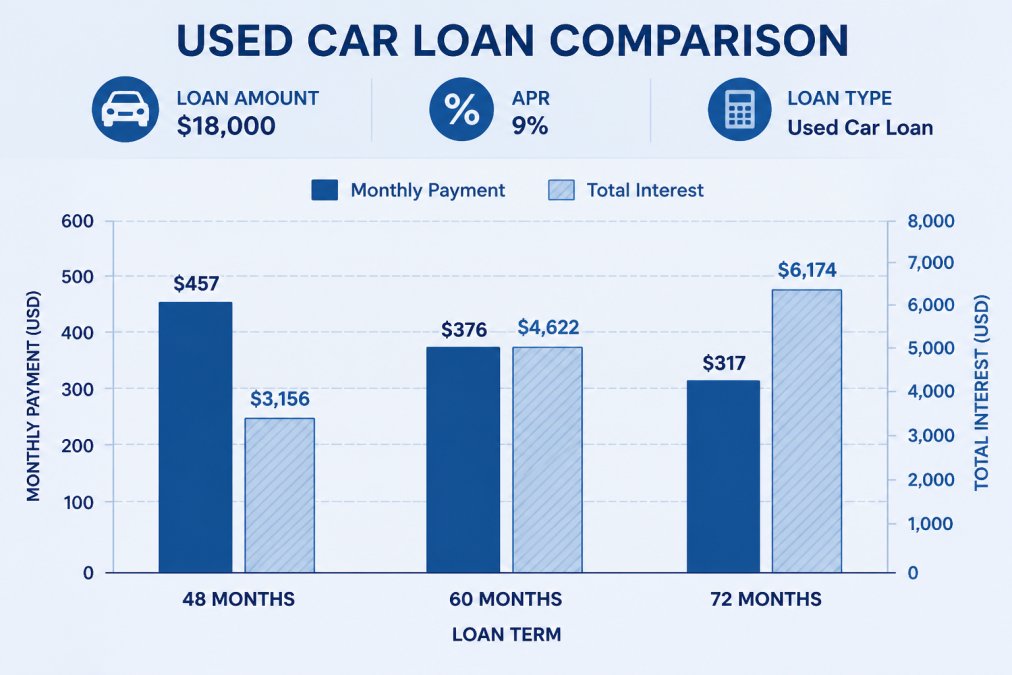
The pattern is consistent: stretching the term drops the monthly figure and raises total interest. A calculator makes that visible in seconds. Use the CFPB's auto loan calculator to model it yourself, and remember that a lower monthly payment is not the same as a lower total loan cost.
6. Compare Offers From Multiple Lenders
Comparing offers from multiple lenders is the only reliable way to know whether a rate is good. Three or more quotes tell you where the market sits for your credit profile and vehicle.
Rate shopping sounds like it hurts your credit, but it doesn't work that way. The Consumer Financial Protection Bureau's guidance on rate shopping confirms that comparing several auto loan offers in a focused period is the right approach.
Shop banks, credit unions, and online lenders, credit unions often beat banks on used-car rates. Get every offer in writing with the APR, term, fees, and total of payments, then compare the totals side by side.
| Option | What It Changes | Best For | Main Risk |
|---|---|---|---|
| Refinance | Interest rate | Improved credit, early in term | Fees, vehicle age limits |
| Extra/biweekly payments | Payoff speed | Stable income, spare cash | Prepayment penalties |
| Extend the term | Monthly payment | Genuine hardship | More total interest |
| Trade in with negative equity | Vehicle and balance | Downsizing | Rolling debt forward |
| Compare lenders | Rate and fees | Everyone, before signing | None if done in one window |
Which Option Fits Your Situation? A Decision Framework
Work through these questions in order, because they eliminate options fast:
- Has your credit improved since you bought the car? If yes, refinance first. It's the highest-impact move.
- Is the payment affordable but the balance stubborn? Add extra or biweekly payments and enroll in autopay.
- Is the payment genuinely unaffordable? Consider extending the term or trading into a cheaper vehicle, and get help before you miss a payment.
Conclusion
The hardest part of lowering a used car monthly payment isn't finding options, it's knowing which one fits your balance, your credit, and your vehicle. We help drivers work through that decision with online financing tools and trade-in valuations, so you can see the real numbers before you commit. Our team can walk you through refinancing, trade-in options, and payment structures that fit your budget.
Frequently Asked Questions
Can refinancing a used car loan lower my monthly payment?
Yes, if you qualify for a lower interest rate or a longer term than your current loan. Refinancing replaces your existing loan with a new one, and a lower rate on the same balance cuts both the payment and total interest. Used-car-specific eligibility matters: many lenders set minimum model-year and mileage limits, so a car older than roughly 10 years or with very high mileage may not qualify. Check your payoff amount, current rate, and remaining term before you apply, and compare at least three offers.
How can I lower my car payment without refinancing?
You can lower your car payment without refinancing by making extra principal payments, switching to biweekly or semi-monthly payments, or asking your lender about an autopay discount. Extra payments shorten the payoff timeline and cut total interest, though they do not change the contracted monthly amount unless your lender re-amortizes. Some lenders also offer a payment deferral for short-term hardship. Confirm whether your loan has a prepayment penalty before you pay ahead, since that fee can offset the savings.
Does extending my loan term actually save me money?
Extending the term lowers the monthly payment but usually raises total loan cost. A longer term means more months of interest on the same balance, and used cars depreciate faster than the loan pays down, which can push you into negative equity. The CFPB notes this trade-off directly: a longer loan means a smaller payment but more total cost. Use a used car loan calculator to compare total interest across terms before you sign, and pick the shortest term your monthly budget can handle.
Can I trade in a car with negative equity to lower my payment?
Sometimes, but it depends on the gap. If you owe more than the car is worth, the negative equity gets rolled into the new loan, which raises the amount financed and often the payment. Trading in for a less expensive vehicle can offset that, but only if the price difference covers the shortfall. Get a written trade-in appraisal and a payoff quote first. If the gap is large, paying down the balance before trading is usually cheaper than carrying it into a new loan.
Will improving my credit score lower my used car payment?
A higher credit score typically qualifies you for a lower annual percentage rate, which reduces both the monthly payment and total interest on the same loan amount. Even a modest score increase can move you into a better rate tier. Pay down revolving balances, avoid opening new credit accounts before you apply, and check your credit reports for errors. Rate shopping within a short window is generally treated as a single inquiry by scoring models, so comparing multiple lenders is worth doing.