 listicle
Reliable Used Sedans for College Students on a Budget
Table of Contents
- 2026 Quick Comparison: Top Reliable Used Sedans for College Students
- Honda Civic and Toyota Corolla: Compact Sedans That Hold Their Value
- Reliable Used Sedans Under $10,000: Mazda 3, Nissan Sentra, and Hyundai Elantra
- Used Car Inspection Checklist: What to Verify Before You Buy
- Used Car Ownership Costs: Insurance, Fuel, and Maintenance for Students
- Used Car Financing for Students: Loans, Cash Purchases, and Emergency Reserves
- Which Reliable Used Sedan Fits Your Campus Commute?
- Frequently Asked Questions
Last Updated: October 9, 2026
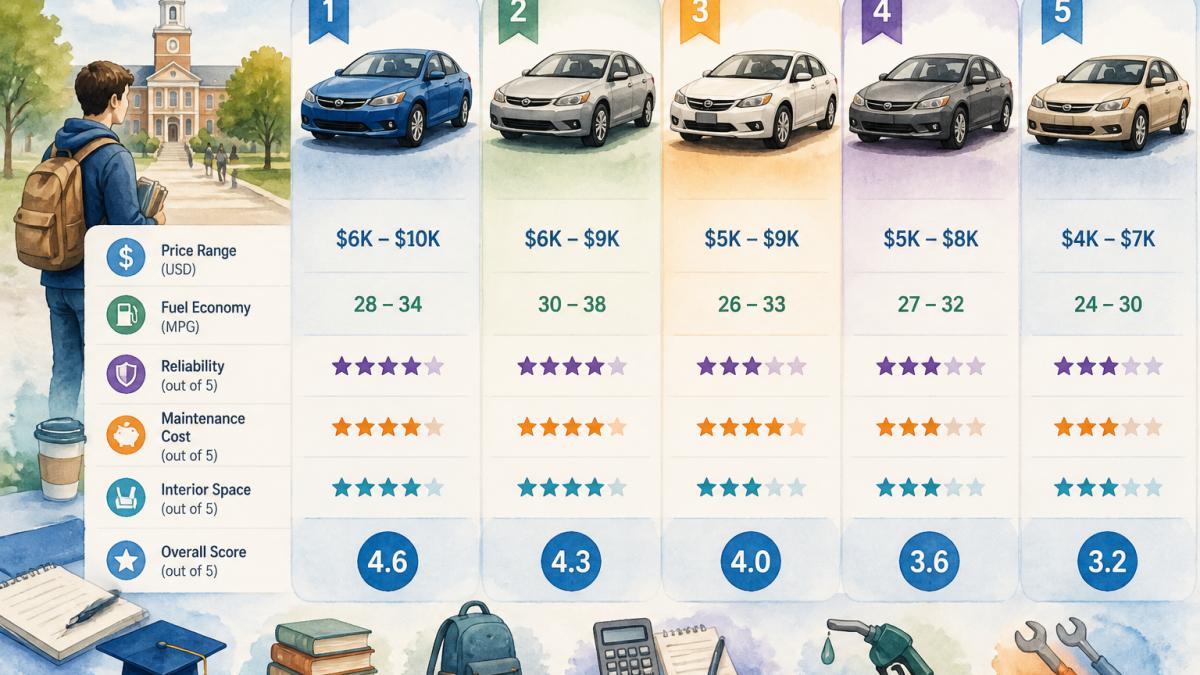
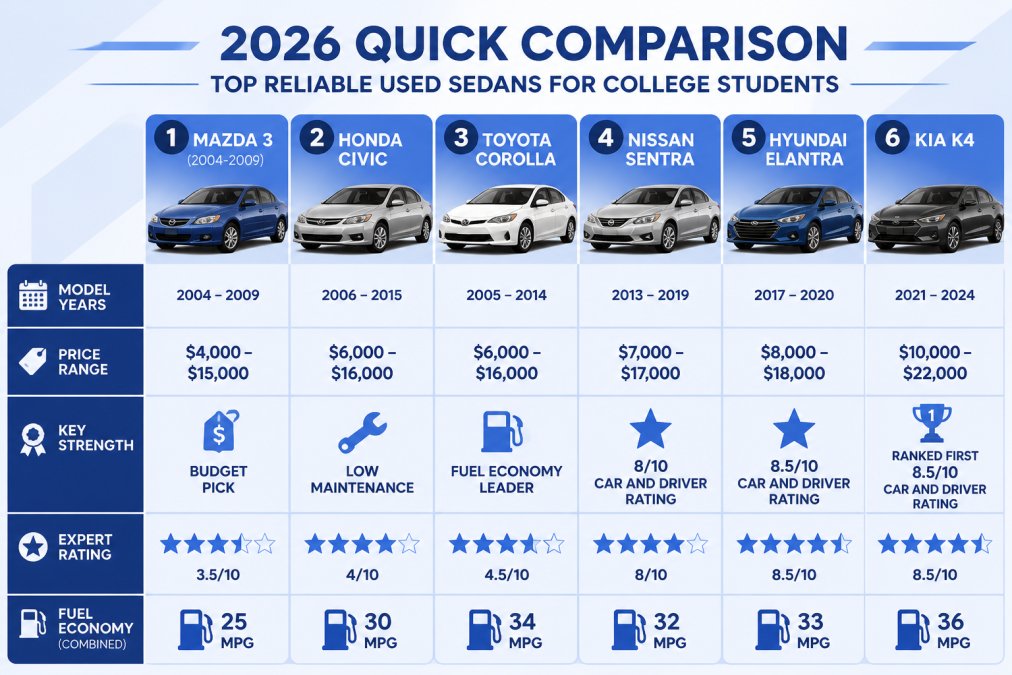
2026 Quick Comparison: Top Reliable Used Sedans for College Students
Finding reliable used sedans for college students on a budget comes down to three things: a documented maintenance history, a model with cheap parts, and a total cost you can actually afford each month. At AutoSport USA, we help Toms River-area students and families sort real value from marketing hype. This guide covers the models worth shortlisting in 2026, what to verify before you buy, and the ownership costs most buyers forget to add up.
The shortlist below leans on published picks from Edmunds' guide to the best used cars for college students and Car and Driver's cheapest sedans ranking, plus our own experience with what holds up on Ocean County roads.
| Model | Listed By | Price Signal | Key Strength |
|---|---|---|---|
| Mazda 3 (2004-2009) | Edmunds | $4,000-$15,000 | Budget entry point |
| Honda Civic | AutoNation USA | Varies by year | Low maintenance costs |
| Toyota Corolla | AutoNation USA / KBB | Varies by year | Fuel economy, reliability |
| Nissan Sentra | Car and Driver | Varies by year | 8/10 affordability rating |
| Hyundai Elantra | Car and Driver | Varies by year | 8.5/10 affordability rating |
| Kia K4 | Car and Driver | Varies by year | Ranked first, 8.5/10 |
Honda Civic and Toyota Corolla: Compact Sedans That Hold Their Value
The Honda Civic and Toyota Corolla earn their reputation the boring way: they stay dependable and keep resale value. Both appear on AutoNation USA's student car recommendations, which cites the Civic's low purchase price and affordable maintenance, while Kelley Blue Book highlights the Corolla's reliability and good fuel economy.
What most guides miss is that a well-kept 2015 Civic with 90,000 miles often beats a neglected 2019 with 40,000. Service records matter more than the badge.
Reliable used sedans for college students in this tier share three traits:
- Parts available at any auto parts store
- Insurance classified as a compact sedan, not a sport model
- Timing chains or belts with documented replacement
Reliable Used Sedans Under $10,000: Mazda 3, Nissan Sentra, and Hyundai Elantra
Under $10,000, the Mazda 3 is the standout on paper. Edmunds lists the 2004-2009 Mazda 3 among its college-student picks with a $4,000-$15,000 range, so a clean example sits comfortably inside budget.
The Nissan Sentra and Hyundai Elantra both appear in Car and Driver's 2026 cheapest sedans ranking, scoring 8/10 and 8.5/10 respectively. The Kia K4 ranks first in that same list at 8.5/10, though used examples are still thin.
Year ranges matter more than model names. A model's reputation is built across generations, and reliability can swing sharply between them. Before you commit to any of these cars, identify the specific generation and research that year range, not the badge. Two habits make this concrete:
- Check open recalls by VIN. The NHTSA maintains a free VIN lookup. A recall is not automatically a dealbreaker, an unrepaired one is. Ask the seller for proof the recall work was done.
- Look up the model-year pattern. Community forums and owner reports often surface a specific year with a known weak point, a transmission, an electrical component, a cooling issue. Knowing the pattern lets you ask the right question during the test drive.
Age-related wear beats mileage on sub-$10,000 cars. Rubber bushings, struts, and hoses degrade with time regardless of how few miles the car has. A low-mileage 2008 that sat unused can need more suspension work than a higher-mileage 2015 that was driven regularly.
Rust is the budget killer in this tier. On older Mazda 3s and other 2000s-era sedans, check the rear wheel arches, rocker panels, and underbody. Surface rust is manageable; structural rust is a walk-away. A pre-purchase inspection on a lift is the only reliable way to see it.
Parts availability is a hidden advantage. The Civic, Corolla, and Mazda 3 have deep aftermarket parts coverage, which keeps repair costs down. Less common models can mean waiting on a dealer-only part and paying dealer prices. For a student on a tight budget, commonality is a feature.
A common mistake is buying the cheapest listing in the search results. The savings usually reappear as a repair bill within six months.
Used Car Inspection Checklist: What to Verify Before You Buy
A used car inspection checklist protects you from the $6,000 engine repair scenario every buyer fears. Run through this before money changes hands:
- Pull the vehicle history report: title status, accident history, odometer rollback
- Verify service records match the mileage and dates
- Check for open recalls by VIN with the NHTSA
- Cold-start the engine and listen for timing rattle
- Inspect tires, brakes, and fluid condition
- Test every electronic feature: windows, AC, backup camera
- Have an independent mechanic perform a pre-purchase inspection
Used Car Ownership Costs: Insurance, Fuel, and Maintenance for Students
Sticker price is the smallest number in this decision. The monthly cost of a used sedan is insurance plus fuel plus a maintenance reserve plus registration, and for a student driver, insurance is usually the largest of the four. Most buying guides stop at the purchase price. That is the gap this section fills.
Insurance is the variable you control least, and can still shop. A base-trim Corolla, Civic, or Mazda 3 is rated as a compact sedan. The same car in a sport or turbo trim can carry a meaningfully higher premium because insurers rate by trim, not just by model. Two practical rules:
- Get a quote on the exact VIN, not the model name. Trim, safety features, and even the previous owner's claims history can move the number.
- Ask about a good-student discount and a defensive-driving course credit. Most major carriers offer both, and stacking them is common.
- A higher deductible lowers the premium but shifts risk back to you. For a student with a funded repair reserve, a mid-range deductible is usually the better trade.
Fuel is predictable once you know the commute. Estimate your weekly campus and home-round-trip miles, then divide by the car's combined EPA rating. A sedan returning roughly 30 mpg combined costs noticeably less per semester than one returning the low 20s, and the gap widens with every mile. Check the EPA's fuel economy site for the exact year, model, and trim, ratings vary by engine and transmission.
Maintenance is a reserve, not a surprise. Oil changes, brakes, tires, and fluids are scheduled costs. On an older sedan, plan for them sooner and set the money aside monthly rather than reacting when the shop calls.
Registration and fees are small but real. Title, registration, and any state inspection add a one-time cost at purchase and a recurring cost each year. Confirm the current fees for your state before you set your budget.
Used Car Financing for Students: Loans, Cash Purchases, and Emergency Reserves
Used car financing for students works best when you keep the loan short and the reserve funded. A longer term lowers the monthly payment but raises total interest, and it can leave you owing more than the car is worth.
Three practical paths:
- Cash purchase: no payment, but keep a repair reserve
- Short-term loan: higher monthly cost, less total interest
- Dealer financing: convenient, but compare the rate
Whichever you choose, set aside an emergency repair reserve. A student with cash on hand negotiates repairs from strength.
Which Reliable Used Sedan Fits Your Campus Commute?
Match the car to the commute. Long highway drives favor the Corolla or Civic for fuel economy and comfort. Tight campus parking favors a compact like the Mazda 3. Winter driving on Ocean County roads rewards good tires and front-wheel drive over any specific badge.
We keep a range of inspected sedans at AutoSport USA, and our online financing tools and trade-in valuations let you sort the numbers from home. If you would rather not drive all over Toms River, start the process online and confirm the details with our team.
Frequently Asked Questions
What is the best affordable car for college students?
The Honda Civic and Toyota Corolla consistently appear in student-car recommendations from sources like AutoNation USA and Kelley Blue Book because of their reliability, low maintenance costs, and strong fuel economy. Edmunds also highlights the Mazda 3 (2004-2009) with a $4,000-$15,000 price range. Car and Driver's 2026 affordability rankings include the Nissan Sentra, Hyundai Elantra, and Kia K4. The best choice depends on your budget, whether you need a compact or midsize sedan, and local availability.
How much should a college student spend on a used sedan?
Edmunds lists a $4,000-$15,000 range for its college-student picks like the Mazda 3, giving you a realistic window. Aim to keep the purchase price under $10,000 if possible, then budget separately for insurance, fuel, and a repair reserve. A common guideline is to set aside $1,000-$1,500 for immediate maintenance after purchase, since older sedans often need new tires, brakes, or fluids within the first few months of ownership.
Which used sedans are inexpensive to maintain?
The Toyota Corolla and Honda Civic are frequently cited for affordable maintenance and reliability by AutoNation USA and Kelley Blue Book. These models have wide parts availability and simple mechanical designs, which keeps repair costs lower than European or luxury sedans. The Mazda 3 also has reasonable maintenance costs. When comparing used sedans under $10,000, check whether the model has a timing belt or timing chain, as belt replacements add several hundred dollars to ownership costs.
What should college students check before buying a used sedan?
Use a used car inspection checklist that covers the vehicle history report for accident history, title status, and service records. Have a mechanic perform a pre-purchase inspection to check the engine, transmission, brakes, tires, and suspension. Verify the mileage matches the odometer and service records. Check for open recalls by entering the VIN on the NHTSA website. Test drive on both city streets and highways to confirm the sedan handles well and accelerates smoothly.
Is it better for a college student to buy a used car or a new car?
A used sedan usually makes more financial sense for college students because the biggest depreciation hit happens in the first few years of a new car's life. Buying used means lower purchase price, lower insurance premiums in many cases, and less stress about campus parking dents. The trade-off is that you need a thorough inspection and a repair reserve. If you can find a well-maintained model with low mileage and a clean title, a used sedan delivers dependable transportation at a fraction of the new-car cost.
Choosing a used sedan as a student means balancing purchase price against everything that comes after it: insurance, fuel, repairs, and registration. AutoSport USA can help you find a dependable sedan with a clear history, apply online for financing, and get a fair trade-in value on your current vehicle. Get started with AutoSport USA and drive away in a car you can actually afford to keep.