 listicle
Best Used SUVs for Daily Commuting (2026 Guide)
Table of Contents
- Quick Comparison: Best Used SUVs for Daily Commuting
- How We Evaluated These Picks
- Top Used SUVs for Daily Commuting: Our Ranked Picks
- 1. Toyota RAV4: Best All-Around Commuter
- 2. Honda CR-V: Most Comfortable for Long Drives
- 3. Mazda CX-5: Best Driving Dynamics
- 4. Subaru Forester: Best for All-Weather Commuting
- 5. Hyundai Tucson: Best Budget Pick
- 6. Kia Sportage: Best Feature Set for the Price
- 7. Nissan Rogue: Best Cargo Space
- 8. Ford Escape Hybrid: Best for EV/PHEV Transition
- Most Reliable Used SUVs Under $20,000
- Fuel-Efficient Used SUVs for Commuting
- How to Inspect a Used Car Before Buying
- Commuter-Specific Features Worth Prioritizing
- Which Used SUV Should You Pick for Your Commute?
Last Updated: August 25, 2026
Finding the best used SUVs for daily commuting means balancing fuel economy, reliability, and ownership costs. This guide breaks down the top used SUV picks for daily driving, what separates a smart buy from a costly mistake, and the commuter-specific features most buyers overlook.
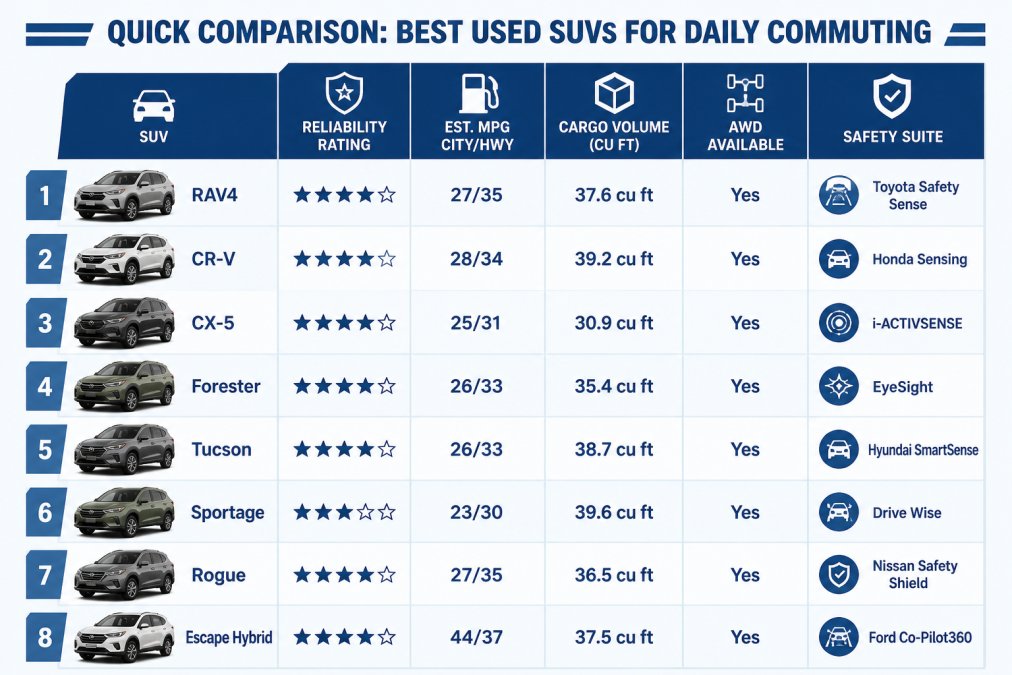
Quick Comparison: Best Used SUVs for Daily Commuting
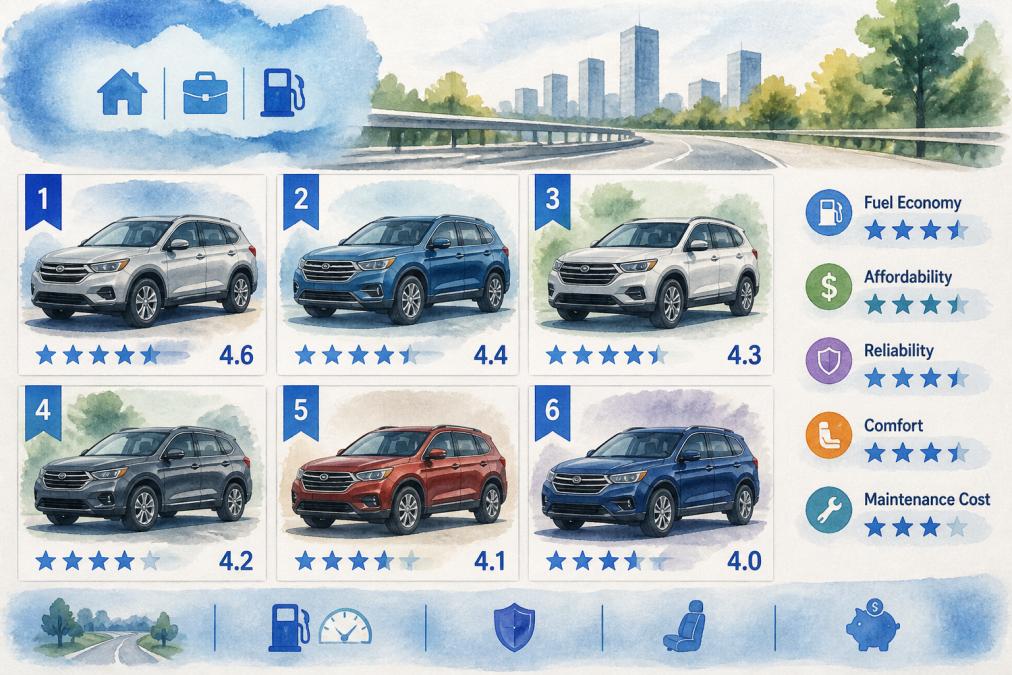
The best used SUVs for daily commuting share three core traits: proven reliability ratings, solid fuel economy, and enough cargo volume to handle real life.
| SUV | Reliability | Est. MPG (City/Hwy) | Cargo Volume (cu ft) | AWD Available | Safety Suite | Best For |
|---|---|---|---|---|---|---|
| Toyota RAV4 | Excellent | 27/35 | 37.6 | Yes | Toyota Safety Sense | All-around commuter |
| Honda CR-V | Excellent | 28/34 | 39.2 | Yes | Honda Sensing | Long-distance comfort |
| Mazda CX-5 | Very Good | 25/31 | 30.9 | Yes | i-Activsense | Driving dynamics |
| Subaru Forester | Very Good | 26/33 | 35.4 | Standard | EyeSight | All-weather driving |
| Hyundai Tucson | Good | 26/33 | 38.7 | Yes | SmartSense | Budget buyers |
| Kia Sportage | Good | 23/30 | 39.6 | Yes | Drive Wise | Feature value |
| Nissan Rogue | Good | 27/35 | 36.5 | Yes | Safety Shield 360 | Cargo space |
| Ford Escape Hybrid | Very Good | 44/37 | 37.5 | Yes | Co-Pilot360 | Fuel savings |
Quick Picks:
- Best Overall: Toyota RAV4, unmatched reliability and resale value
- Best Comfort: Honda CR-V, quietest cabin in its class for long drives
- Best Budget: Hyundai Tucson, most features per dollar on the used market
- Best Fuel Saver: Ford Escape Hybrid, cuts annual fuel costs dramatically
How We Evaluated These Picks
Our evaluation framework weighted long-term durability beyond 100,000 miles, ownership costs including maintenance and parts availability, commuter comfort including cabin noise and seat support, and safety suite completeness with driver-assist technology. We deliberately excluded vehicles with known powertrain issues in specific model years.
Top Used SUVs for Daily Commuting: Our Ranked Picks
1. Toyota RAV4: Best All-Around Commuter
The RAV4 is the benchmark for reliability and resale value. Target 2019 or newer models with Toyota Safety Sense standard, providing adaptive cruise control, automatic emergency braking, and lane-keeping assist. Available all-wheel drive handles wet roads and winter weather. The RAV4 Hybrid delivers better city fuel economy, ideal for stop-and-go commuting.
Pros: Exceptional long-term durability, strong resale value, comprehensive safety suite, hybrid option available Cons: Premium pricing on the used market, avoid 2006-2008 models with transmission issues
2. Honda CR-V: Most Comfortable for Long Drives
Cabin noise is the underrated metric in commuter SUV comparisons. The CR-V wins outright. Honda's sound insulation in the fifth-generation model (2017 and newer) produces one of the quietest rides in the compact SUV class. The CR-V's interior is spacious with 39.2 cubic feet of cargo volume. Honda Sensing is standard on most trims from 2017 onward.
The 1.5L turbocharged engine in 2017-2018 models had oil dilution concerns in cold climates. Check service records carefully if buying from that era.
Pros: Quietest cabin in class, generous passenger and cargo space, Honda Sensing standard, consistently high reliability Cons: Older infotainment feels dated, 2017-2018 engine concerns in cold weather
3. Mazda CX-5: Best Driving Dynamics
The CX-5 handles with responsiveness and ride quality that sits noticeably above the segment average. Soft-touch materials and genuinely supportive seats make it the best daily commuter for drivers who care about the driving experience. Advanced safety features including blind-spot monitoring and adaptive cruise control are available across most trim levels from 2017 onward. The trade-off is cargo space at 30.9 cubic feet, trailing competitors by a meaningful margin.
Pros: Engaging driving dynamics, upscale interior quality, strong safety ratings, i-ACTIV AWD available Cons: Smallest cargo volume in this group, older infotainment systems lack intuitive controls
4. Subaru Forester: Best for All-Weather Commuting
Standard symmetrical all-wheel drive on every trim is the Forester's defining advantage. For commuters in regions with serious winter weather, you don't have to hunt for the right trim or pay a premium for AWD. The Forester's visibility is exceptional with large windows and minimal blind spots. EyeSight Driver Assist Technology covers adaptive cruise, pre-collision braking, and lane sway warning on most trims from 2015 onward.
Pros: Standard AWD on all trims, excellent outward visibility, strong safety record, spacious headroom Cons: Less engaging powertrain, CVT transmission divides opinion
5. Hyundai Tucson: Best Budget Pick
The Tucson offers more features per dollar than any other vehicle on this list. On the used market, pricing runs lower than comparable Japanese brands. Ride quality is comfortable and quiet, and newer models include modern infotainment with wireless smartphone integration. Hyundai's SmartSense suite covers core driver-assist features. Stick to 2019 and newer for the best ownership experience.
Pros: Competitive used market pricing, good warranty on certified pre-owned, comfortable ride, modern infotainment Cons: Resale value trails Japanese competitors, pre-2016 reliability concerns
6. Kia Sportage: Best Feature Set for the Price
Wireless Apple CarPlay and Android Auto as standard equipment. Adaptive cruise control and lane-keep assist available across most recent trims. The Sportage offers 39.6 cubic feet of cargo volume. Kia's reliability has improved significantly in the 2017+ generation.
Pros: Generous feature list, spacious cargo area, competitive used pricing, improved reliability in recent generations Cons: Fuel economy trails competitors, exterior styling is polarizing
7. Nissan Rogue: Best Cargo Space
The Rogue wins on practical cargo space with a low cargo floor and flexible storage. Nissan Safety Shield 360, covering automatic emergency braking, rear cross-traffic alert, and blind-spot monitoring, is standard on most Rogue trims from 2021 onward. Avoid 2013-2016 models with documented CVT issues. Target 2020 and newer for the revised platform.
Pros: Best practical cargo space, strong safety suite, good fuel economy, comfortable ride Cons: CVT concerns in older models, less engaging driving dynamics
8. Ford Escape Hybrid: Best for EV/PHEV Transition
For commuters thinking about electrification but not ready to commit to a full EV, the Ford Escape Hybrid and Plug-In Hybrid (PHEV) represent a logical bridge. The PHEV variant delivers an EPA-estimated 37 miles of electric-only range, enough to cover many daily commutes on electricity alone. The SYNC infotainment system with touchscreen, Apple CarPlay, and Android Auto is well-executed in the 2020+ generation.
Pros: Hybrid and PHEV options for fuel savings, good cargo capacity, modern technology features, PHEV covers most daily commutes on electricity Cons: Some 2020-2022 model years have reliability concerns, 1.6L EcoBoost third-gen models had documented problems
Most Reliable Used SUVs Under $20,000
The most reliable used SUVs under $20,000 are the Toyota RAV4, Honda CR-V, and Mazda CX-5. For high-mileage commuters putting 15,000-20,000 miles per year on a vehicle, reliability matters most.
| Model | Target Year Range | Why It Works Under Budget |
|---|---|---|
| Toyota RAV4 | 2016-2018 | Pre-TSS trims, still excellent reliability |
| Honda CR-V | 2015-2017 | Proven 2.4L engine, low ownership costs |
| Mazda CX-5 | 2016-2019 | Premium interior, strong reliability record |
| Subaru Forester | 2016-2019 | Standard AWD, EyeSight on most trims |
| Hyundai Tucson | 2019-2021 | Redesigned platform, improved reliability |
| Nissan Rogue | 2020-2022 | Revised CVT, better long-term track record |
Request a vehicle history report on every candidate, budget for a pre-purchase inspection by an independent mechanic, and prioritize certified pre-owned options with extended warranty coverage. According to Consumer Reports' used car reliability data, the Toyota RAV4 and Honda CR-V consistently rank among the most reliable used compact SUVs.
Fuel-Efficient Used SUVs for Commuting
Fuel economy is where commuter math gets concrete. The difference between a vehicle returning 27 MPG and one returning 44 MPG is hundreds of dollars per year in fuel costs that compound over ownership.
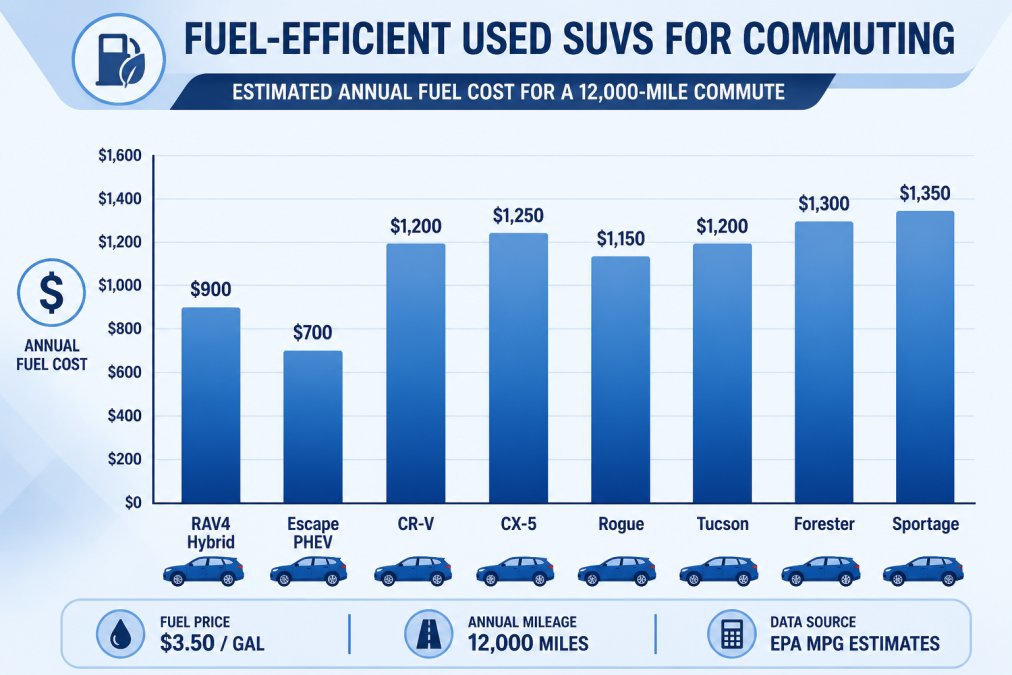
Hybrid vs. Gasoline: Real-World Commute Cost Breakdown
A hybrid powertrain pays for itself faster on a commute-heavy driving profile than almost any other use case. City driving with stop-and-go patterns is exactly where hybrid systems recapture energy most efficiently through regenerative braking.
| Vehicle | Est. Annual Fuel Cost* | Hybrid Premium (used) | Break-Even Point |
|---|---|---|---|
| RAV4 Hybrid | ~$900 | ~$2,000-3,000 over gas | 3-4 years |
| Escape PHEV | ~$700 | ~$3,000-4,000 over gas | 3-5 years |
| CR-V (gas) | ~$1,200 | N/A | N/A |
| Forester (gas) | ~$1,300 | N/A | N/A |
*Estimates based on EPA MPG figures and $3.50/gallon. Actual costs vary by driving conditions and fuel prices.
For commuters driving more than 12,000 miles per year, a used hybrid SUV typically offsets its premium over a gas model within three to four years. The U.S. Department of Energy's fuel economy guide provides current EPA ratings and real-world owner MPG data for every model year.
How to Inspect a Used Car Before Buying
Buying a used SUV without a proper inspection is the single biggest financial risk in this process. A vehicle that looks clean and drives fine on a short test drive can have serious mechanical issues that surface under sustained highway driving.
What to Check Mechanically
A pre-purchase inspection by an independent mechanic is non-negotiable. Check engine and transmission for fluid leaks, unusual noises, and shift quality; braking performance for pad thickness and rotor condition; suspension and steering for worn bushings and steering play; all-wheel drive system for engagement and transfer case noise; cabin noise at highway speed; and exhaust system for rust and leaks. A full inspection typically takes 60-90 minutes and costs a modest fee that can reveal problems costing far more to repair.
Documents and History to Request
Every used SUV purchase should include a vehicle history report covering accident history, title status, and service records; maintenance records confirming oil changes and timing belt replacements were done on schedule; title verification confirming clean title with no liens or salvage history; and emissions inspection records. According to the National Highway Traffic Safety Administration's vehicle history resources, checking a vehicle's VIN against recall databases is critical. Outstanding recalls may affect safety systems including driver-assist technology and braking performance.
Commuter-Specific Features Worth Prioritizing
Commuters spend hours per week in their vehicle, and features that determine daily satisfaction often differ from spec sheets.
Ergonomic priorities for long drives: Power-adjustable seats with lumbar control make a measurable difference on drives over 30 minutes. The CR-V and CX-5 offer strong seat support in upper trims. Full telescoping and tilt steering wheel adjustment lets drivers find a genuinely comfortable position, reducing fatigue. The Subaru Forester's large window area and minimal blind spots reduce stress in dense traffic.
Parking and maneuverability: The CX-5 and CR-V handle tight urban parking well. The Forester's large windows make reversing easier than most. A rearview camera is standard on all vehicles manufactured after May 2018.
Technology features that matter daily: Wireless Apple CarPlay and Android Auto (standard on most 2021+ Sportage and Tucson trims), adaptive cruise control for highway commuting, heated front seats for cold-weather commuters, and USB-C charging ports in newer models.
Which Used SUV Should You Pick for Your Commute?
The right answer depends on your budget, commute profile, and weather conditions.
If your commute is highway-heavy and you want the lowest long-term ownership costs: Toyota RAV4 Hybrid. The reliability track record is unmatched, and resale value means you'll recover more when you eventually sell.
If cabin comfort over long distances is your priority: Honda CR-V. The quietest ride in the segment and generous passenger space make it the most refined daily driver.
If you want the most features for the least money: Hyundai Tucson or Kia Sportage. Both offer technology and comfort that punches well above their used market price. Stick to 2019 and newer for the best reliability.
If you drive in serious winter weather: Subaru Forester. Standard AWD with no trade-off required. EyeSight and exceptional visibility make it the most confidence-inspiring daily driver when conditions get difficult.
If you're ready to reduce fuel costs dramatically: Ford Escape PHEV. For commutes under 40 miles round-trip, you'll run primarily on electricity most days.
The AutoSport USA team can help you find the right model from our current inventory, with online financing tools and a vehicle finder that alerts you when specific models come in. Our guaranteed credit approval process means financing concerns shouldn't stop you from getting the right vehicle for your commute. The EPA's used vehicle buying checklist is worth bookmarking as a reference before any purchase.
| Your Priority | Best Pick | Runner-Up |
|---|---|---|
| Overall reliability | Toyota RAV4 | Honda CR-V |
| Long-drive comfort | Honda CR-V | Mazda CX-5 |
| All-weather confidence | Subaru Forester | Toyota RAV4 |
| Budget under $20K | Hyundai Tucson | Kia Sportage |
| Fuel savings | Ford Escape Hybrid | Toyota RAV4 Hybrid |
| Driving engagement | Mazda CX-5 | Honda CR-V |
| Cargo space | Nissan Rogue | Honda CR-V |
| Feature value | Kia Sportage | Hyundai Tucson |
Frequently Asked Questions
What is the most reliable used SUV for daily driving?
The Toyota RAV4 and Honda CR-V consistently top reliability rankings for used compact SUVs. Both hold up well over high mileage, have widely available parts, and carry lower-than-average maintenance costs. The Mazda CX-5 is another strong option, with an upscale interior and solid long-term durability. For the best results, target model years with clean vehicle history reports and documented maintenance schedules.
Which used SUVs offer the best gas mileage for commuters?
Among fuel-efficient used SUVs for commuting, the Toyota RAV4 Hybrid and Ford Escape Hybrid lead the pack. The RAV4 Hybrid returns strong combined fuel economy figures, while the Escape PHEV can cover short daily commutes almost entirely on electric power. For gas-only options, the Honda CR-V and Nissan Rogue both deliver competitive fuel economy that keeps ownership costs manageable over a high-mileage commute.
How many miles is too many for a used commuter SUV?
There is no universal cutoff, but most buyers treat 100,000 miles as a natural checkpoint. Well-maintained models from Toyota, Honda, and Subaru regularly run reliably past 150,000 miles. The key factors are service history, not just mileage. A 90,000-mile SUV with complete maintenance records and a clean vehicle inspection report is often a safer buy than a 60,000-mile vehicle with no documented history.
Are compact or midsize SUVs better for daily commuting?
Compact SUVs generally suit daily commuting better. They are easier to park in tight urban lots, return better fuel economy, and cost less to buy and maintain than midsize models. Options like the RAV4, CR-V, and CX-5 offer enough cargo space and legroom for most commuters without the bulk. Midsize SUVs make more sense if you regularly carry passengers or need significantly more cargo volume.
What should I look for when buying a used SUV for commuting?
Start with reliability ratings and ownership costs for the specific model year you are considering. Request a full vehicle history report and confirm the maintenance schedule has been followed. Check for driver-assist technology like blind-spot monitoring, adaptive cruise control, and lane-keeping assist, which reduce fatigue on long commutes. Inspect the infotainment system, test the ride comfort, and verify that AWD or front-wheel drive suits your typical driving conditions before committing.
Finding the best used SUVs for daily commuting requires matching the vehicle to your specific driving profile, not just picking the highest-rated model on a generic list. AutoSport USA carries a rotating inventory of the models covered in this guide, with online financing tools, a price-drop notification system, and a vehicle finder that takes the legwork out of the search. Apply online today and let our team help you find a commuter-ready SUV that fits your budget and your drive.
This article was written using GrandRanker