 how-to
Get a Trade-In Appraisal Online: 2026 Guide
Table of Contents
- How an Online Trade-In Appraisal Actually Works
- How to Prepare Your Car for Trade-In
- What Documents Are Needed for a Car Trade-In
- How to Increase Trade-In Value Before You Submit
- Factors That Affect Your Trade-In Appraisal
- Steps to Get a Trade-In Offer Online
- How to Negotiate After You Receive an Offer
- Conclusion
Last Updated: August 27, 2026
Getting a trade-in appraisal online is the fastest way to understand what your current vehicle is worth before you set foot in a dealership. At AutoSport USA, we offer an online trade-in valuation tool that helps drivers in the Toms River area navigate this process. The single biggest mistake we see is people walking in without any appraisal data at all. They end up accepting whatever number a dealer offers. Below, we'll show you exactly how the online appraisal process works, what factors move your number up or down, and how to negotiate effectively once you have an offer in hand.
The trade-in landscape has shifted significantly. Many buyers now arrive with multiple offers from online appraisal tools, which creates a more transparent negotiation environment. That's a good thing. But knowing how to read those offers, prepare your vehicle, and understand the gap between market value and trade-in value is what separates a strong deal from a mediocre one.
How an Online Trade-In Appraisal Actually Works
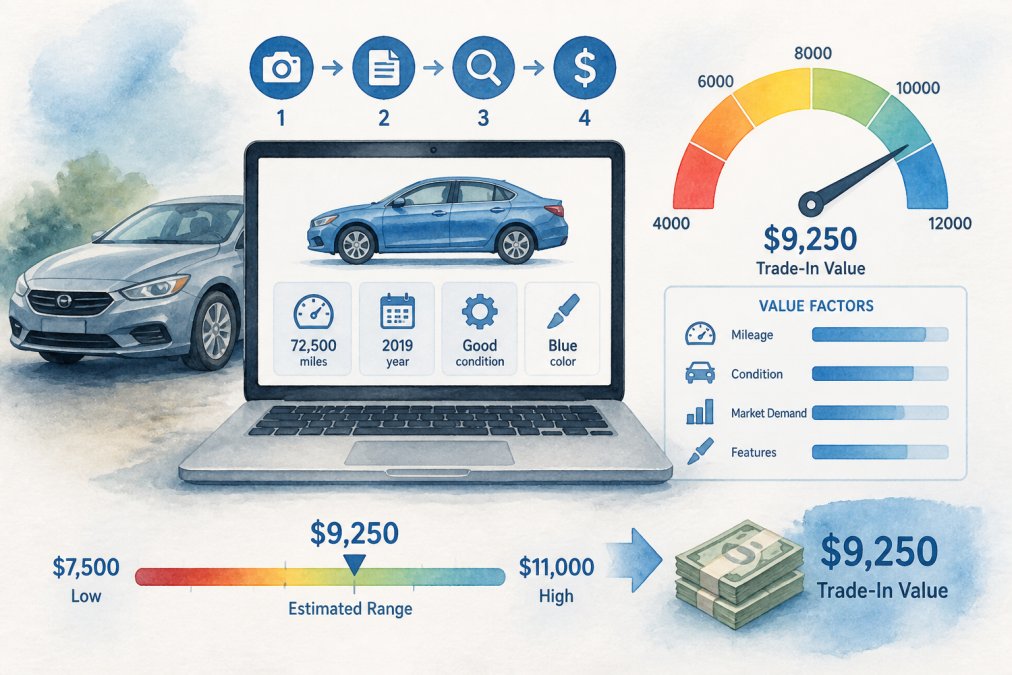
An online trade-in appraisal is a digital estimate of your vehicle's wholesale or dealer trade-in value, generated by entering key details about your car into a valuation tool. The tool cross-references your inputs against current market data, recent auction results, and regional demand to produce a fair market range.
The process is faster than most people expect. Most tools return an instant offer within minutes, though some require a follow-up inspection before finalizing the number. That inspection is standard and not a red flag.
What Information You'll Need to Enter
Before you start, gather these details:
- Vehicle Identification Number (VIN): The VIN is a 17-character code found on your dashboard or door jamb. It tells the tool your exact year, make, model, trim level, and factory options without you needing to remember every detail.
- License plate number: Some tools can pull vehicle data directly from a license plate lookup if you don't have the VIN handy.
- Odometer reading: Your current mileage is one of the highest-impact inputs. Be precise.
- Condition report: Most tools ask you to self-assess your vehicle's paint condition, interior wear, and mechanical status. Be honest, overestimating condition leads to offers that collapse at inspection.
- Vehicle history report: If you have a Carfax or AutoCheck report, have it ready. Accident history, number of owners, and title status all affect the appraisal.
Market Value vs. Trade-In Value: The Real Difference
Market value is what a private buyer would pay for your car in a direct sale. Trade-in value is what a dealer offers to buy it from you, which is consistently lower because the dealer needs margin to recondition the vehicle, carry it in inventory, and eventually resell it.
The gap between private party value and dealer trade-in value can be meaningful. Trading in is not the maximum-dollar option. It is the maximum-convenience option. You avoid listing the car, fielding calls, arranging test drives, and handling the title transfer yourself. For most buyers, that trade-off is worth it.
According to Kelley Blue Book's vehicle valuation methodology, trade-in values reflect what dealers typically pay at auction for similar vehicles, adjusted for local market demand.
How to Prepare Your Car for Trade-In
Preparation is where most sellers leave money on the table. A vehicle that looks neglected during inspection will receive a lower condition grade, and that grade directly affects the final offer.
Mechanical Assessment and Paint Condition
Start with the basics a dealer will check immediately:
- Tire tread depth: Worn tires signal deferred maintenance. If you're close to replacement, the dealer will factor that cost into their offer.
- Fluid levels: Top off oil, coolant, and windshield washer fluid. It's a small signal that the car has been cared for.
- Warning lights: Any active check engine light will trigger a mechanical assessment that typically reduces the offer. Address known issues if the repair cost is less than the likely appraisal deduction.
- Paint condition: Surface scratches and minor dents are expected. Deep scratches that expose primer, rust spots, or large dents are graded as significant damage. Touch-up paint on small chips can help.
- Interior: Vacuum thoroughly, remove personal items, and wipe down surfaces. A clean interior reads as a well-maintained vehicle.
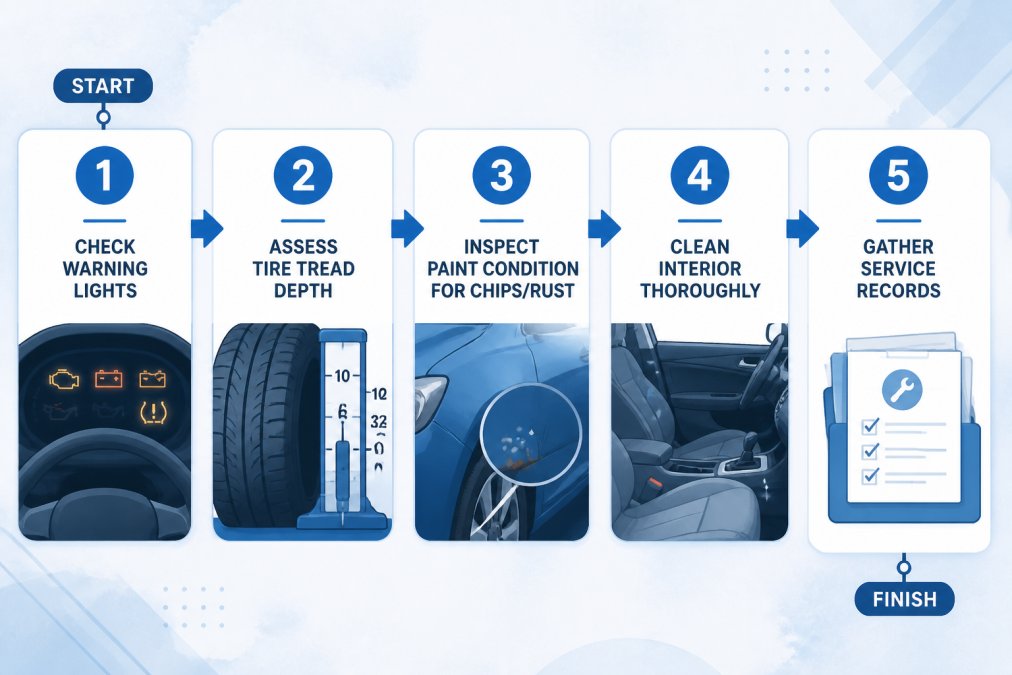
Service records are worth finding before your appraisal. A documented history of oil changes and scheduled maintenance supports a higher condition grade and gives the appraiser confidence in the vehicle's mechanical history.
What Documents Are Needed for a Car Trade-In
Missing paperwork is one of the most common reasons a trade-in closes late or falls through entirely. Gather these before you submit your online appraisal:
- Vehicle title: You must have the title in your name to complete a trade-in. If there's a lien holder (a bank or finance company that financed your car), you'll need the payoff amount from them, not the title itself.
- Current registration: Confirms the vehicle is legally registered and matches the VIN.
- Valid photo ID: Required for all title transfer paperwork.
- Loan payoff statement: If you still owe money on the vehicle, contact your lender for a current payoff amount. This figure determines whether you have positive or negative equity.
- Service records: Not required, but they support your condition claims and can strengthen your negotiating position.
- Keys and remotes: Both sets, if you have them. Missing a key fob is a documented deduction at most dealers.
The Federal Trade Commission's guide to selling and trading in a vehicle outlines your rights during the trade-in process, including requirements around title disclosure and payoff handling.
How to Increase Trade-In Value Before You Submit
The highest-return actions happen before you submit your appraisal, not after.
Clean the vehicle thoroughly. A professional detail typically costs less than the condition-grade improvement it can generate. First impressions affect appraisers the same way they affect buyers.
Fix what's cheap. Burned-out bulbs, cracked windshields covered by insurance, and missing trim pieces are low-cost fixes that prevent automatic condition downgrades.
Gather your documentation. A complete service history, original window sticker, and any warranty paperwork all support a higher appraisal.
Time your appraisal strategically. Demand for certain vehicle types is seasonal. Trucks and SUVs tend to appraise higher before winter. Convertibles and sports cars peak in spring. Submitting when regional demand is strong can move your fair market range upward.
Get multiple offers. Submitting your vehicle to more than one appraisal tool gives you a documented range to reference during negotiation. No dealer expects you to have only one offer.
Factors That Affect Your Trade-In Appraisal
Several inputs drive your trade-in appraisal number, and understanding their relative weight helps you know where to focus your energy.
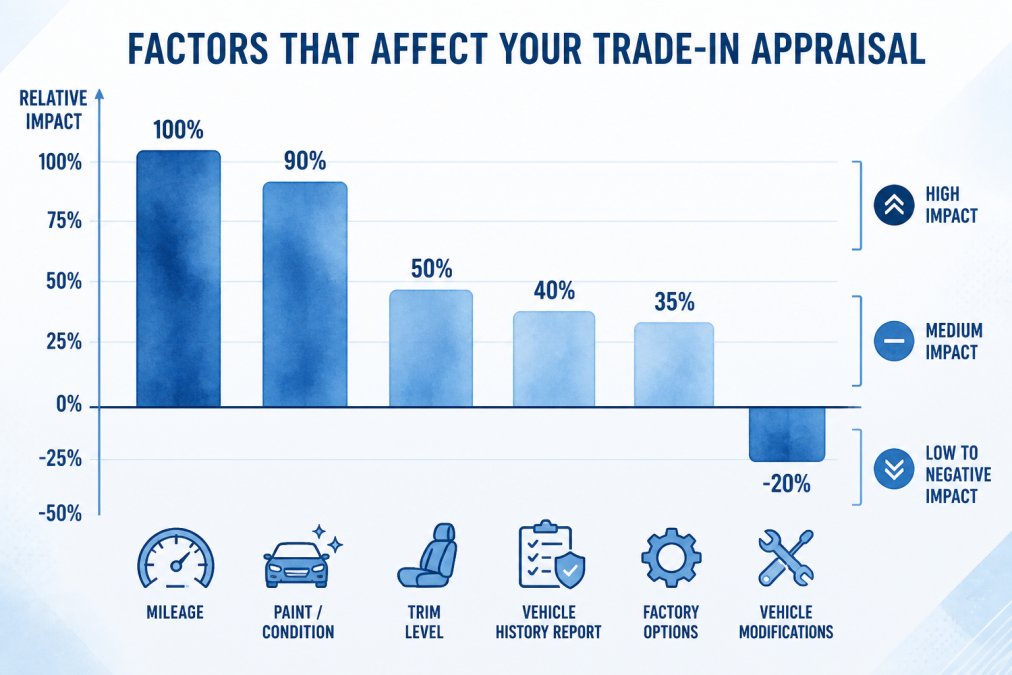
Mileage is the single most consistent factor. Higher mileage accelerates depreciation and increases the dealer's reconditioning risk. The odometer reading is objective and non-negotiable.
Condition covers paint, interior, and mechanical state. This is the most subjective factor and the one most open to honest negotiation if you have documentation.
Trim level matters more than most sellers realize. The difference between a base trim and a fully-loaded version of the same model can be substantial in resale value. Factory options like leather seats, sunroofs, and advanced driver assistance packages add to the wholesale price.
Vehicle history report findings, including accidents, flood damage, salvage titles, and number of previous owners, are weighted heavily. A clean history supports the upper end of the fair market range.
Regional demand affects your appraisal more than most tools disclose. A four-wheel-drive truck appraises differently in a market with harsh winters than in a warm-weather region.
Negative Equity, Modifications, and Tax Benefits
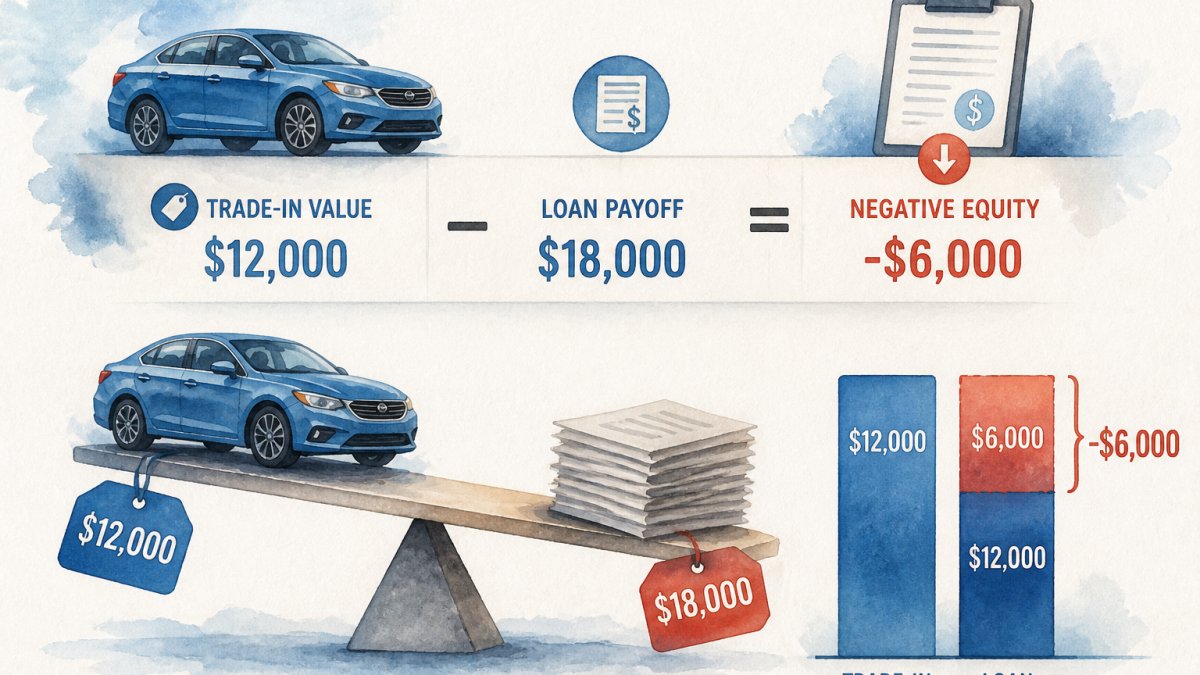
Negative equity occurs when your payoff amount exceeds your trade-in value. Many sellers assume this blocks a trade-in. It doesn't. The negative equity (the difference between what you owe and what the vehicle is worth) is typically rolled into the new vehicle's financing. This is a common scenario and worth understanding before you start the process.
Vehicle modifications almost always reduce trade-in value, not increase it. Aftermarket wheels, lift kits, tinted windows, and custom exhaust systems narrow the pool of buyers a dealer can sell to. Dealers price that risk into their offer. If your vehicle has significant modifications, expect the appraisal to reflect a conservative wholesale price.
Tax benefits are a legitimate financial consideration that many buyers overlook. In most states, when you trade in a vehicle, the trade-in value is deducted from the purchase price of the new vehicle before sales tax is calculated. This sales tax credit can represent real savings on the overall transaction. The National Conference of State Legislatures' summary of state trade-in tax policies documents how this credit varies by state. Check your state's specific rules, as the credit amount and eligibility conditions differ.
Steps to Get a Trade-In Offer Online
Getting a trade-in offer online follows a consistent process across most appraisal tools. Here's the full sequence:
- Enter your VIN or license plate number. This pulls your vehicle's year, make, model, and factory configuration automatically.
- Input your current mileage. Use your actual odometer reading, not an estimate.
- Select your trim level. If the VIN lookup didn't populate this, choose carefully. Trim level affects resale value significantly.
- Complete the condition report. Assess paint condition, interior condition, and mechanical status honestly. Most tools use a scale from Excellent to Poor.
- Review the instant offer. This is your no-obligation offer, representing the dealer's estimated trade-in value based on your inputs.
- Schedule an inspection. The final offer is confirmed after a physical vehicle inspection. This step verifies your self-reported condition.
- Accept, negotiate, or walk away. You are not obligated to accept the first number. The inspection creates an opportunity to discuss condition findings and negotiate.
- Complete the title transfer and payoff. If you have a lien, the dealer coordinates the payoff directly with your lender. The title transfers to the dealer, and your equity (or negative equity) is applied to your transaction.
Most online appraisal tools guarantee their offers for a set window, typically seven days, giving you time to shop without pressure.
How to Negotiate After You Receive an Offer
Most buyers treat the trade-in offer as final. It isn't.
The offer you receive is a starting position, not a ceiling. Here's how to negotiate effectively:
Bring competing offers. If you've submitted your vehicle to multiple appraisal tools and received different figures, present the higher offers in writing. Dealers can and do match documented competing offers rather than lose the deal.
Separate the trade-in from the purchase negotiation. Dealers sometimes bundle trade-in value and purchase price into a single monthly payment conversation. This obscures whether you're getting fair value on either transaction. Negotiate the trade-in value and the purchase price as two separate line items before discussing financing.
Use your documentation. If your vehicle has a clean vehicle history report, recent service records, and original equipment, reference these specifically. An appraiser who sees documentation of regular maintenance has less justification for a low condition grade.
Know your payoff amount before you negotiate. Walking in without knowing your exact payoff amount puts you at a disadvantage. Get that figure from your lender first.
Understand the dealer's floor. Dealers buy vehicles to resell them. Their offer must account for reconditioning costs, carrying costs, and resale margin. There is a floor below which they genuinely cannot go. Reasonable negotiation works; demanding above-market value doesn't.
According to Consumer Financial Protection Bureau's auto loan and trade-in guidance, buyers who understand the separation between trade-in value and purchase price negotiation consistently achieve better outcomes on both sides of the transaction.
Getting a fair trade-in appraisal requires preparation, documentation, and a clear understanding of how dealers value vehicles. AutoSport USA offers an online trade-in valuation tool that gives you a transparent starting point, with no-pressure follow-up and a team that walks you through the full transaction. Our simplified online process covers trade-in valuation and financing in one place, so you're not bouncing between tools. Apply Online today and see what your vehicle is worth before you make your next move.
Frequently Asked Questions
Q: Does an online appraisal guarantee a final trade-in offer?
A: No. An online trade-in appraisal gives you a fair market range based on your vehicle's mileage, trim level, and self-reported condition. It is a no-obligation offer estimate, not a binding contract. The final number is confirmed after a physical vehicle inspection at the dealership, where a dealer checks paint condition, mechanical condition, and verifies the odometer reading against the vehicle history report.
Q: Where can I get my car appraised for free online?
A: Several appraisal tools let you enter your vehicle identification number or license plate lookup details to generate a free instant offer. Dealerships, including AutoSport USA, often provide free online trade-in valuations directly on their websites. These tools pull real-time market data to estimate your car's wholesale price and private party value. Always get multiple estimates before committing to any offer.
Q: What documents do I need to get a trade-in appraisal?
A: For an online trade-in appraisal, you typically need your vehicle identification number, current odometer reading, and basic trim level details. When you bring the car in, you will also need the title or lien holder payoff information, a valid government-issued ID, service records if available, and your vehicle registration. If you still owe money on the car, have your payoff amount ready to calculate your equity position accurately.
Q: How long does a trade-in appraisal take?
A: An online trade-in appraisal takes about two to five minutes to complete. You enter your VIN or license plate, mileage, condition details, and factory options, then receive an instant offer. The in-person inspection, which confirms the online estimate, typically takes 20 to 30 minutes. Having your documents ready and your car clean beforehand keeps the process moving without delays.
This article was written using GrandRanker