 ultimate-guide
How to Check Used Car Reliability: A Step-by-Step Guide
Table of Contents
- Why Checking Used Car Reliability Matters Before You Buy
- How to Read a Vehicle History Report
- Questions to Ask a Private Seller About Car History
- Used Car Pre-Purchase Inspection Checklist
- Using OBD-II Scanners and Digital Diagnostics
- Understanding Reliability Ratings and Common Failure Points
- Red Flags That Signal Reliability Problems
- Conclusion
Last Updated: August 29, 2026
Why Checking Used Car Reliability Matters Before You Buy
Buying a used car without verifying its reliability is like signing a contract you haven't read. A single catastrophic failure, engine seizure, transmission failure, rust perforation, can transform what seemed like a bargain into an expensive liability.
At AutoSport USA, we help buyers navigate this decision every day. The buyers who pull vehicle history reports, run diagnostics, and ask the right questions consistently walk away with reliable vehicles. The ones who skip these steps often call us six months later regretting the purchase.
The good news: checking used car reliability doesn't require a mechanic's license. It requires a systematic approach: knowing what documents to review, what questions to ask, what physical signs matter, and how to interpret the data you collect.
How to Read a Vehicle History Report
A vehicle history report is your first line of defense. It's a digital record of a vehicle's past, ownership, accidents, maintenance, and title status.
What Title Status Tells You
Start with the title status. A clean title means the vehicle was never branded as salvage, flood-damaged, or lemon. A salvage title means an insurance company deemed repair costs higher than the vehicle's value, usually after a major accident, flood, or fire. A rebuilt title means the vehicle was salvaged, repaired, and passed inspection again.
A salvage or rebuilt title doesn't automatically mean the vehicle is unreliable, but it means you're buying a vehicle with documented serious damage. Repairs may have been done well or poorly. Flood-damaged vehicles are particularly risky; water damage corrodes wiring, bearings, and electronics in ways that aren't immediately visible.
Accident History and Hidden Damage
The vehicle history report lists reported accidents. A single minor fender-bender from years ago probably isn't a reliability concern if repairs were completed properly. Multiple accidents or one major accident require closer inspection.
Structural damage to the frame affects alignment and suspension wear. Collision damage to the engine compartment may have damaged cooling systems or engine mounts in ways that show up later as overheating or vibration.
When you see accident history, ask the seller: "What was repaired? Can you show me the repair documentation?" Legitimate repairs come with invoices from body shops or dealerships. If the seller can't produce them, that's a red flag.
Service Records and Maintenance Gaps
A vehicle with consistent service records, oil changes every 5,000 miles, fluid top-ups, scheduled maintenance, is far more likely to be reliable than one with gaps.
Look for the maintenance schedule in the report. A vehicle that followed manufacturer recommendations was cared for. One with gaps of 20,000 miles or more between services indicates the owner was cutting corners. Gaps compound: skip an oil change and sludge builds up; skip transmission fluid service and the fluid breaks down, accelerating transmission wear.
Questions to Ask a Private Seller About Car History
Ask: "Why are you selling?" A straightforward answer is a good sign. Vague or reluctant answers may indicate the seller knows something's wrong.
Ask: "Have you had any problems with the vehicle?" Listen carefully. If the seller mentions recent repairs, ask how they were fixed and whether they kept invoices.
Ask: "What's the maintenance history?" A seller who can recall service intervals and produce invoices is credible. One who says "I got it serviced regularly" but can't show records is either forgetful or dishonest.
Ask: "Has the vehicle been in any accidents?" Compare their answer to the accident history report. If they deny an accident the report shows, you've found a liar.
Ask: "Any rust, leaks, or warning lights?" A seller who admits minor issues is more trustworthy than one who claims the car is perfect when you can see fluid under it.
Ask: "Can I have it inspected by my mechanic?" A seller who refuses is a major red flag. Reliable vehicles have nothing to hide.
Used Car Pre-Purchase Inspection Checklist
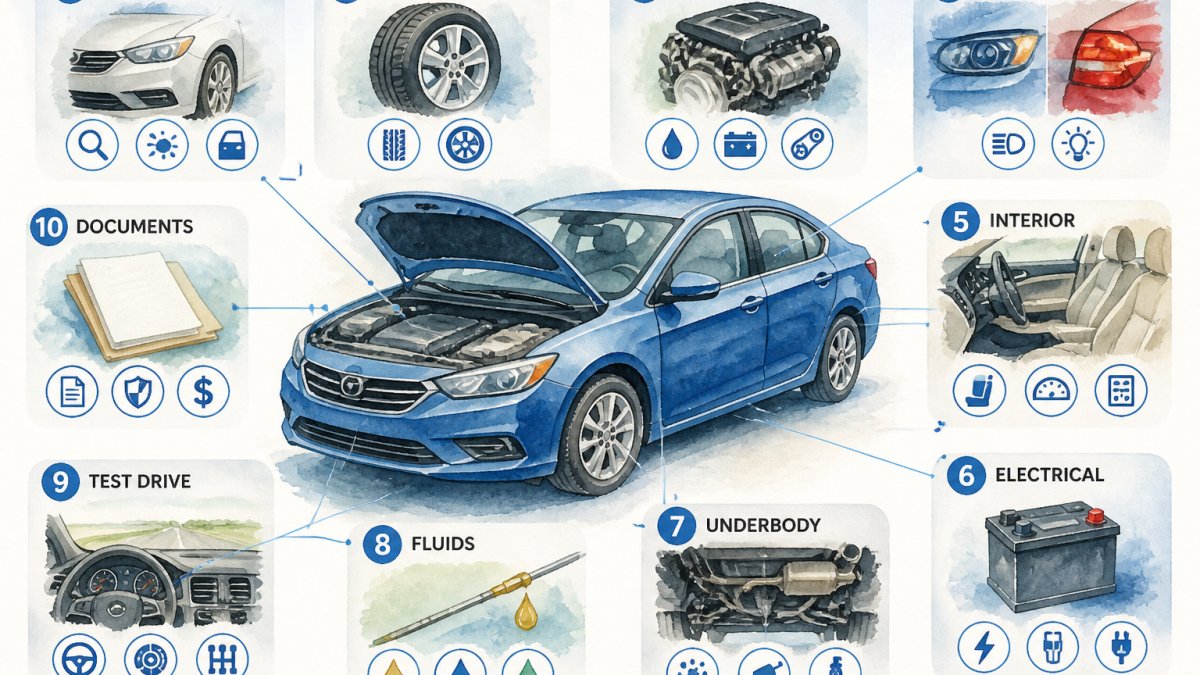
This is where you move from documents to the vehicle itself. A physical inspection reveals problems that reports and seller stories can't capture.
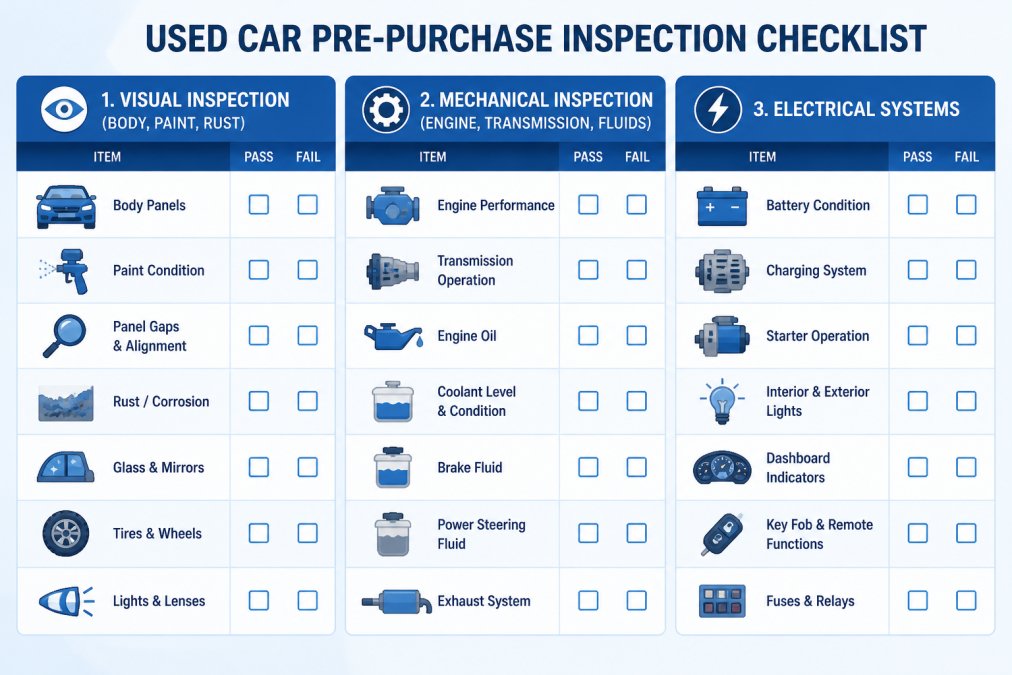
You don't need to be a mechanic, but you do need to be methodical. Bring a flashlight, a rag, and a notebook.
Visual Inspection: Body, Paint, and Rust
Walk around the entire vehicle. Look at the paint finish. Does it match across all panels? Mismatched paint suggests a panel was repainted after damage. Run your hand across the body; you'll feel if filler was used to cover dents.
Check for rust on the undercarriage, wheel wells, door jambs, and rocker panels. Surface rust is cosmetic. Deep rust, where you can see pitting or holes, is structural and expensive to repair.
Look at the tires. Are they all the same brand and condition? Check the tread depth with a penny: insert it into the tread with Lincoln's head upside down. If you can see the top of his head, the tread is less than 2/32 inches and the tires are near the end of their life (nhtsa.gov).
Check the windows and weatherstripping. Cracks in windows are expensive to replace. Dried-out weatherstripping allows water to leak into the vehicle, causing rust and electrical problems.
Mechanical Inspection: Engine and Transmission
Open the hood. Check fluid levels. The oil dipstick should show oil between the minimum and maximum marks. The coolant reservoir should be full. The transmission fluid should be bright red or pink, not brown or burnt-smelling. Dark transmission fluid indicates the fluid has broken down.
Look for leaks. Get down and look under the vehicle. Small drips of oil are common on older vehicles; puddles of fluid are a problem. Coolant leaks are green, orange, or pink. Transmission fluid is red.
Start the engine. Does it start smoothly or struggle? Does it idle smoothly or shake? Listen for knocking, pinging, or grinding noises. A smooth, quiet idle is a good sign.
Take it for a test drive. Accelerate moderately; does the vehicle respond smoothly or hesitate? Do shifts feel smooth or do you feel a jolt or delay? Does the transmission slip or hunt for gears? These are signs of transmission wear.
Electrical Systems and Fluid Leaks
Turn on the headlights, high beams, fog lights, and interior lights. Do they all work? Check the dashboard lights and warning indicators. Turn on the air conditioning and heating. Check the power windows, locks, and seat adjustments. Each non-working feature is a repair bill.
Look under the vehicle for fluid leaks. Engine oil is dark brown or black. Coolant is green, orange, or pink. Transmission fluid is red. Power steering fluid is clear. Brake fluid is clear to light amber.
Check the battery date code. Batteries typically last 3-5 years. An old battery isn't necessarily a reliability problem, it just means you may need to replace it soon.
Using OBD-II Scanners and Digital Diagnostics
Modern vehicles have onboard diagnostic systems. An OBD-II scanner reads fault codes from the vehicle's computer, telling you if the engine, transmission, emissions system, or other components have detected a problem.
You can buy an OBD-II scanner for under $30 or use a smartphone app with a Bluetooth adapter. Plug it in (the OBD-II port is usually under the steering wheel on the driver's side), and it will read any stored or pending fault codes.
A vehicle with no fault codes is a good sign. Codes like "P0171 System Too Lean" or "P0300 Random Misfire" indicate engine problems. Transmission codes like "P0700 Transmission Control System Malfunction" indicate transmission issues. A loose gas cap can trigger an emissions code; a faulty oxygen sensor can trigger an engine code. But codes are worth investigating with a mechanic.
A professional pre-purchase inspection typically includes advanced diagnostics that read live data, real-time information about engine temperature, fuel pressure, and ignition timing, revealing problems that fault codes don't catch.
Understanding Reliability Ratings and Common Failure Points
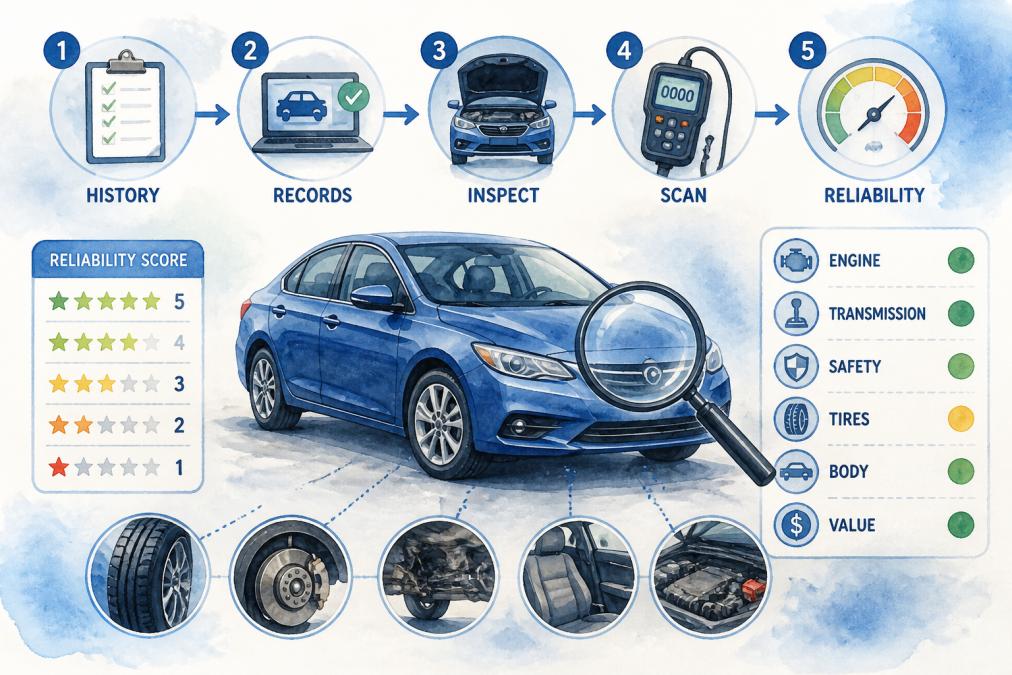
Reliability ratings quantify which vehicles are most dependable. Organizations like J.D. Power, Consumer Reports, and Edmunds collect data from vehicle owners about repairs they've had done, tracking which systems fail most frequently and how much repairs cost.
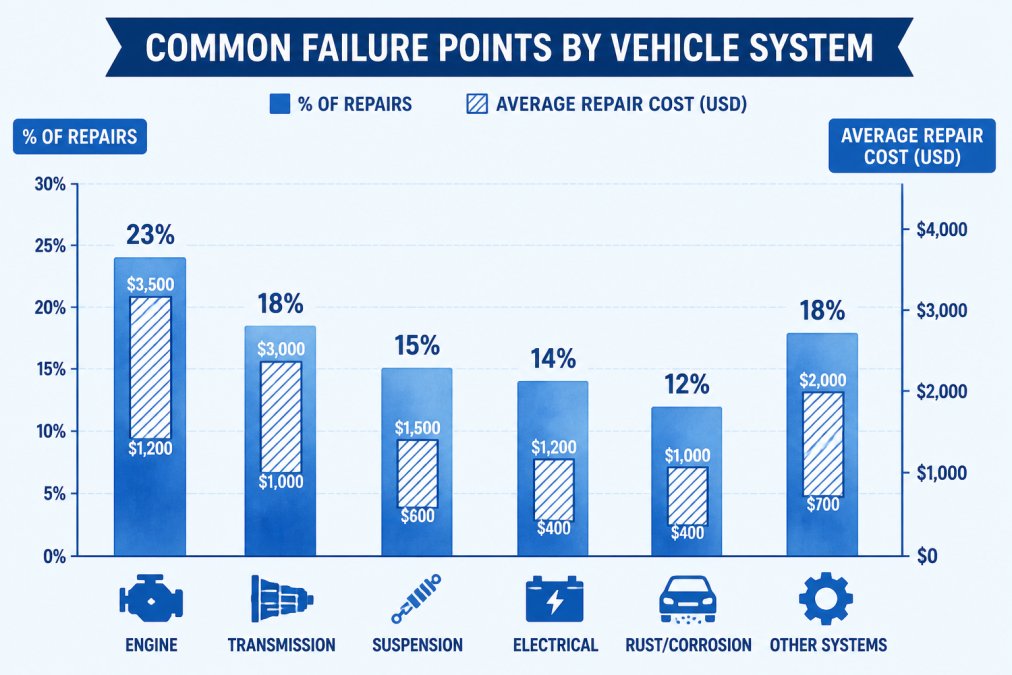
How Reliability Ratings Are Calculated
These ratings are based on real ownership experience, not speculation. A vehicle with a high reliability rating has fewer reported problems across its ownership period. A low rating indicates frequent repairs.
However, ratings apply to vehicle models and model years, not individual cars. A highly reliable model can have a lemon. A less reliable model can be well-maintained and run fine. This is why the physical inspection and maintenance history matter, they tell you about this specific vehicle.
Mileage vs. Age: Which Matters More
Mileage matters more than age for mechanical wear. An engine with 120,000 miles has had 120,000 combustion cycles and 120,000 opportunities for wear (peer-reviewed research). An engine with 80,000 miles has had proportionally less wear.
However, age matters for corrosion and component degradation. Rubber seals, hoses, and gaskets dry out and crack over time, regardless of mileage. The sweet spot is a vehicle that's moderate in both age and mileage, ideally less than 8 years old with under 100,000 miles (consumerreports.org). If you have to choose between high mileage and old age, a higher-mileage newer vehicle is usually the better bet, assuming the maintenance history is solid.
Red Flags That Signal Reliability Problems
Walk away if you see multiple warning signs: service gaps in the maintenance history; rust on structural components like the frame or rocker panels; a transmission that hesitates, slips, or hunts for gears; an engine that knocks, pings, or runs rough at idle; signs of coolant leaks or overheating; multiple fault codes from the OBD-II scanner; a seller who refuses to allow a professional inspection or is evasive about history; accident history combined with inability to produce repair documentation; excessive oil consumption; or a vehicle that pulls to one side, has excessive steering play, or bounces excessively.
Buying a used car without verifying reliability is a gamble. The process outlined here, reviewing the vehicle history report, asking the right questions, conducting a thorough physical inspection, running diagnostics, and understanding reliability ratings, removes most of the guesswork.
AutoSport USA specializes in helping buyers find reliable used vehicles. We provide detailed vehicle history reports and honest appraisals. Apply online today to explore our inventory and let us guide you toward a vehicle you can trust.
=== FAQ ANSWERS (audit these too, same rules) ===
[1] Q: What are the biggest red flags when buying a used car? A: Watch for mismatched paint indicating accidents, fluid leaks under the engine, transmission hesitation during test drives, and service records with large gaps. A title that shows multiple owners in short timeframes, salvage or rebuilt status, or repeated claims for the same issue all signal potential problems. Fault codes on an OBD-II scanner reveal hidden mechanical issues. If the seller avoids questions about maintenance or won't let you inspect the car thoroughly, walk away.
[2] Q: How do I check a vehicle history report to assess reliability? A: Obtain a report through CARFAX or AutoCheck using the Vehicle Identification Number (VIN). Review the title status first, clean titles are essential. Check for accident history, flood damage, and structural damage claims. Look at service records to confirm regular maintenance intervals were followed. Count the number of previous owners and how long each owned the car. Gaps in service records suggest neglect. Cross-reference reported mileage with the odometer reading to catch tampering.
[3] Q: What questions should I ask a private seller about a car's history? A: Ask about the reason for selling, any accidents or damage (even minor), all maintenance performed and when, any persistent mechanical issues, how many miles driven annually, whether it was garaged or parked outside, and if they have service records to provide. Inquire about warranty coverage remaining and whether they've had any transmission, engine, or suspension work done. Ask if the car has been in flood zones or exposed to salt water. Request the complete history of repairs, not just major ones.
[4] Q: Is 70,000 miles considered high for a used vehicle? A: Not necessarily. Modern vehicles built after 2010 typically run reliably past 150,000 miles with proper maintenance. A car with 70,000 miles is generally considered mid-range. What matters more is how those miles were accumulated, highway miles are easier on a vehicle than city stop-and-go driving. Check the service records to confirm maintenance was performed at intervals. A well-maintained 100,000-mile vehicle can be more reliable than a neglected 50,000-mile one.
Frequently Asked Questions
What are the biggest red flags when buying a used car?
Watch for mismatched paint indicating accidents, fluid leaks under the engine, transmission hesitation during test drives, and service records with large gaps. A title that shows multiple owners in short timeframes, salvage or rebuilt status, or repeated claims for the same issue all signal potential problems. Fault codes on an OBD-II scanner reveal hidden mechanical issues. If the seller avoids questions about maintenance or won't let you inspect the car thoroughly, walk away.
How do I check a vehicle history report to assess reliability?
Obtain a report through CARFAX or AutoCheck using the Vehicle Identification Number (VIN). Review the title status first, clean titles are essential. Check for accident history, flood damage, and structural damage claims. Look at service records to confirm regular maintenance intervals were followed. Count the number of previous owners and how long each owned the car. Gaps in service records suggest neglect. Cross-reference reported mileage with the odometer reading to catch tampering.
What questions should I ask a private seller about a car's history?
Ask about the reason for selling, any accidents or damage (even minor), all maintenance performed and when, any persistent mechanical issues, how many miles driven annually, whether it was garaged or parked outside, and if they have service records to provide. Inquire about warranty coverage remaining and whether they've had any transmission, engine, or suspension work done. Ask if the car has been in flood zones or exposed to salt water. Request the complete history of repairs, not just major ones.
Is 70,000 miles considered high for a used vehicle?
Not necessarily. Modern vehicles built after 2010 typically run reliably past 150,000 miles with proper maintenance. A car with 70,000 miles is generally considered mid-range. What matters more is how those miles were accumulated, highway miles are easier on a vehicle than city stop-and-go driving. Check the service records to confirm maintenance was performed at intervals. A well-maintained 100,000-mile vehicle can be more reliable than a neglected 50,000-mile one.
This article was written using GrandRanker