 listicle
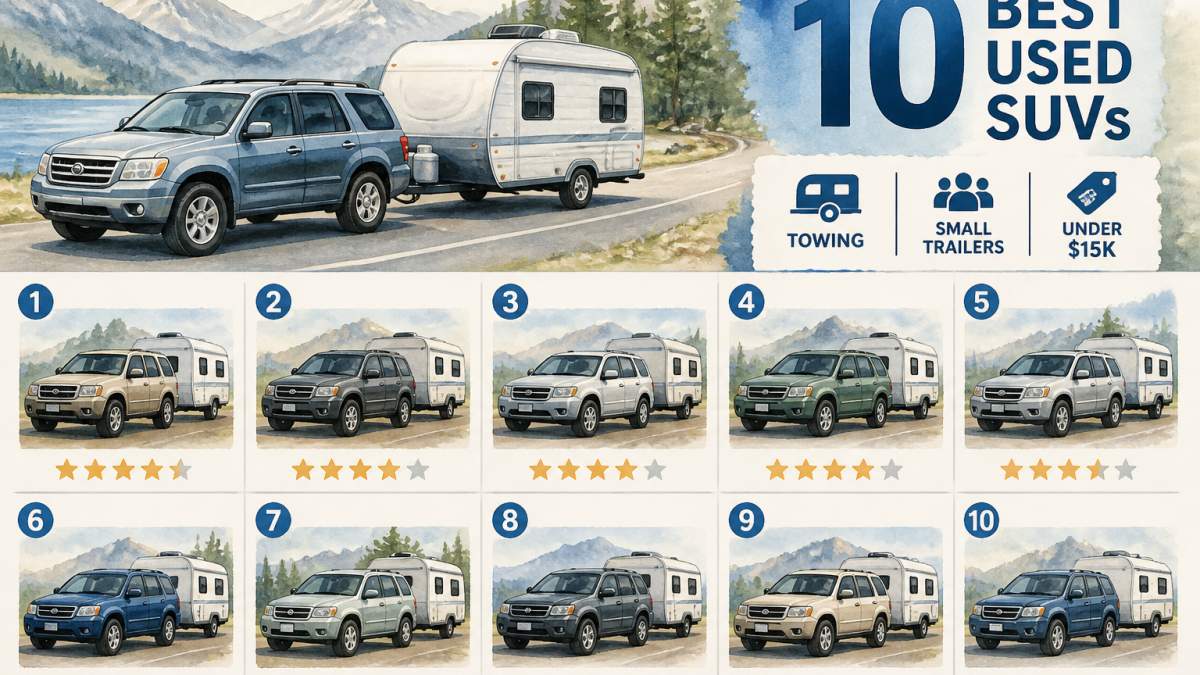
10 Best Used SUVs for Towing Small Travel Trailers Under $15K
Table of Contents
- What Makes a Used SUV Good for Towing Travel Trailers
- Comparison Table: Top 10 Used SUVs for Trailer Towing Under $15,000
- Used SUVs with 5,000-Pound Towing Capacity: Best Budget Options
- Small Travel Trailer Weight and Towing Capacity: What You Need to Know
- Used SUV Towing Package Checklist: What to Verify Before Buying
- How to Calculate Trailer Tongue Weight and Match It to Your SUV
- Inspection and Value: What to Check on a Used SUV Before Towing
- Frequently Asked Questions
Last Updated: October 8, 2026
What Makes a Used SUV Good for Towing Travel Trailers
When shopping for used SUVs towing travel trailers, three things matter: towing capacity, payload capacity, and the right equipment.
Towing capacity is the maximum weight your SUV can safely pull, but only with the proper tow package installed.
Payload capacity is how much weight your vehicle can carry, including passengers. With a 1,200-pound limit, two people, gear, and a hitch might leave only 400 pounds for cargo.
Gross vehicle weight rating (GVWR) is the total weight your SUV can carry fully loaded; gross combined weight rating (GCWR) is your SUV plus the loaded trailer. Many buyers ignore these numbers and end up overloaded.
The best used SUVs towing travel trailers are those where you can verify all three specs for the exact model year and trim. A 2019 Ford Explorer with a tow package handles different loads than a 2015 model without one.
Comparison Table: Top 10 Used SUVs for Trailer Towing Under $15,000
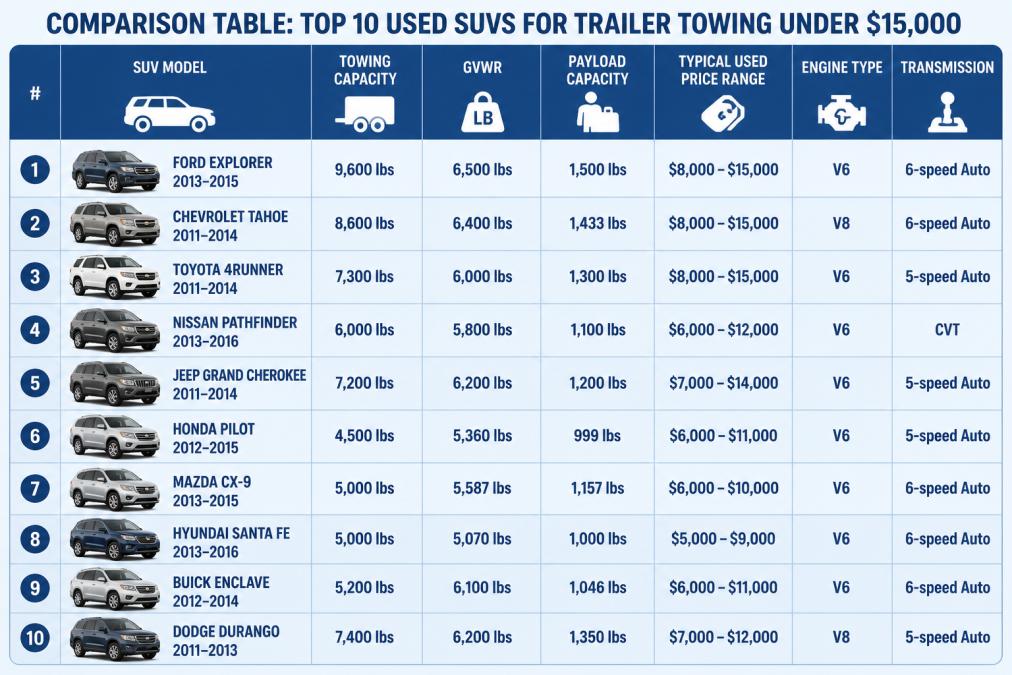
| Model | Towing Capacity | GVWR | Payload | Typical Price | Engine | Best For |
|---|---|---|---|---|---|---|
| Chevrolet Tahoe | 8,600 lbs | 6,200 lbs | 1,400 lbs | $12,000-$15,000 | 5.3L V8 | Full-size towing |
| Ford Explorer | 5,600 lbs | 5,100 lbs | 1,100 lbs | $10,000-$14,000 | 3.0L EcoBoost | Mid-size balance |
| Toyota 4Runner | 5,000 lbs | 5,200 lbs | 1,050 lbs | $11,000-$15,000 | 4.0L V6 | Off-road + towing |
| Jeep Grand Cherokee | 5,000 lbs | 4,850 lbs | 900 lbs | $9,000-$13,000 | 3.6L V6 | Compact capability |
| Subaru Forester | 1,500 lbs | 4,600 lbs | 700 lbs | $8,000-$12,000 | 2.5L H4 | Light trailers only |
| Nissan Rogue | 1,500 lbs | 4,700 lbs | 650 lbs | $8,500-$12,500 | 2.5L I4 | Light trailers only |
| Hyundai Tucson | 1,500 lbs | 4,750 lbs | 680 lbs | $8,000-$11,500 | 2.4L I4 | Light trailers only |
| Ford Expedition | 9,600 lbs | 6,500 lbs | 1,500 lbs | $13,000-$15,000 | 5.0L V8 | Heavy loads |
| Toyota Sequoia | 9,520 lbs | 6,300 lbs | 1,450 lbs | $13,500-$15,000 | 5.7L V8 | Maximum capacity |
| Chevrolet Traverse | 5,000 lbs | 5,050 lbs | 1,200 lbs | $10,000-$14,000 | 3.6L V6 | Three-row space |
The table shows the range of capabilities under $15,000: some vehicles max out at 1,500 pounds of towing, others handle 9,600. That difference isn't just engine size, it's frame reinforcement, transmission cooling, and brake systems built for sustained towing stress.
Used SUVs with 5,000-Pound Towing Capacity: Best Budget Options
If you're towing a small travel trailer in the 2,500- to 4,000-pound range, you need an SUV rated for at least 5,000 pounds, so the vehicle isn't operating at its limit.
The Ford Explorer, Toyota 4Runner, Jeep Grand Cherokee, and Chevrolet Traverse all deliver 5,000-pound towing capacity.
Smaller crossovers like the Subaru Forester, Nissan Rogue, and Hyundai Tucson are tempting at lower prices, but limited to 1,500 pounds of towing. If your trailer weighs more than 1,000 pounds loaded, they're undersized, risking transmission failure and brake wear.
Chevrolet Tahoe: Full-Size Power on a Budget
The Chevrolet Tahoe is a proven towing platform. With an 8,600-pound towing capacity and a 5.3L V8, it handles larger trailers without strain; most 2015-and-newer models came with integrated trailer brake controllers on higher trims.
The transmission cooler comes standard on tow-equipped models, keeping fluid temperatures stable during sustained pulling. The heavy-duty suspension handles tongue weight without sagging, and payload capacity is 1,400 pounds on most models.
The tradeoff is fuel economy: expect 15-18 mpg combined on highway towing. Parts are inexpensive and widely available. Check the service history, a well-maintained Tahoe tows reliably for years, while a neglected one will cost you in transmission repairs.
Ford Explorer: Mid-Size Reliability and Towing
The Ford Explorer balances capability and efficiency. With a 5,600-pound towing capacity and a 3.0L EcoBoost V6, it delivers solid towing power and better fuel economy than a Tahoe. Most Explorers from 2016 onward handle small to medium travel trailers without issue.
The turbocharged EcoBoost delivers V8-like power from a six-cylinder package, translating to lower fuel costs on long towing trips. The transmission cooler and integrated brake controller come standard on tow-equipped models.
Verify the exact model year and trim: a 2015 Explorer has different towing specs than a 2018. Make sure the specific vehicle has the tow package, without it, towing capacity drops significantly. Check the build sheet or have a Ford dealer confirm before purchase.
Toyota 4Runner: Off-Road Capability Meets Towing
The Toyota 4Runner is a truck-based SUV built on a frame similar to the Toyota Tacoma pickup, giving it genuine off-road capability and solid towing performance. The naturally aspirated 4.0L V6 is reliable and rated for 5,000 pounds of towing.
What sets the 4Runner apart is durability. Toyota's reliability reputation extends to it, most used examples are well-maintained, and parts are affordable and widely available. If you need highway towing and light off-road travel, the 4Runner is uniquely suited to both.
The 4Runner is heavier than the Explorer or Grand Cherokee, so it handles tongue weight better and feels more stable when towing. The downside: fuel economy is lower, typically 16-19 mpg combined.
Jeep Grand Cherokee: Compact Yet Capable
The Jeep Grand Cherokee delivers 5,000 pounds of towing capacity in a more compact package than the Tahoe or 4Runner. The 3.6L V6 is sufficient for small to medium trailers, and its unibody construction keeps weight down, improving fuel economy versus truck-based SUVs.
The Grand Cherokee's advantage is maneuverability: easier to park, navigate tight campground roads, and back up with a trailer than a full-size SUV. The interior is comfortable for long drives and quieter than older truck-based designs.
What to watch: payload capacity is lower than competitors, around 900 pounds, so passengers, gear, and a hitch use it up quickly. Older Grand Cherokees with the five-speed automatic are less efficient than newer eight-speed models. Check service records carefully; the transmission can be costly to repair if neglected.
Small Travel Trailer Weight and Towing Capacity: What You Need to Know
A small travel trailer typically weighs 2,000 to 4,500 pounds dry. Add water, propane, gear, and supplies, and the loaded weight can reach 5,000 pounds, which is why matching your SUV's towing capacity to your specific trailer is critical.
The mistake most buyers make is assuming dry weight is what matters. It isn't, the loaded weight is what your SUV must handle.
Here's the rule: your SUV's towing capacity should be at least 1.25 times the loaded trailer weight. If your trailer weighs 4,000 pounds loaded, your SUV should be rated for at least 5,000 pounds. This margin ensures you're not running at the edge of the vehicle's limits.
Tongue weight is the downward force the hitch applies to your SUV's rear bumper, typically 10% to 15% of the trailer's loaded weight. A 4,000-pound trailer has a tongue weight of 400-600 pounds, and your payload capacity must accommodate it.
Used SUV Towing Package Checklist: What to Verify Before Buying
Not every used SUV with a high towing rating has the equipment to tow safely. Before you buy, verify these components on the specific vehicle.
Transmission Cooler: The most important component. This separate cooling system keeps transmission fluid cool during sustained towing.
Integrated Trailer Brake Controller: Manages power to the trailer's brakes, synchronizing them with the SUV's.
Hitch Receiver: Must be rated for the tongue weight you'll apply. A Class II handles up to 3,500 pounds of towing; a Class III up to 8,000 pounds.
Wiring Harness: Trailer lights must be wired properly. A corroded or loose connection causes brake light failures, which are dangerous and illegal.
Suspension and Brakes: Towing stresses both. Have a mechanic inspect brake pads, rotors, and suspension components.
Engine Oil and Coolant: Towing generates heat, so make sure the SUV has fresh oil and coolant. Old oil breaks down faster under load.
How to Calculate Trailer Tongue Weight and Match It to Your SUV
Tongue weight is the downward force at the hitch, calculated as 10-15% of the trailer's loaded weight. A 4,000-pound loaded trailer has a tongue weight of 400-600 pounds.
Your SUV's payload capacity must accommodate the tongue weight plus passengers and cargo. Here's the formula:
Available Payload = Gross Vehicle Weight Rating (GVWR) - Curb Weight
If your SUV has a GVWR of 5,100 pounds and a curb weight of 4,200 pounds, your available payload is 900 pounds. With a 500-pound tongue weight, you have 400 pounds left for passengers and gear.
This is where many buyers get into trouble: they calculate towing capacity but forget tongue weight eats into payload. A vehicle rated for 5,600 pounds of towing might have only 1,100 pounds of payload. With a 600-pound tongue weight and two passengers (400 pounds), your payload is used up before adding a single piece of gear.
To match your trailer to your SUV:
- Weigh your loaded trailer (or estimate based on dry weight plus gear)
- Calculate tongue weight as 12% of loaded weight (middle of the range)
- Check your SUV's payload capacity from the door jamb sticker
- Subtract tongue weight from payload; this is your remaining capacity
- Verify your SUV's towing capacity exceeds the loaded trailer weight by at least 25%
If the math doesn't work, your SUV is undersized for that trailer. Don't force it.
Inspection and Value: What to Check on a Used SUV Before Towing
Before you buy a used SUV for towing, inspect it as if you're trusting it with your family's safety on a mountain road.
Engine and Transmission: Have a mechanic, not just the dealer, do a pre-purchase inspection. Listen for knocking or grinding.
Cooling System: Check the radiator and hoses for leaks or corrosion.
Suspension and Brakes: Have the mechanic inspect brake pad thickness, rotor condition, and suspension components. Worn brakes or weak shocks are safety issues when towing.
Frame and Undercarriage: Look for rust or damage underneath. Rust weakens structural integrity, and towing stresses the frame, a corroded frame is a liability.
Tow Package Verification: Confirm the transmission cooler, brake controller, and hitch receiver are installed. Without them, the towing capacity rating is theoretical, not practical.
Accident History: Use a vehicle history report (CarFax or AutoCheck).
Mileage and Service Records: Higher mileage isn't disqualifying, but consistent maintenance is essential.
We inspect every vehicle in our inventory for towing readiness.
Finding the right used SUV for towing a small travel trailer requires matching three things: towing capacity, payload capacity, and proper equipment. At AutoSport USA, we help you navigate that process with transparent inspections and financing options designed to get you behind the wheel of a reliable vehicle. Check our inventory of quality used SUVs and apply online to get started.
Frequently Asked Questions
What is a good used SUV to pull a small travel trailer under $15,000?
The Chevrolet Tahoe, Ford Explorer, Toyota 4Runner, and Jeep Grand Cherokee are strong choices for used SUVs with 5,000-pound towing capacity. Select based on your specific trailer weight, desired features, and local market availability. Always verify the individual vehicle's tow rating, confirm the tow package is installed, and inspect the transmission cooler and brake controller before purchase.
How much towing capacity do I need for a small travel trailer?
A small travel trailer typically weighs 3,000 to 5,000 pounds dry weight, plus cargo. Your SUV's towing capacity should exceed the loaded trailer weight by at least 20 percent. Check your trailer's specifications and add supplies, water, and gear to find the true loaded weight. Your vehicle's gross combined weight rating (GCWR) must accommodate both the SUV and trailer loaded weights combined.
What should I inspect before buying a used SUV for towing?
Check the transmission cooler for leaks or damage, verify the brake controller is present and functional, confirm the hitch receiver is secure and rated for your trailer, and inspect cooling system hoses for cracks. Review the service history for regular transmission fluid changes and cooling system maintenance. Test the brakes under load and listen for transmission slipping during acceleration. Request a pre-purchase inspection from a trusted mechanic, especially checking for towing-related wear on the suspension and brakes.
How do I calculate trailer tongue weight for my SUV?
Trailer tongue weight is typically 10 to 15 percent of the total loaded trailer weight. For example, a 4,000-pound loaded trailer would have a tongue weight of 400 to 600 pounds. Add this to your SUV's curb weight to verify it stays under the vehicle's gross vehicle weight rating (GVWR). Your vehicle's payload capacity must also accommodate the tongue weight plus any cargo or passengers inside the SUV.