 comparison
Sedan vs SUV for College Students: Fuel Efficiency Guide
Table of Contents
- Sedan vs SUV: Fuel Efficiency Comparison for Students
- Why MPG Matters on a Student Budget
- Best Used SUVs for Daily Commuting
- Top Sedans for Fuel Savings
- How to Calculate Cost Per Mile for a Vehicle
- Sedan vs SUV Maintenance Costs
- Real-World Annual Fuel Cost Breakdown
- Which Vehicle Type Wins for College Students
- Frequently Asked Questions
Last Updated: September 28, 2026
Sedan vs SUV: Fuel Efficiency Comparison for Students
When you're managing a college budget, every dollar matters. Fuel costs can easily become the second-largest expense after your car payment, which is why understanding sedan vs SUV fuel efficiency isn't just about what you like, it's about what you can afford to drive every day.
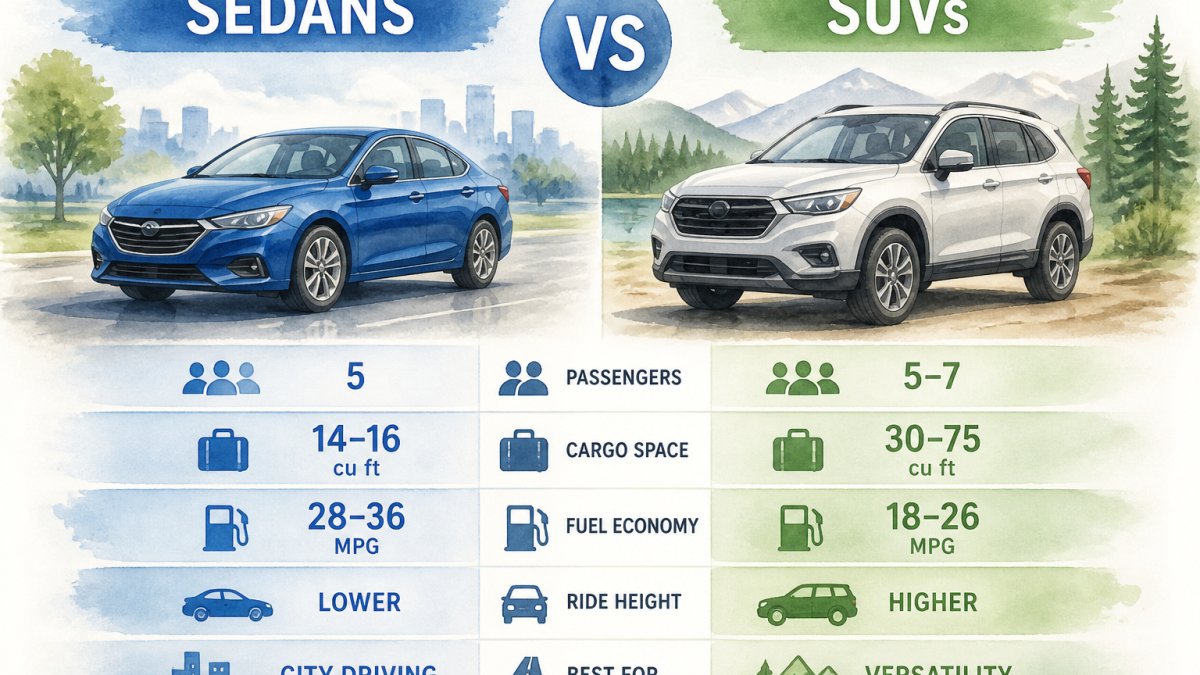
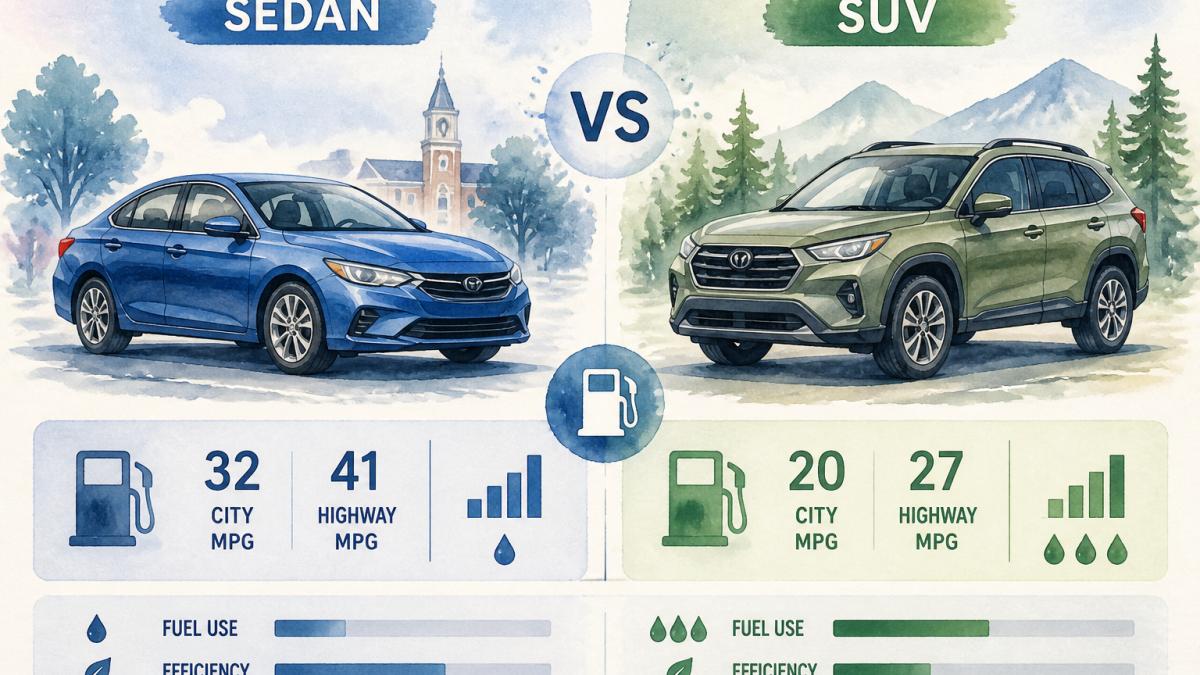
A sedan typically delivers 25-35 miles per gallon combined fuel economy, while a compact SUV averages 20-28 mpg. That difference adds up fast over a year of commuting between campus and home. At current fuel prices, that gap could mean saving hundreds annually with the right choice.
This guide breaks down the real costs of sedan versus SUV ownership for college students. We'll compare fuel efficiency, maintenance, insurance, and total cost of ownership so you can make the choice that actually fits your life and budget.
Why MPG Matters on a Student Budget
Fuel efficiency isn't just an environmental concern, it's a financial one. Miles per gallon directly affects how much you'll spend each month just to get to class and back home.
Consider this: if you drive 12,000 miles per year (typical for a college student), a sedan at 30 mpg costs roughly $1,200 in fuel annually. The same distance in an SUV at 23 mpg costs about $1,560. That's $360 per year, or $30 per month. Over four years of college, that's $1,440 you could have spent on textbooks, housing, or paying down student loans.
But fuel economy isn't the only cost factor. Insurance premiums, maintenance expenses, and resale value all shift when you choose a sedan over an SUV. The real question isn't "which gets better gas mileage?" but "which costs less to own overall?"
Best Used SUVs for Daily Commuting
If you need cargo space, whether for moving between dorm and home or hauling gear for weekend trips, an SUV delivers practical utility that sedans simply can't match. The trade-off is fuel efficiency, but some compact SUVs minimize that penalty.
2026 Toyota RAV4: Cargo Space Meets Practicality
It offers superior cargo capacity with a spacious interior that handles moving boxes, sports equipment, or a semester's worth of belongings. The available all-wheel drive provides traction in winter weather, important if you're driving in regions with snow.
The RAV4's fuel economy hovers around 23-28 mpg combined, depending on drivetrain and driving conditions. That's respectable for an SUV, though noticeably lower than hybrid sedans. Highway driving pushes efficiency higher; city traffic and frequent acceleration drop it lower.
Pros:
- Excellent cargo space for moving gear between home and campus
- High reliability scores and strong resale value
- Available all-wheel drive for weather versatility
- Comfortable for long drives home during breaks
Cons:
- Lower fuel efficiency compared to compact sedans
- Higher insurance premiums than similarly-priced sedans
- More expensive maintenance than compact cars
- Overkill for students who don't need the extra space
The RAV4 makes sense if you're regularly hauling items or driving in variable weather. For pure commuting between campus and class, the cargo advantage disappears.
Top Sedans for Fuel Savings
Sedans dominate the fuel-efficiency conversation for college students. Their aerodynamic design, lighter curb weight, and efficient engines combine to deliver exceptional gas mileage. Modern sedans also offer surprising interior space despite their compact footprint.
2026 Toyota Prius: Maximum Efficiency
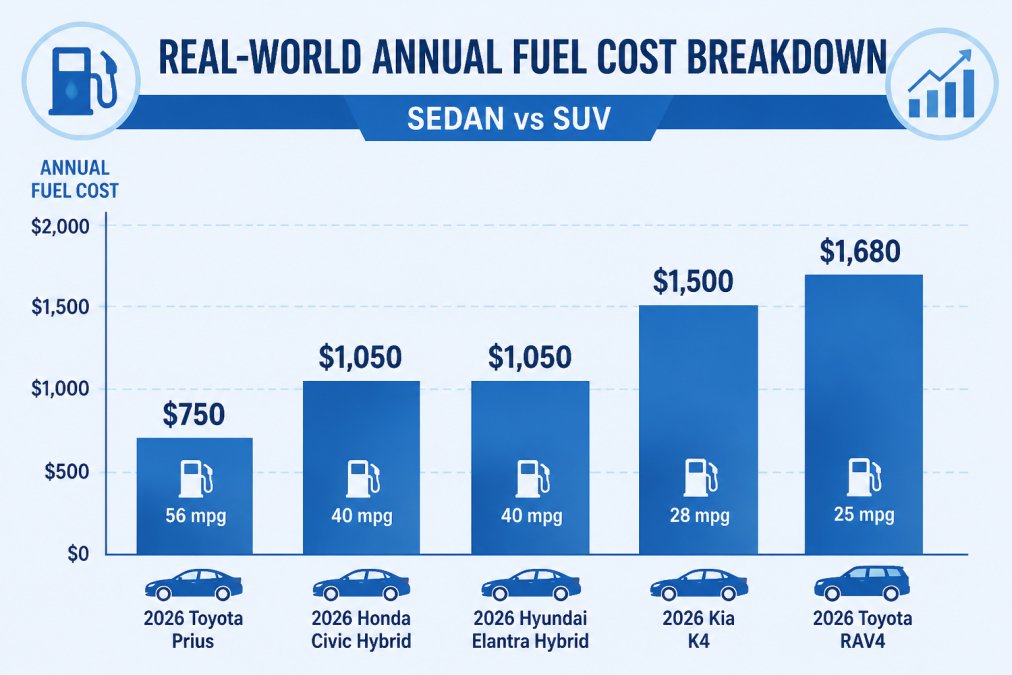
The Prius is the gold standard for fuel economy. Its hybrid powertrain combines a gasoline engine with electric motors to achieve an estimated 56+ mpg combined, nearly double what most compact SUVs deliver.
This efficiency translates directly to your wallet. At 12,000 annual miles, a Prius costs roughly $800 per year in fuel. Compare that to a RAV4at $1,600, and you're looking at annual savings of $800 just in gas. Over four years, that's $3,200 in your pocket.
The Prius often has lower insurance premiums than gas-only vehicles. Maintenance costs are moderate, though hybrid-specific repairs can be pricey if something goes wrong outside warranty.
Pros:
- Exceptional fuel economy (55+ mpg combined)
- Lowest annual fuel costs of any vehicle type
- High reliability and strong resale value
- Quiet, smooth driving experience
Cons:
- Limited cargo space compared to SUVs
- Compact interior feels tight for taller drivers
- Higher upfront cost than non-hybrid sedans
- Hybrid battery replacement is expensive if needed after warranty
The Prius is the right choice if your priority is minimizing fuel costs and you don't need serious cargo space.
2026 Honda Civic Hybrid and Hyundai Elantra: Balanced Options
The Honda Civic Hybrid delivers 40-45 mpg combined with better interior space and driving dynamics than the Prius. It feels more like a "normal" car while still delivering exceptional efficiency. The agile handling makes city driving and tight campus parking easier than bulkier vehicles.
The Hyundai Elantra offers an available hybrid trim that achieves 40+ mpg combined. It's newer to the hybrid market but delivers competitive efficiency with strong warranty coverage, important for college students who can't afford surprise repairs. The Elantra also includes modern tech features and a user-friendly infotainment system that students appreciate.
Both vehicles split the difference between maximum efficiency and practical usability. They're more spacious than a Prius, more efficient than a standard sedan, and less expensive than some premium alternatives.
Honda Civic Hybrid Pros:
- Excellent fuel efficiency (40-45 mpg combined)
- High resale value and reliability
- Agile handling for city driving
- Quality interior materials
Hyundai Elantra Pros:
- Competitive fuel economy (40+ mpg hybrid)
- Comprehensive warranty coverage
- Modern tech integration and infotainment
- Lower purchase price than Civic
Cons (both):
- Less cargo space than non-hybrid sedans
- Hybrid systems add complexity
- Higher initial cost than gas-only models
2026 Kia K4: Modern Sedan Value
The K4 is Kia's entry-level compact sedan, designed specifically for budget-conscious buyers. It delivers solid fuel economy around 28-32 mpg combined with a modern exterior design and updated safety technology that appeals to younger drivers.
The K4 won't match the Prius's efficiency, but it costs significantly less upfront. For students who can't afford a $30,000+ vehicle, the K4 offers a practical balance of affordability and reasonable fuel economy. The 4-cylinder engine is simple, reliable, and inexpensive to maintain.
Pros:
- Good fuel economy for a non-hybrid sedan
- Modern styling and tech features
- Lower purchase price than hybrid competitors
- User-friendly digital dashboard
- Strong warranty coverage
Cons:
- Lower fuel efficiency than hybrid sedans
- Limited cargo space due to sedan design
- Smaller interior than some competitors
- Less established resale value than Toyota or Honda
The K4 works if your budget is tight and you need reliable transportation without premium pricing.
How to Calculate Cost Per Mile for a Vehicle
Fuel efficiency tells only part of the story.
Here's the formula:
Total Annual Cost ÷ Annual Miles Driven = Cost Per Mile
Start by estimating your total annual ownership cost:
- Fuel: (annual miles ÷ mpg) × current fuel price
- Insurance: your actual premium (call for quotes)
- Maintenance: typically $500-1,500 per year depending on vehicle age
- Depreciation: (purchase price - expected resale value) ÷ years owned
Example calculation for a Prius:
- Fuel: (12,000 ÷ 56) × $3.50 = $750
- Insurance: $1,200 per year (estimate)
- Maintenance: $600 per year
- Depreciation: ($24,000 - $18,000) ÷ 5 years = $1,200 per year
- Total: $3,750 ÷ 12,000 miles = $0.31 per mile
Same calculation for a RAV4:
- Fuel: (12,000 ÷ 25) × $3.50 = $1,680
- Insurance: $1,400 per year (higher for SUV)
- Maintenance: $800 per year
- Depreciation: ($28,000 - $20,000) ÷ 5 years = $1,600 per year
- Total: $5,480 ÷ 12,000 miles = $0.46 per mile
Sedan vs SUV Maintenance Costs
Sedans and SUVs differ significantly in maintenance expenses, and this gap matters more than many students realize.
Real-World Annual Fuel Cost Breakdown
Which Vehicle Type Wins for College Students
For most college students, a sedan wins on pure economics. The fuel efficiency advantage, combined with lower insurance and maintenance costs, creates a compelling financial case.
Frequently Asked Questions
Do sedans get better MPG than SUVs?
Yes. Sedans typically achieve 25-35 MPG combined fuel economy, while compact SUVs range from 20-28 MPG. The difference stems from aerodynamic design and lower curb weight in sedans. Hybrid sedans like the Prius can exceed 50 MPG combined. For college students driving 12,000-15,000 miles annually, this translates to $400-600 in annual fuel savings with a sedan.
What is the best SUV for a college student?
The 2026 Toyota RAV4 balances practicality with reasonable fuel efficiency for students needing cargo space. It offers 26-28 MPG combined, all-wheel drive capability, and the reliability to handle frequent moves between campus and home. However, if fuel savings are your priority, a compact sedan like the Prius delivers superior economy at a lower total cost of ownership.
How does vehicle weight impact fuel efficiency for daily commuting?
Heavier vehicles require more engine power to accelerate and maintain speed, reducing fuel efficiency. A compact sedan (2,800-3,200 lbs) uses less fuel than an SUV (3,500-4,200 lbs) on identical routes. For urban traffic and campus commuting, lighter sedans navigate congestion more efficiently and recover fuel lost during frequent stop-and-go driving faster than heavier SUVs.
Are hybrid SUVs a cost-effective choice for students?
Hybrid SUVs improve efficiency but still trail hybrid sedans. A hybrid SUV might achieve 30-32 MPG combined versus 50+ MPG for a hybrid sedan. The upfront cost premium for hybrid technology ($2,000-4,000 more) takes 5-7 years to recoup through fuel savings alone. For students with short ownership timelines, a standard sedan or non-hybrid SUV often delivers better value.