 comparison
Sedans vs SUVs for Small Families: What Fits Your Life
Last Updated: October 23, 2026
Quick Summary
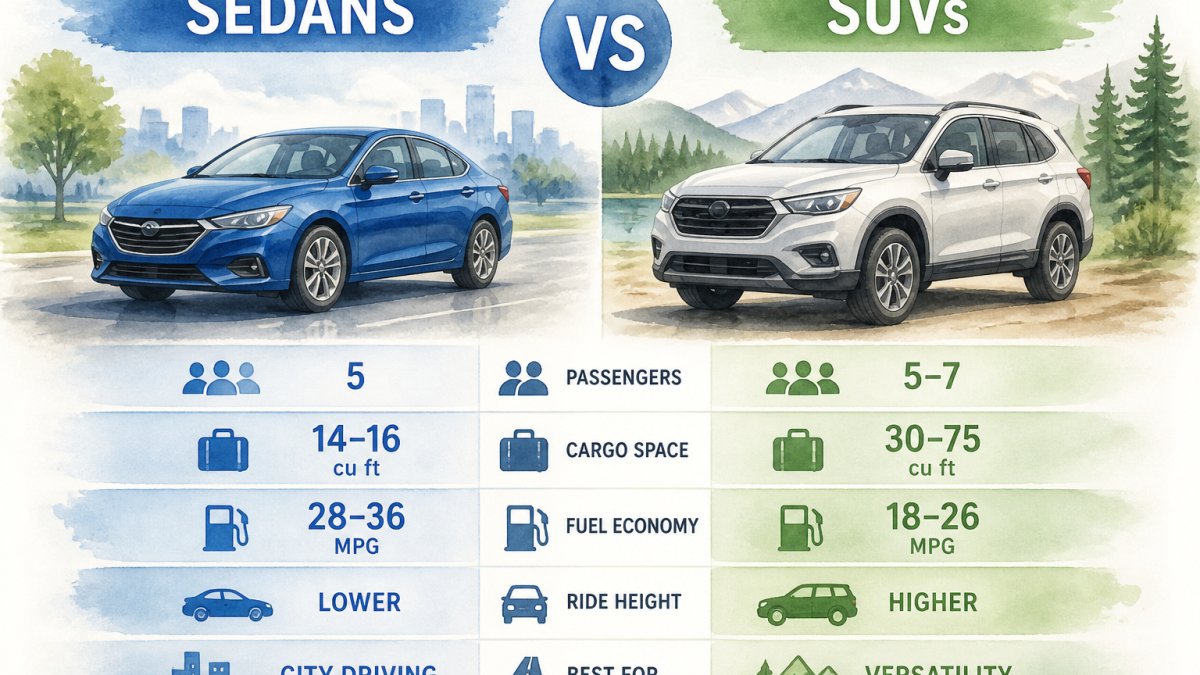
Sedans vs SUVs for small families comes down to one trade-off: sedans win on fuel economy, handling, and rear-seat child-seat fit, while SUVs win on ride height, cargo flexibility, and all-weather capability. The right body style depends on your stroller, your driveway, and how often you actually haul more than groceries.
- A compact SUV with a short rear bench can be tighter for a rear-facing car seat than a midsize sedan.
- Do a five-minute gear test on the test drive with your folded stroller, diaper bag, and groceries.
- Compare each vehicle's crash-test ratings and standard crash-avoidance features rather than assuming the SUV is safer.
- Taller SUVs often mean larger tires that cost more to replace, and all-wheel drive adds a maintenance item.
- Sedans are easier to park and place in a tight garage, while SUVs offer a higher hip point for loading.
Table of Contents
- Sedans vs SUVs for Small Families: The Quick Comparison
- Car Seat Fit in Sedan vs SUV: What Parents Need to Know
- Sedan vs SUV Cargo Space: Strollers, Groceries, and Real Family Gear
- Sedan vs SUV Safety: Crash Protection, Visibility, and Ride Height
- Sedan vs SUV Fuel Economy and Running Costs
- Everyday Practicality: Parking, Entry, and Passenger Comfort
- Which Is Right for Your Small Family? A Decision Framework
- Frequently Asked Questions
Sedans vs SUVs for Small Families: The Quick Comparison
Sedans vs SUVs for small families comes down to one trade-off: sedans win on fuel economy, handling, and rear-seat child-seat fit, while SUVs win on ride height, cargo flexibility, and all-weather capability. The right body style depends on your stroller, your driveway, and how often you actually haul more than groceries.
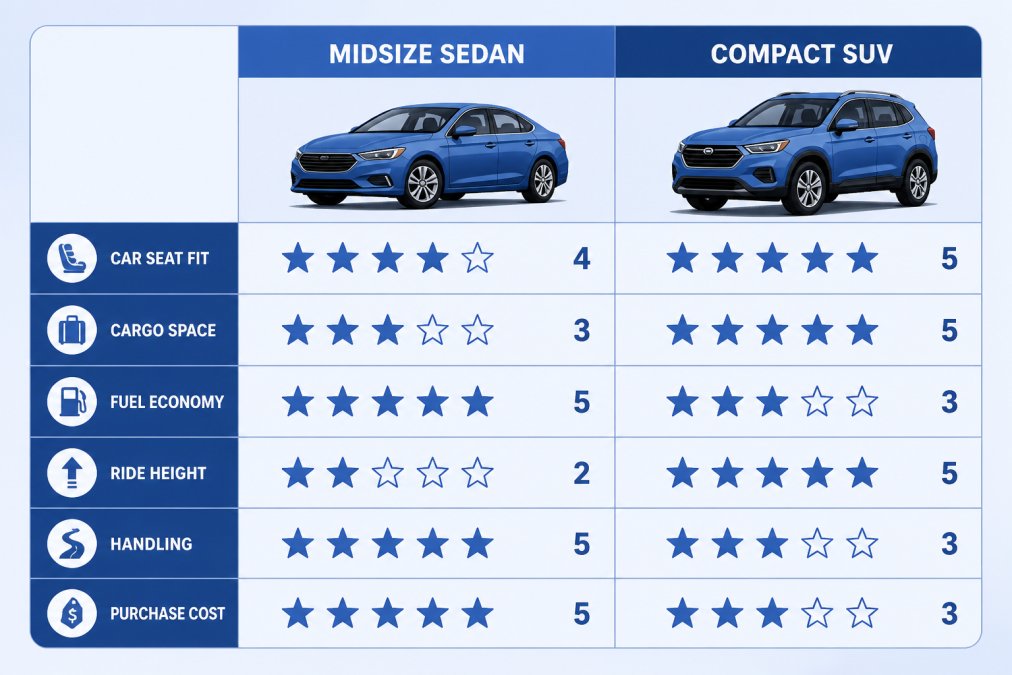
Here is the fast version before we dig in:
| Category | Sedan | Compact SUV | Edge |
|---|---|---|---|
| Rear-facing car seat fit | Lower, flatter seat cushions | Higher, deeper bench | Sedan |
| Cargo behind rear seats | Enclosed trunk, lower load height | Taller hatch opening | SUV |
| Fuel economy | Better aerodynamics, lighter | Heavier, taller frontal area | Sedan |
| Ride height and entry | Lower step-in | Higher hip point | SUV |
| Handling and parking | Tighter turning, easier to place | More body roll, taller sightline | Sedan |
| Purchase cost | Generally lower | Generally higher | Sedan |
Car Seat Fit in Sedan vs SUV: What Parents Need to Know
Car seat fit in a sedan vs SUV is less about the body style and more about the specific rear bench. A rear-facing car seat needs a flat, firm cushion and enough front-seat travel to keep the seat off the front passenger's knees.
SUVs raise the bench, which helps your back when you lift a toddler in. That same height can work against you: deeper cushions and a taller seatback sometimes push a rear-facing seat forward. Measure before you commit.
- Check the NHTSA car seat installation guidance for the current recommendation on rear-facing limits and tether use.
- Look for lower anchor access that is not buried under stiff seat foam.
- Confirm the front passenger seat still has usable legroom with the infant seat installed behind it.
Sedan vs SUV Cargo Space: Strollers, Groceries, and Real Family Gear
Sedan vs SUV cargo space is usually decided on the spec sheet, where the SUV wins by a wide margin.
Start with the distinction that spec sheets hide.
Here is how common small-family gear tends to load in each body style. Treat these as patterns to verify with your own gear on a test drive, not as guarantees for a specific model.
- Full-size stroller (folded flat): Fits in most midsize sedan trunks, often with room for a diaper bag beside it. In a compact SUV it drops in upright through the hatch, which is faster and easier on your back.
- Jogging stroller or double stroller: The awkward one. Its folded footprint is long and bulky, and a sedan trunk may require removing a wheel or angling it diagonally. A compact SUV's taller opening usually swallows it without disassembly.
- Pack-and-play or travel crib: Fits in a sedan trunk if laid flat, but it eats most of the length. In an SUV it stands upright against the seatback and leaves floor space free.
- Weekly grocery run: A sedan trunk holds a full cart of bags and hides them under the parcel shelf. An SUV holds more, but bags slide on the flat floor and are visible through the glass unless you add a cargo cover or a collapsible bin.
- Airport run with luggage: Two large checked bags plus a carry-on fit in a midsize sedan trunk. The same load fits in a compact SUV with room to spare, and the taller opening makes lifting heavy bags easier.
- Bulk-box store run: This is where the SUV's height pays off. Tall boxes and multipacks stack vertically instead of being wedged under a trunk lip.
A few mechanisms explain most of the difference. The sedan's low load lip is harder on your back but keeps cargo enclosed and the cabin quieter.
One more practical point: the sedan's enclosed trunk keeps purchases out of sight, which matters in apartment and street parking. If visibility and security are priorities, a sedan trunk plus a fold-down rear seat for occasional bulky items can cover most small-family needs. If you routinely haul strollers, cribs, or bulk goods, the SUV's opening and height are the difference between a quick load and a wrestling match.
Sedan vs SUV Safety: Crash Protection, Visibility, and Ride Height
Sedan vs SUV safety is where intuition and evidence diverge most. The common assumption is that the bigger, taller vehicle is automatically safer.
Start with the ratings. Both body styles are tested against the same front, side, and roof-strength standards, and the IIHS vehicle ratings and the NHTSA New Car Assessment Program publish results by vehicle, not by body style.
Where body style does matter is physics.
Visibility is a wash in the ways that matter. SUVs see farther ahead over traffic. Sedans see better directly behind and have smaller blind spots at the rear corners.
Active safety is the area where the playing field is most level, and where families should focus.
Child-passenger safety deserves its own note. The NHTSA car seat guidance recommends keeping children in rear-facing seats as long as the seat allows, then forward-facing with a tether, then a booster, then the seat belt.
For a small family, the practical approach is to shortlist vehicles in both body styles, check their ratings and standard safety features, and then install your actual car seat in each one. The vehicle that lets you get a tight, correct install and has the crash-avoidance tech you want is the safer choice, regardless of whether it has a trunk or a hatch.
Sedan vs SUV Fuel Economy and Running Costs
Sedan vs SUV fuel economy tilts toward the sedan, and it compounds over years of school runs and commutes. A lighter, lower sedan cuts through air with less drag.
Running costs go beyond the pump. Taller SUVs often mean larger tires, which cost more to replace. All-wheel drive, common on SUVs, adds a maintenance item and slightly more drag.
For a family watching the monthly budget, the sedan's lower fuel and tire costs free up real money. You can also explore ways to lower your used car monthly payment.
Everyday Practicality: Parking, Entry, and Passenger Comfort
Everyday practicality splits cleanly. Sedans are easier to park, easier to place in a tight garage, and easier to maneuver in a crowded lot.
SUVs win on entry height for most adults, who slide in at hip level instead of dropping down. The taller cabin gives rear passengers more headroom. Five seats is standard for both, so seating capacity is not the differentiator.
Ride quality favors the sedan on smooth pavement. The SUV's longer suspension travel soaks up rough roads better. If your daily drive includes broken pavement or winter weather, that matters.
Which Is Right for Your Small Family? A Decision Framework
Use this framework to settle it. Answer each question honestly.
- Do you install a rear-facing car seat and keep it in for another year or more? Lean sedan, then verify fit with your seat. If you settle on a sedan, see our used sedan buyer's guide.
- Do you haul a stroller, pack-and-play, or bulk groceries weekly? Lean SUV. If the framework points you to an SUV, browse our reliable used SUV picks.
- Is most of your driving commuting and school runs on paved roads? Lean sedan.
- Do you face snow, steep driveways, or unpaved roads regularly? Lean SUV with all-wheel drive.
- Is parking tight at home or work? Lean sedan.
- Does a parent with back or knee issues do most of the loading? Lean SUV for the higher hip point.
Frequently Asked Questions
Is a sedan or SUV better for installing car seats?
Sedans often have an edge for rear-facing car seat fit because their lower ride height makes it easier to lift a child in and out, and the rear seat cushion angle can help the seat sit flush. SUVs offer more headroom for taller seats and easier access through taller door openings. The deciding factor is usually the specific vehicle's rear legroom and seat cushion depth, so test-install your car seat in any used sedan or SUV before you buy.
Which has more cargo space, a sedan or a small SUV?
A compact SUV typically offers more cargo volume behind the second row and a taller, more square opening that swallows strollers and bulky boxes. A midsize sedan's trunk is longer and flatter, which works well for groceries and luggage but can struggle with tall items. If you regularly haul a stroller plus a week of groceries, the small SUV's shape usually wins on sedan vs SUV cargo space.
Is a small SUV safer than a sedan?
Neither body style is automatically safer. Modern sedans and compact SUVs both earn top marks from the Insurance Institute for Highway Safety and the National Highway Traffic Safety Administration when equipped with standard crash-avoidance features. SUVs sit higher and weigh more, which can help in a collision with a smaller car, but they also roll over more easily. On sedan vs SUV safety, check the specific model's ratings and standard driver-assist features rather than the body style alone.
Which is cheaper to own, a sedan or a small SUV?
A sedan usually costs less to buy, insure, and fuel. Its lower weight and smaller frontal area give it better sedan vs SUV fuel economy, often 3 to 6 mpg more in combined driving. Tires and some maintenance items also cost less on a sedan. A small SUV can hold value slightly better in some segments, but for a budget-conscious family the sedan's lower purchase price and running costs typically add up to thousands of dollars saved over five years.
Do small SUVs get better visibility than sedans?
It depends on the model. SUVs offer a higher seating position that lets you see over traffic, which many drivers find reassuring. However, thicker pillars and a taller rear window can create blind spots. Sedans sit lower but often have a more open view of the road ahead and easier rear visibility when reversing. Test-drive both and check blind spots with the mirrors set for your seating position before deciding.
The real question is not which body style is better in general, but which one fits your specific car seat, your parking situation, and your weekly haul. At AutoSport USA, we stock both sedans and SUVs and can help you install your own car seat in a candidate vehicle before you decide. Our online financing tools and trade-in valuations make it easy to see your real numbers up front. Get started with AutoSport USA and find the vehicle that fits your family's actual life.