 how-to
7 Steps to Check a Used Car Before You Buy
Last Updated: October 31, 2026
Quick Summary
To check a used car before buying, verify the VIN matches the title and paperwork, then review a vehicle history report for accidents and title issues. Next, inspect the exterior, interior and tires, test drive the car on roads you normally use, and consider a professional inspection before you buy.
- Confirm the 17-character VIN matches the title and sales paperwork.
- Review a history report from CARFAX or AutoCheck for accidents and title brands.
- Use the penny test to check tire tread depth in the groove.
- Test drive for at least 15 to 20 minutes, covering local streets and highway.
- Get an independent pre-purchase inspection, especially for cars sold as is.
Table of Contents
- Why a Used Car Check Matters Before You Buy
- Verify the VIN and Review the Vehicle History Report
- Run a Used Car Inspection Checklist on the Exterior and Interior
- Follow a Used Car Test Drive Checklist
- When to Get a Used Car Pre-Purchase Inspection
- Warning Signs That Mean Walk Away
- Scheduling Your Next Step at Silverton Motors
- Frequently Asked Questions
Why a Used Car Check Matters Before You Buy
Checking a used car before you buy it can help you avoid costly surprises. A used car has already lived a life, and some of that history is hidden behind a clean paint job.
Most buyers focus on price and mileage. Those matter, but they only tell part of the story.
A quick check helps you spot problems early. It also gives you a clear list of questions to ask the seller or dealer. That puts you in a stronger position when you talk about price.
- Confirm the vehicle matches the paperwork
- Review the history report for accidents and title issues
- Inspect the outside, inside, and under the car
- Test drive the car on roads you normally use
- Decide whether a professional inspection is worth the cost
Verify the VIN and Review the Vehicle History Report
Start with the vehicle identification number, or VIN. It is a 17-character code that identifies a specific vehicle.
Check that the VIN on the car matches the title and the sales paperwork.
Next, run a vehicle history report. Two popular options are CARFAX and AutoCheck. For a side-by-side look at how they compare, read our CARFAX vs AutoCheck: Accident History Comparison guide.
Look closely at these items in the report:
- Title status: Salvage, flood, or rebuilt titles signal major past damage
- Accident history: Note the number, severity, and whether airbags deployed
- Odometer records: Watch for gaps or readings that go backward
- Service records: Regular maintenance is a good sign
- Ownership history: Frequent owner changes can point to hidden problems
A history report is not a full inspection. Many accidents never get reported, so use the report as one tool among several.
Run a Used Car Inspection Checklist on the Exterior and Interior
Walk around the car in good daylight. Look for dents, scratches, and rust, especially in the wheel wells and along the bottom of the doors. Check for paint that does not quite match from one panel to the next.
Once you have looked over the outside, move to the interior. Check the seats, carpet, headliner, and door panels for wear, stains, or water damage. A musty smell or damp carpet can point to a leak or flood damage.
Test every button and switch. Try the windows, locks, air conditioning, heat, radio, and lights. Small electrical issues can be expensive to fix.
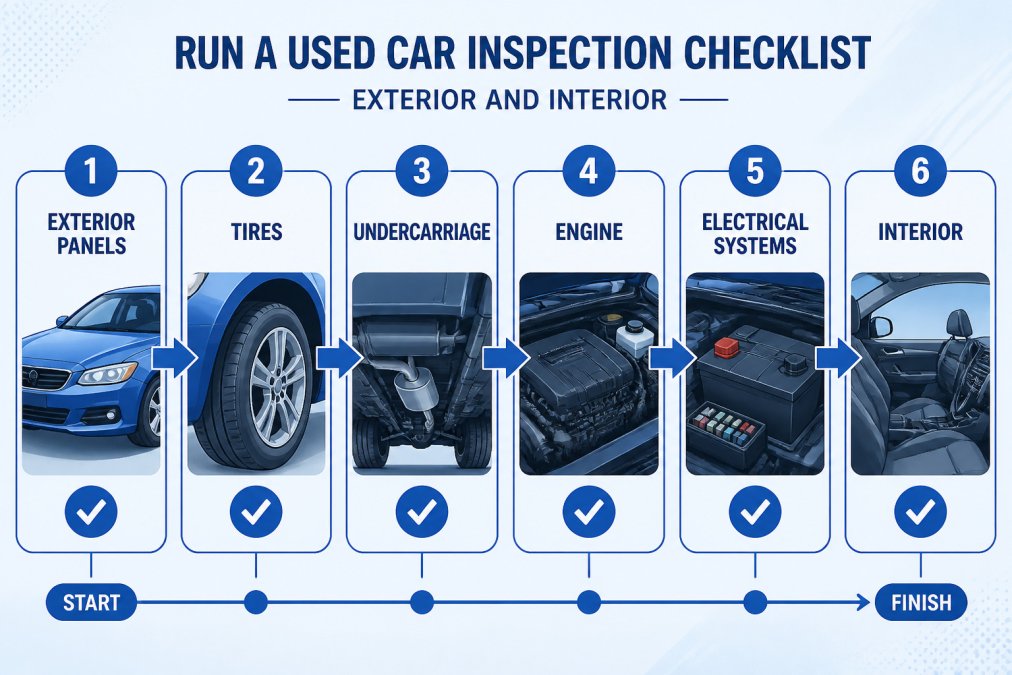
A used car inspection checklist covers the most important items:
- Body panels and paint match across the car
- No rust on the frame, floor pans, or wheel wells
- Glass has no cracks or chips that block vision
- Seats, carpets, and headliner look clean and dry
- All lights, windows, locks, and climate controls work
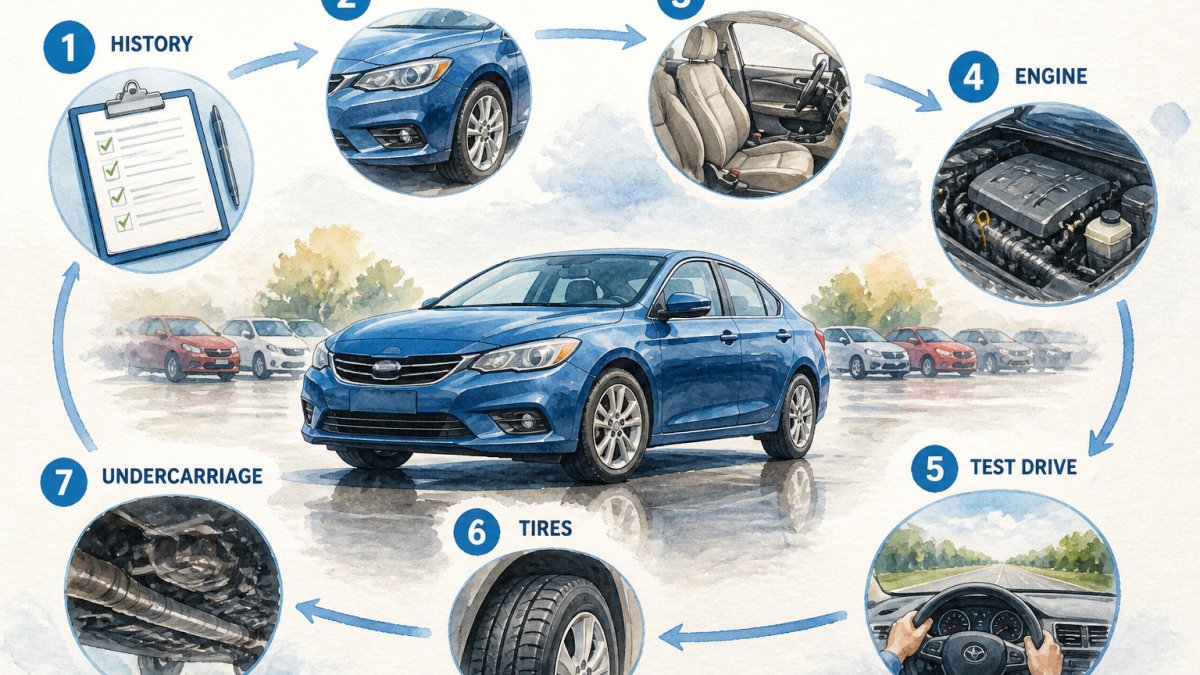
Here is an infographic to help you remember the steps:
Tires, Tread Depth and Uneven Wear
Tires tell you a lot about how a car has been driven and maintained. Check the tread depth on each tire. You can use a penny test: place a penny upside down in the groove.
Look for uneven wear across the tread. Wear on only one edge can point to alignment problems. Wear in the center may mean the tires were overinflated. Cupping or scalloped patterns can suggest worn suspension parts.
Also check the tire brand and age. Tires older than six years may need replacing, even if the tread looks fine.
Oil, Dashboard Warning Lights and OBD-II Scans
Pull the dipstick and check the oil level and color. Clean, amber oil is a good sign. Dark, gritty oil may mean maintenance was skipped.
Start the engine and watch the dashboard. All warning lights should come on briefly and then turn off. If a light stays on, ask why before you buy.
A basic OBD-II scan can reveal stored trouble codes. Many auto parts stores offer free code reading, and an independent mechanic can run a deeper scan. Codes can reveal problems that the dashboard does not show.
Follow a Used Car Test Drive Checklist
A test drive is the only part of the check where you feel how the car actually behaves. Plan a route that lets you test the systems that matter, and keep the radio off so you can hear the car. Aim for at least 15 to 20 minutes and cover four phases: a cold start, local streets, a highway stretch, and a return to the lot.
Before you move: the cold start
Ask the seller not to warm up the car before you arrive. A cold start reveals more than a warm one. Listen for a fast, uneven idle, a puff of blue or white smoke, or a check-engine light that stays on. Let the engine idle for a minute and watch the temperature gauge climb normally.
Phase 1: local streets (0-35 mph)
Start on quiet residential or side streets. This is where you test low-speed behavior:
- Steering: Make full left and right turns in a parking lot. Listen for clicks, groans, or a whine that changes with engine speed.
- Brakes: At low speed, brake gently and firmly. The pedal should feel firm, not spongy, and the car should stop straight without pulling.
- Transmission: In an automatic, accelerate smoothly and feel for hesitation between gears. In a manual, shift through the gears and check that the clutch engages without slipping or chatter.
- Suspension: Drive over a speed bump or rough patch. You should hear one clean thump, not rattles or clunks.
Phase 2: highway (55-70 mph)
Merge onto a highway and hold a steady speed. This phase exposes problems that low-speed driving hides:
- Vibration: A shake in the steering wheel often points to wheel balance or alignment; a shake in the seat points to driveline or tire issues.
- Tracking: The car should hold a straight line without constant correction. Pulling can mean alignment or brake drag.
- Overdrive and passing: Accelerate from about 45 to 65 mph. The transmission should downshift smoothly without slipping or flaring.
- Wind and road noise: Some noise is normal, but whistling or roaring can mean worn weatherstripping or wheel bearings.
Phase 3: return and shutdown
Pull back into the lot and let the car idle for a minute before shutting it off. Check for new warning lights, a hot or burning smell, or smoke. Look under the car for fresh drips. Then restart the engine warm; a warm restart that struggles can point to a fuel or ignition issue.
The article breaks the test drive into phases, each with specific things to check.
| Phase | What to check | Speed or timing |
|---|---|---|
| Cold start | Idle, smoke, check-engine light | Before moving |
| Local streets | Steering, brakes, transmission, suspension | 0-35 mph |
| Highway | Vibration, tracking, overdrive, noise | 55-70 mph |
| Return and shutdown | Warning lights, smells, drips, warm restart | After 15-20 min drive |
When to Get a Used Car Pre-Purchase Inspection
A pre-purchase inspection (PPI) by an independent mechanic is the single best protection you can buy. The mechanic puts the car on a lift, checks the engine and transmission, measures brake and tire wear, and scans for diagnostic trouble codes.
When a PPI is essential
Get an independent inspection when any of these apply:
- The car is sold as is, with no warranty
- The model is older or has high mileage
- The seller will not let you take the car to your own mechanic
- The history report shows accidents, title brands, or gaps
- You plan to finance the car or keep it for many years
How to use the report to prioritize repairs
Ask the mechanic for a written report that separates findings into three tiers:
- Safety and drivability: Brakes, tires, steering, suspension, and warning lights. These are must-fix items.
- Major mechanical: Engine, transmission, and cooling system. These are expensive and can affect reliability.
- Cosmetic and convenience: Paint, trim, and minor electrical items. These are negotiable.
A common pattern is that a PPI turns up several small items and one or two larger ones. Use the tiers to decide what you can live with and what you cannot.
Turning findings into a negotiation
Bring the written report to the seller. Ask for the repair estimate in writing, then use it as a basis for the price. You have three options: ask the seller to fix the safety items before purchase, ask for a price reduction equal to the repair estimate, or walk away if the seller will not budge on a major issue.
Warning Signs That Mean Walk Away
Some problems are not worth the risk. Walk away if you notice any of these:
- The VIN does not match the title or paperwork
- The title is branded salvage, flood, or rebuilt
- The seller will not allow an independent inspection
- You see milky oil or thick smoke from the exhaust
- The car has a strong smell of mildew or smoke
- The history report shows major, unrepaired damage
- The price seems too good to be true
Trust your gut. If something feels wrong, it probably is.
Scheduling Your Next Step at Silverton Motors
Once you have checked the car, you are ready for the next step.
Apply online to get started.
Frequently Asked Questions
How do you inspect a used car before buying it?
Start with the VIN and a vehicle history report, then walk around the car looking for uneven panel gaps, mismatched paint, rust and uneven tire wear. Open the hood to check the oil level and condition, look for leaks and inspect belts and hoses. Inside, test the electrical systems, confirm the dashboard warning lights behave normally at startup, and check the odometer against the service records. Finish with a test drive on a route that includes highway speeds, stops and turns, then decide whether to pay for a professional pre-purchase inspection.
What should you check during a used car test drive?
Listen for knocking, squealing or grinding, and notice whether the engine idles smoothly. Test the brakes at moderate speed to see whether the car pulls to one side or pulses. Drive over a few bumps to check the suspension, and make sure the steering feels centered and responsive. Shift through every gear and watch for hesitation or slipping. Keep an eye on the dashboard, and note any warning lights that stay on after the engine is running.
Should you get a used car inspected by a mechanic before buying?
Yes, a pre-purchase inspection by an independent mechanic is one of the most useful steps a buyer can take. A mechanic who has no stake in the sale can put the car on a lift, look at the undercarriage, scan the onboard computer for diagnostic trouble codes and spot problems that are easy to miss in a driveway. The cost varies by shop and region, so ask for a written list of findings before you commit to the purchase.
How can you check a used car's history and title?
Use the vehicle identification number to pull a vehicle history report, which can show title status, reported accidents, service records and past ownership. Compare the odometer reading on the report to the reading on the dashboard, and look for gaps or inconsistencies. Check that the title matches the seller's name and that no brands such as salvage or flood appear. If something does not add up, ask the seller for documentation or walk away.