 how-to
How to Get Used Car Financing After a Bank Denial
Last Updated: October 29, 2026
Quick Summary
After a bank denial, first get the specific reason in writing and pull your free credit reports from all three bureaus. Then fix the matching problem, such as disputing errors or lowering your debt-to-income ratio, and prequalify with a few lenders inside a short window. Used car financing is still available through credit unions, alternative lenders, and dealer financing.
- Ask for the adverse-action notice, which generally explains the main reasons for the denial.
- Get free credit reports from AnnualCreditReport.com and dispute any factual errors you find.
- Prequalify with soft pulls first, then submit formal applications within a two-week window.
- Compare total loan cost by multiplying the monthly payment by the number of months, then adding the down payment.
- Watch for buy-here-pay-here warning signs like same-day pressure and refusal to state total cost.
Table of Contents
- Why a Bank Denied Your Auto Loan
- Car Loan Denied: What to Do in the First 72 Hours
- How to Shop for Another Loan Without Hurting Your Credit
- Used Car Financing Options After a Bank Denial
- How to Improve Your Chances of Car Loan Approval
- Car Loan With a Co-Signer: When It Helps and When It Hurts
- Compare Total Loan Cost and Book Your Next Step at Silverton Motors
- Frequently Asked Questions
Why a Bank Denied Your Auto Loan
Getting turned down by a bank feels personal. It usually isn't. Lenders deny auto loans for a handful of specific, fixable reasons, and knowing which one applies to you is the first step toward used car financing after a bank denial.
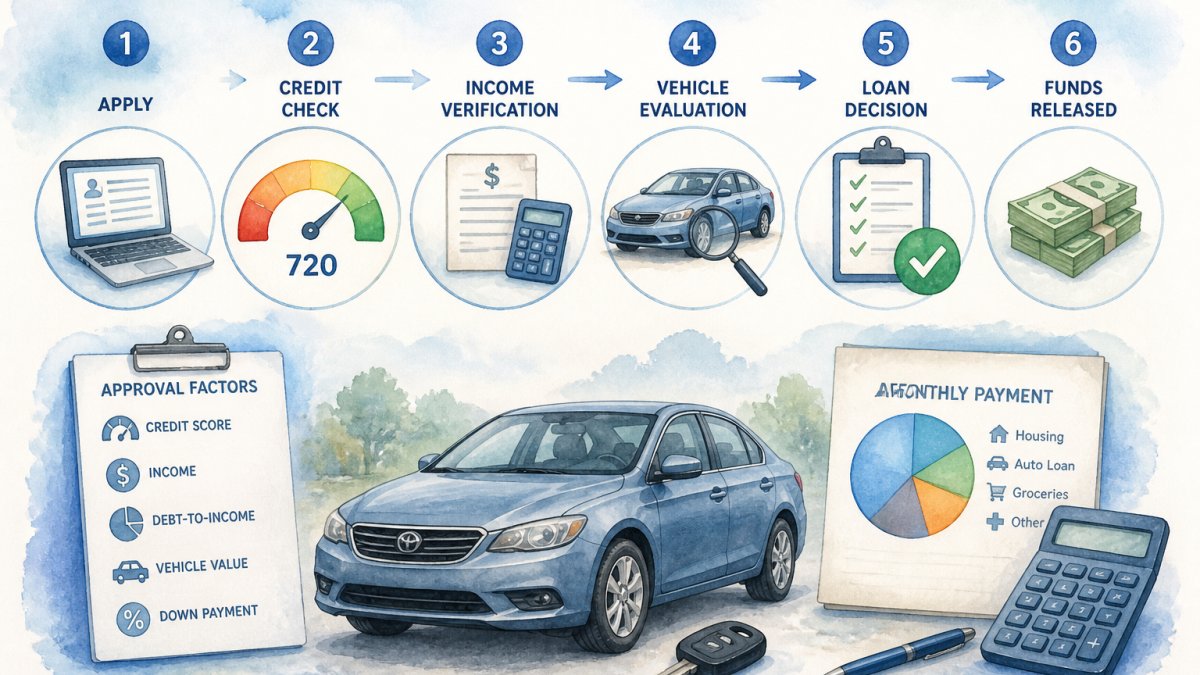
Most denials come down to two things: your credit profile or your ability to repay. Banks look at both before they approve a loan.
Credit score and credit history problems
Your credit score is a quick summary of how you have handled debt. Lenders also review your full credit history and payment record to see patterns, not just the number.
A common surprise is multiple recent applications. Each hard credit inquiry can lower your score a little, and several in a short span can make a lender nervous.
Debt-to-income ratio and income verification
Lenders compare your monthly debts to your monthly income. This is your debt-to-income ratio. If your current debts already take up a large share of your paycheck, a new car payment may look too risky.
Income verification matters too. If your pay stubs, employment history, or stated income do not match what the lender can confirm, the application stalls or gets denied.
Car Loan Denied: What to Do in the First 72 Hours
A denial is not the end of the road, but the order in which you act matters. Most people either reapply immediately at the next lot or give up for a month.
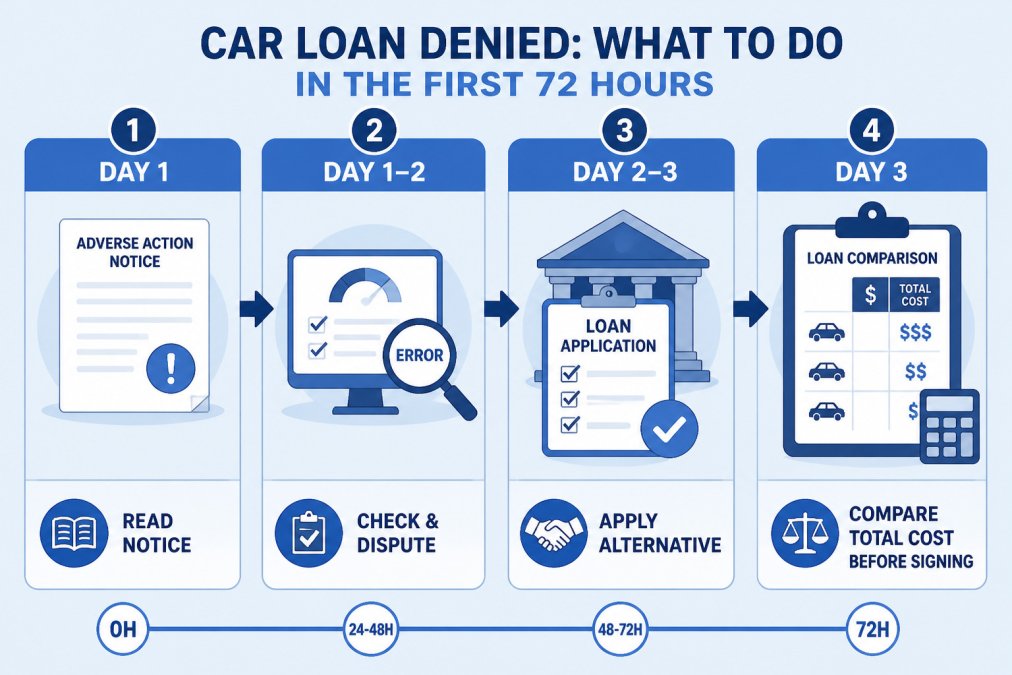
Here's the short answer: In the first 24 hours, get the denial in writing and pull your credit reports.
!Flowchart of the first 72 hours after a car loan denial
Hours 0-24: Get the reason in writing and pull your reports
Under federal law, a lender that denies your application generally must send an adverse-action notice explaining the main reasons. Ask for the reasons in writing if you were told them only orally.
At the same time, request your free credit reports from each of the three major bureaus at AnnualCreditReport.com. You are entitled to free reports, and you want all three because lenders do not all report to or pull from the same bureau.
Hours 24-48: Match the fix to the reason
The right remedy depends on why you were denied, so use the notice to pick your path:
- Credit score or negative history: Dispute any factual errors you found on your reports before applying again. A wrong late payment or an account that is not yours can be removed, and that can change a decision.
- Debt-to-income ratio: Pay down a credit card balance or two and gather proof of any income the lender did not count, such as side work or a recent raise. A lower ratio changes how the same payment looks on paper.
- Income verification: Collect recent pay stubs, bank statements, and proof of residence so the next application does not stall on paperwork.
- Vehicle value or loan-to-value: The car may be the problem, not you. An older or higher-mileage vehicle can be harder to finance. A larger down payment or a less expensive vehicle lowers the lender's risk.
- Too many recent inquiries: Stop applying for a few weeks and use prequalification tools, which typically use a soft pull, until your file settles.
Hours 48-72: Prequalify before you apply
Once you know the reason and have started the fix, line up prequalifications from two or three lenders that fit your profile, a credit union, an online lender, and possibly dealer-arranged financing. Prequalification generally uses a soft inquiry, so you can compare offers before committing to a formal application.
Read the adverse-action notice closely
When a lender turns you down, read any adverse-action notice closely. It explains the main reasons, such as a low score or too much existing debt.
Write down each reason. Each one points to a specific fix, and you will use this list when you shop for another loan.
Pull your credit reports and check for errors
You are entitled to free credit reports from each of the three major bureaus. Visit AnnualCreditReport.com to get them. Look for accounts you do not recognize, wrong balances, or payments marked late that you paid on time.
If you find an error, dispute it with the bureau in writing. Fixing a real mistake can change the outcome of your next application.
How to Shop for Another Loan Without Hurting Your Credit
Applying everywhere at once is a common mistake. Each formal application can trigger a hard inquiry, and several in a short span can make a lender nervous. But you also do not want to apply one lender at a time over several weeks, that stretches your inquiries across multiple scoring periods and gives you no clean comparison.
Soft pulls versus hard pulls
A soft inquiry happens when you check your own credit, use a prequalification tool, or a lender reviews your file for a preapproved offer. Soft pulls do not affect your score. A hard inquiry happens when you submit a formal application and authorize the lender to pull your full report.
That distinction is the whole game. Use soft-pull prequalification to narrow the field, then spend your hard inquiries only on the offers worth pursuing.
Use the rate-shopping window correctly
Scoring models generally treat multiple auto loan inquiries within a short window as a single inquiry, because the models recognize that you are shopping for one loan rather than opening several. The window is commonly described as 14 to 45 days depending on the scoring model, so the safe approach is to keep every formal auto loan application inside a two-week window.
A simple order that limits damage
- Start with prequalification tools, which usually use a soft pull
- Get pre-approved from a bank or credit union before visiting a dealer
- Submit any remaining formal applications inside the same two-week window
- Stop applying once you have an offer you can afford on total cost, not just monthly payment
Pre-approval lets you know your real budget before you shop. It also gives you a rate to compare against any dealer offer.
Used Car Financing Options After a Bank Denial
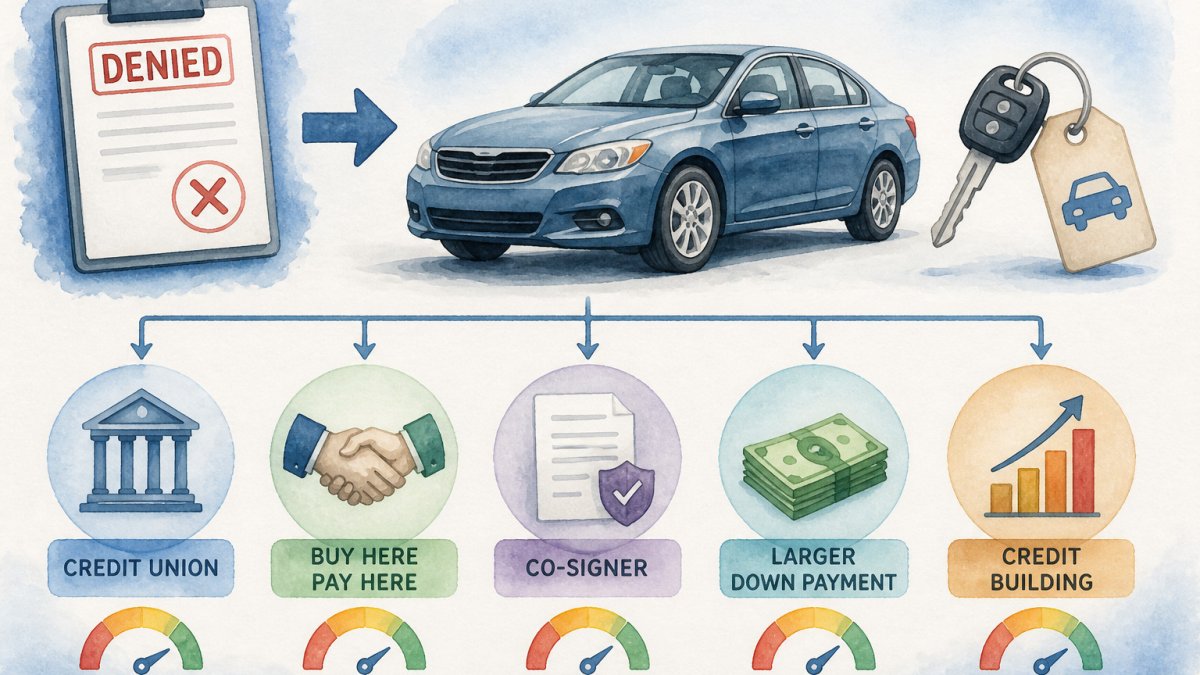
You still have options. Each one comes with trade-offs, so compare them carefully.
Credit unions, alternative lenders, and dealer financing
Credit unions are often more flexible than large banks, especially for members with thin or damaged credit. Alternative lenders focus on borrowers who were turned down elsewhere, but they often charge higher interest rates.
Dealer financing can work well because dealers work with several lenders at once. Ask what the annual percentage rate (APR) is, not just the monthly payment.
Buy-here-pay-here dealers and predatory lending warning signs
Buy-here-pay-here lots finance the car themselves. They approve almost anyone, but interest rates can be very high and payments are often due weekly. Watch for these warning signs:
- Pressure to sign the same day without reviewing the contract
- Interest rates far above what other lenders quoted
- Add-on products you did not ask for
- Refusal to tell you the total amount you will pay
If you see any of these, slow down and get a second opinion.
The article lays out the main financing routes open after a denial, each with its own trade-offs.
| Option | Best for | Key difference |
|---|---|---|
| Credit unions | Members with thin or damaged credit | Often more flexible than large banks |
| Alternative lenders | Borrowers turned down elsewhere | Often charge higher interest rates |
| Dealer financing | Shoppers wanting several lenders at once | Ask for the APR, not just the monthly payment |
| Buy-here-pay-here dealers | Buyers who are approved almost anyone | Very high rates; payments often due weekly |
How to Improve Your Chances of Car Loan Approval
Small changes can improve your odds on the next application.
- Save a larger down payment to lower the amount you borrow
- Pay down existing credit card balances to improve your debt-to-income ratio
- Bring recent pay stubs and proof of residence to avoid verification delays
- Choose a less expensive vehicle so the loan amount fits your income
Each of these reduces the lender's risk, which is what matters most in a decision.
Car Loan With a Co-Signer: When It Helps and When It Hurts
A co-signer is someone who agrees to repay the loan if you cannot. A strong co-signer can help you qualify for a better rate.
Be careful, though. If you miss payments, your co-signer's credit takes the hit too. Only ask someone to co-sign if you are confident you can make every payment on time.
Compare Total Loan Cost and Book Your Next Step at Silverton Motors
A low monthly payment can hide an expensive loan. Compare the total cost of each offer by multiplying the monthly payment by the number of months, then adding the down payment. Lower your monthly payment with practical steps you can apply.
Watch out: Stretching the loan to 84 months to lower the payment can cost you thousands more in interest than a shorter term.
If you were denied and want a clear path forward, Silverton Motors in Toms River offers a selection of pre-owned vehicles. Apply online to get started.
Frequently Asked Questions
Can I get a used-car loan after a bank denies me?
Yes. A bank denial does not rule out used car financing. Credit unions, online lenders and dealer finance departments often work with buyers who have lower credit scores or thinner credit files. Each lender sets its own criteria, so a denial from one bank tells you little about what another lender will approve. Ask each lender for the specific reason for denial, since that reason shapes which lender is likely to say yes.
Will a car-loan denial hurt my credit score?
The denial itself does not lower your credit score. Each formal loan application can add a hard credit inquiry, which may reduce your score by a few points for a short time. Applications for the same type of loan made within a short window are often counted as one inquiry. Limiting applications to a focused rate-shopping window protects your score while you look for approval.
Should I apply with another lender after an auto-loan denial?
Often yes, but do it deliberately. Start with a credit union you belong to or can join, since credit unions frequently approve borrowers that banks decline. Before applying, check your credit reports for errors and confirm the reason for denial in the adverse-action notice. Applying to several lenders in one short window keeps the credit impact limited while you compare offers.
Can a co-signer help me get approved for a used-car loan?
A co-signer with stronger credit and steady income can improve your approval odds and may lower your interest rate. The co-signer is equally responsible for the loan, so a missed payment hurts both credit reports. Only ask someone who can afford the full payment if you stop paying, and confirm the loan terms in writing before signing.