 comparison
CARFAX vs AutoCheck: Accident History Comparison
Table of Contents
- CARFAX vs AutoCheck: Head-to-Head Comparison
- How to Inspect a Used Car for Hidden Accident Damage
- Limitations of Vehicle History Reports
- What Does a Salvage Title Mean
- Odometer Rollback Detection: Where Each Report Stands
- Which Report Should You Use
- Frequently Asked Questions
Last Updated: October 1, 2026
CARFAX vs AutoCheck: Head-to-Head Comparison
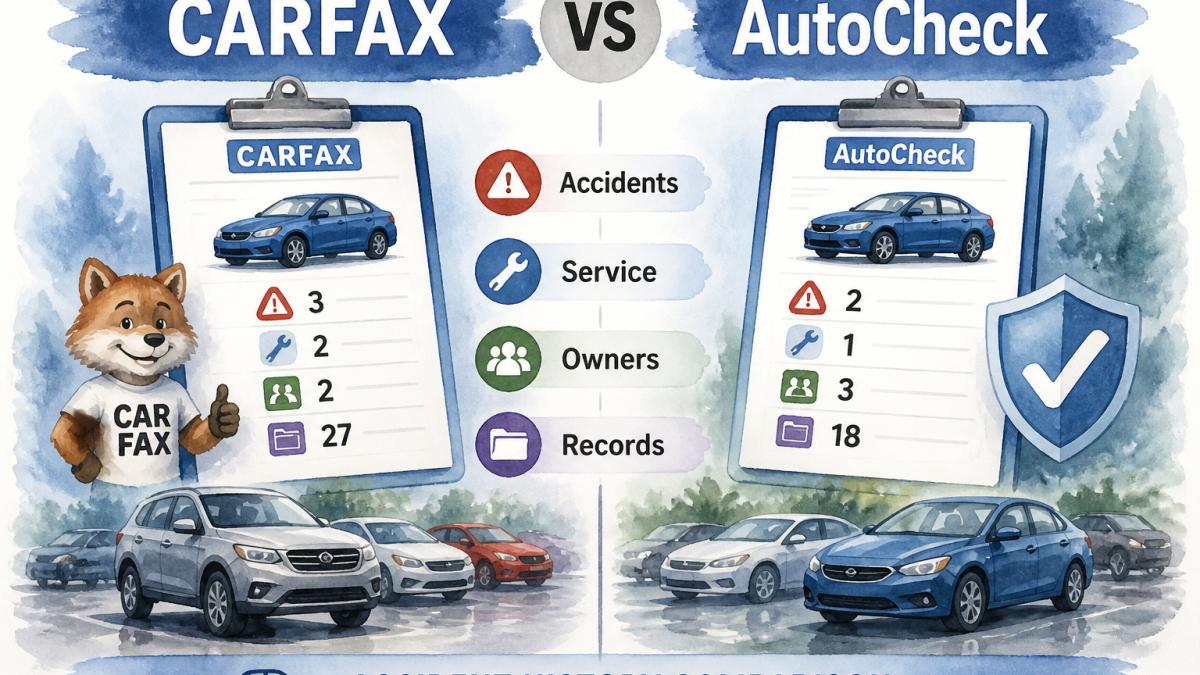
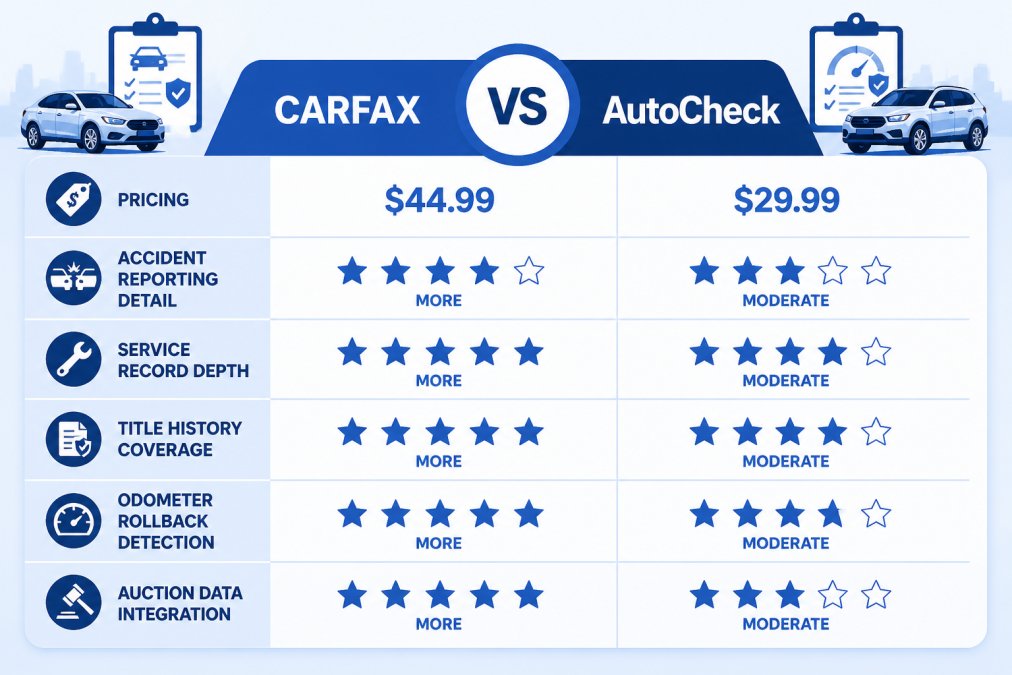
When buying a used car, CARFAX and AutoCheck both provide vehicle history reports, but they pull from different data sources and catch different problems. This guide breaks down what separates them so you can decide which one you need.
CARFAX focuses on dealership service records and maintenance history, while AutoCheck emphasizes auction data and title records. Neither catches hidden accident damage that a physical inspection would reveal.
| Aspect | CARFAX | AutoCheck | Winner |
|---|---|---|---|
| Starting Price | $44.99 per report | $29.99 per report | AutoCheck |
| Best For | High-value vehicles with service history | Budget buyers, auction history | Depends on use case |
| Database Strength | Dealership records, maintenance | Auction data, title branding | CARFAX for service, AutoCheck for auctions |
| Accident Detection | Severity and damage location | Comprehensive title tracking | CARFAX for detail |
| Odometer Rollback Detection | Limited | Strong detection capability | AutoCheck |
| Lemon Law Branding | Yes | Yes | Tie |
Pricing and Report Models
CARFAX charges $44.99 per report; AutoCheck costs $29.99. CARFAX's higher price reflects deeper dealership service records, while AutoCheck's lower cost suits buyers checking multiple vehicles or prioritizing title issues.
Bumper offers a subscription model starting at $1 for a 7-day trial, useful if checking 5+ vehicles.
Accident Detection and Accuracy
CARFAX reports accident severity and damage location from insurance claims, police reports, and repair shops, telling you whether damage was minor or structural.
AutoCheck excels at catching salvage titles, flood damage branding, and lemon law history through auction house data integration.
Neither catches unreported accidents fixed at independent shops with cash. Physical inspection matters more than the report.
Database Sources and Coverage
CARFAX aggregates data from over 100,000 sources, but rural areas with fewer dealerships show less complete service records.
AutoCheck pulls from Copart and IAA auction houses, rental companies, and fleet operators, making it exceptional for identifying vehicles with auction or rental history.
How to Inspect a Used Car for Hidden Accident Damage
Both reports combined miss what a physical inspection reveals. A vehicle history report is a starting point, not a finish line.
Physical Inspection Checklist
Look at panel gaps. Consistent gaps mean the car was never taken apart; uneven gaps suggest collision repair.
Feel the paint for texture changes and overspray on trim, door jambs, or seals, signs of repainting and accident repair.
Check the undercarriage for fresh welds, new frame components, or mismatched bolts. Factory bolts have markings; plain bolts indicate structural work.
Inspect the engine bay for consistent bolts and hoses. New parts on an older car suggest major repair work.
Check headlights and taillights for consistent manufacturing dates. Mixed dates suggest collision damage.
Test all electrical systems, windows, locks, wipers, lights, climate control. Collision repairs often leave electrical problems.
What Reports Miss
Reports capture insured accidents but miss unreported damage, structural issues from minor collisions, electrical problems from poor repairs, suspension damage, and frame straightening.
A clean report means no insurance claim was filed, not that the car is accident-free. Many minor accidents are fixed privately to avoid rate increases.
An independent pre-purchase inspection ($150-200) catches problems no report reveals and is essential before buying.
Limitations of Vehicle History Reports
Both reports have blind spots. Understanding false negatives and false positives helps calibrate confidence in a 'clean' report.
The False Negative Problem: Clean Reports That Hide Damage
Reports depend on data being reported. Cash-paid repairs at independent shops, frame straightening without insurance claims, and out-of-pocket fixes are invisible to both reports.
Industry estimates suggest 30-40% of minor collision repairs happen outside the insurance system, creating false security in "clean" reports.
Structural repairs present another false negative risk. A vehicle that was in a serious accident, declared a total loss, repaired, and re-titled as "rebuilt" will show that salvage history. But a vehicle that was in a serious accident, repaired by the original owner without an insurance claim, and never declared a total loss? Both reports show nothing, even though the structural integrity may be compromised.
Electrical gremlins and hidden suspension damage are particularly prone to false negatives. A collision can bend frame rails in ways that don't immediately show up in reports but cause alignment problems, electrical shorts, or transmission issues months later. The report shows no accident. The vehicle develops problems that are expensive to diagnose and repair.
The False Positive Problem: Flagged Issues That Aren't What They Seem
False positives are rarer but do occur. A vehicle might be flagged with a salvage title that was issued in error and later corrected, but the flag remains in the history. A vehicle might show multiple "accidents" when one accident resulted in multiple insurance claims (one for the collision, one for rental reimbursement, one for medical). The report counts these as separate incidents when they're the same event.
Odometer discrepancies can trigger false positives. A vehicle might show a mileage decrease if the odometer was corrected after being discovered to be inaccurate, or if records from different sources reported slightly different readings. AutoCheck flags these, but not all represent actual fraud.
Title branding can also produce false positives.
Timing Lags in Reporting
A recent accident might not appear in either report for weeks or months. Insurance claims take time to process. Repair shops batch their reports. If you're buying a car days after an accident, the report shows nothing yet. This creates a window of vulnerability where a vehicle with fresh damage appears clean.
Data Accuracy Varies by Region and Reporting Source
Urban areas with large dealership networks show complete service records. Rural areas show gaps. A vehicle serviced consistently at one independent shop might show scattered records because that shop doesn't report to both databases, or reports inconsistently.
What This Means for Your Decision
A clean vehicle history report is necessary but not sufficient. It tells you:
- No major insurance claims were filed
- No salvage or flood branding exists in the title system
- No obvious odometer fraud was detected
- The vehicle wasn't a rental or fleet vehicle (if AutoCheck shows no auction history)
It does NOT tell you:
- Whether the vehicle sustained unreported collision damage
- Whether frame straightening or structural repairs occurred outside the insurance system
- Whether electrical or suspension damage exists from past accidents
- Whether all service was performed at shops that report to the database
- Whether the vehicle is mechanically sound
This is why an independent pre-purchase inspection by a certified mechanic is non-negotiable. A mechanic can identify frame damage, welding, paint overspray, electrical issues, and suspension wear that no report reveals. That $150-200 inspection catches problems that would cost thousands to repair later. It's the cheapest insurance you'll buy, and it's the only way to move beyond the limitations of vehicle history data.
What Does a Salvage Title Mean
A salvage title means an insurance company declared the vehicle a total loss after damage. The cost to repair exceeded a threshold (typically 70-80% of the vehicle's value). The title gets branded "salvage" permanently.
- The vehicle was damaged badly enough that an insurer wrote it off
- Repairs might be incomplete or substandard
- Resale value drops significantly
- Insurance becomes harder to obtain
- Financing becomes nearly impossible
Odometer Rollback Detection: Where Each Report Stands
Odometer fraud, rolling back mileage to hide wear, is illegal but still happens. Both reports flag suspicious mileage patterns, but they approach it differently.
Which Report Should You Use
For most buyers: start with AutoCheck at $29.99. It catches title issues, auction history, and odometer problems efficiently. If the report looks clean and you're buying from a private seller or small dealer, you're probably done.
Order CARFAX if:
- The vehicle is high-value (over $15,000)
- You want detailed service history
- The vehicle has multiple previous owners
- You're buying from a dealer and they won't provide service records
Order both if:
- The vehicle is very high-value (over $25,000)
- You're buying sight-unseen online
- The vehicle has an accident flag you want to understand fully
- You want maximum confidence before committing
Skip both if:
- You're having an independent pre-purchase inspection done (the mechanic's findings matter more than the report)
- You're buying from a trusted dealer with full service records available
- The vehicle is under $5,000 and you're prepared to accept higher risk
Frequently Asked Questions
How accurate are CARFAX accident reports?
CARFAX reports depend on data reported to insurance companies, police, and repair shops. Major accidents are typically captured, but minor incidents and out-of-pocket repairs often don't appear. CARFAX draws from thousands of sources including dealership service records, which gives it an advantage in detecting maintenance patterns tied to accident repairs. However, no report is 100% complete, a physical inspection by a mechanic is essential to catch hidden damage reports may miss.
Does AutoCheck show accidents that CARFAX misses?
AutoCheck has a different strength: it excels at detecting auction and wholesale history, which often reveals vehicles that have been damaged and resold. Both services pull from different data sources, so gaps exist in both. Neither catches private-party repairs or damage fixed without insurance claims. For comprehensive accident detection, run both reports and combine them with a pre-purchase inspection by a trusted mechanic.
What does a salvage title mean?
A salvage title indicates the vehicle was declared a total loss by an insurance company due to damage, theft recovery, or other major issues. Salvage-titled vehicles can sometimes be repaired and re-registered with a rebuilt or reconstructed title, but they carry higher risk, lower resale value, and may have structural or hidden damage. Both CARFAX and AutoCheck flag salvage and rebuilt titles clearly, making this one area where reports are reliable.
What are the main limitations of vehicle history reports?
Reports only capture accidents reported to insurance, police, or major repair shops. Private repairs, minor collisions paid in cash, and flood damage in some cases never appear. Service records depend on dealers reporting to CARFAX or AutoCheck. Regional data variations mean some areas have better reporting than others. Reports also cannot detect frame damage, rust, or mechanical wear, only a hands-on inspection reveals those issues. Treat reports as a screening tool, not a guarantee of vehicle condition.