 listicle
Best Used Sedans for Daily Commuting in 2026
Table of Contents
- Quick Comparison: Top Used Sedans for Commuters
- Honda Civic (2016-2020): Best for Fuel Economy
- Toyota Corolla (2017-2020): Best for Low Ownership Costs
- Toyota Camry (2018-2021): Best for Long-Distance Comfort
- Honda Accord (2017-2020): Best for Driving Dynamics
- Mazda Mazda3 (2017-2019): Best for Interior Quality
- Hyundai Sonata (2019-2022): Best for Tech Features
- Toyota Prius (2016-2017): Best for Stop-and-Go Traffic
- How to Inspect a Used Car Before Buying
- Frequently Asked Questions
Last Updated: September 19, 2026
Quick Comparison: Top Used Sedans for Commuters
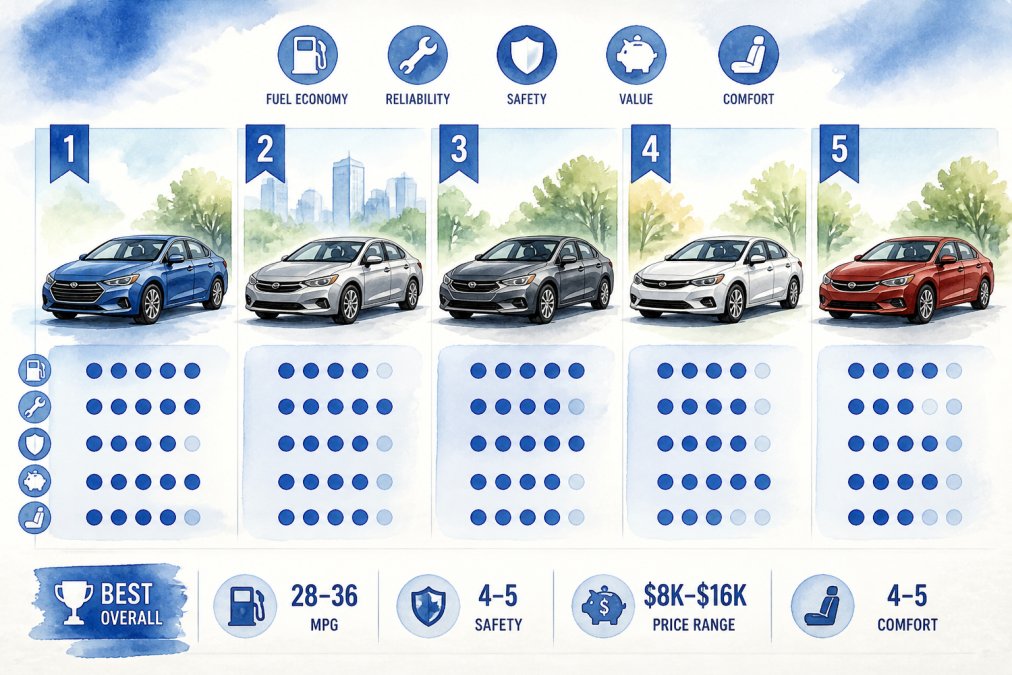
The best used sedans for daily commuting are the Honda Civic, Toyota Corolla, Toyota Camry, Honda Accord, Mazda Mazda3, Hyundai Sonata, and Toyota Prius. Each one earns its spot for a different reason: fuel economy, low ownership costs, highway comfort, driving feel, interior quality, tech, or stop-and-go efficiency. This guide breaks down which used sedans fit which commute, and what to check before you buy.
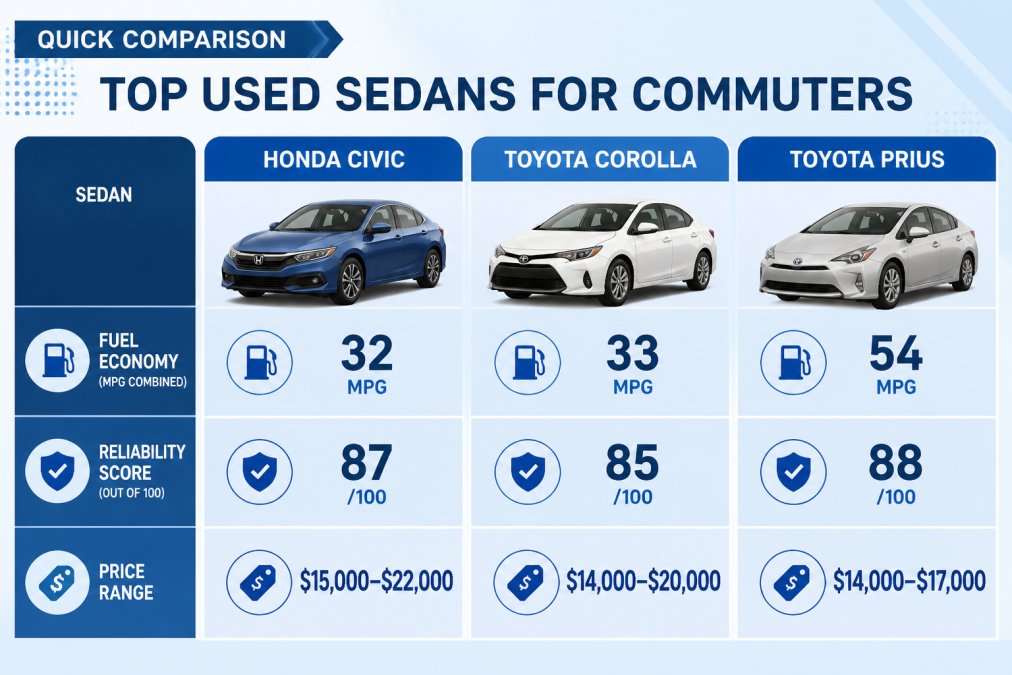
| Sedan | Best For | Standout Strength | Watch Out For |
|---|---|---|---|
| Honda Civic (2016-2020) | Fuel economy | High MPG, strong resale | Clunky older infotainment |
| Toyota Corolla (2017-2020) | Low ownership costs | Standard safety tech | Modest acceleration |
| Toyota Camry (2018-2021) | Long-distance comfort | Quiet, spacious cabin | Harder to park |
| Honda Accord (2017-2020) | Driving dynamics | Responsive handling | Low seating position |
| Mazda Mazda3 (2017-2019) | Interior quality | Upscale materials | Tight rear seat |
| Hyundai Sonata (2019-2022) | Tech features | Generous standard tech | Weaker resale value |
| Toyota Prius (2016-2017) | Stop-and-go traffic | Exceptional MPG | Polarizing styling |
Honda Civic (2016-2020): Best for Fuel Economy
The Honda Civic is the best used sedan for commuters who prioritize fuel economy. Its compact size, efficient powertrain, and strong reliability score make it a smart daily driver. Tenth-generation Civics also hold their resale value well, which softens the long-term cost of ownership.
Toyota Corolla (2017-2020): Best for Low Ownership Costs
The Toyota Corolla wins on low ownership costs. Toyota Safety Sense came standard on most trims, so even base models include forward collision warning and automatic braking. For budget-conscious commuters, few used sedans deliver this much trouble-free driving for the money.
Toyota Camry (2018-2021): Best for Long-Distance Comfort
The Toyota Camry is the best pick for long-distance comfort, and the reason is ergonomic rather than just "smooth ride quality." The eighth-generation Camry (2018 and newer) moved to the Toyota New Global Architecture (TNGA) platform, which lowered the center of gravity and stiffened the body. The practical result for commuters is a quieter, flatter ride over expansion joints and bridge seams, the surfaces that make a 45-minute highway commute feel like two hours in a cheaper sedan.
What actually makes it comfortable
- Seat geometry. The Camry's front seats use a longer cushion and adjustable lumbar support on most trims, which distributes pressure across the thighs and lower back instead of concentrating it. For drivers logging 12,000 to 15,000 miles a year, that geometry matters more than any single feature.
- Cabin noise. Acoustic glass and additional sound deadening on higher trims reduce wind and tire roar at highway speed. Lower trims are noticeably louder, so if your commute is mostly interstate, prioritize an upper trim or budget for aftermarket sound insulation.
- Ride quality. The TNGA suspension absorbs broken pavement without the floaty feel of older Camrys, which reduces the small corrections that tire out a driver over time.
- Climate and visibility. A large greenhouse and strong HVAC output help in both hot and cold commutes, and the upright seating position gives a better view of traffic than the low-slung Accord.
Powertrain choices for commuters
The standard 2.5-liter four-cylinder returns strong highway fuel economy and handles most commutes without complaint. The available V6 adds passing power for two-lane highways, but it costs more at the pump. The Camry Hybrid (2018 and newer) is the sleeper pick for commuters who face both highway and stop-and-go traffic: it pairs the comfortable cabin with hybrid fuel economy, so you are not forced to choose between comfort and MPG.
The trade-offs
If your priority is arriving at work without a stiff back and a headache from road noise, the Camry is one of the most comfortable used sedans you can buy. If you want the same comfort with better fuel economy, the Camry Hybrid deserves a serious look.
Honda Accord (2017-2020): Best for Driving Dynamics
The Honda Accord delivers the best driving dynamics in this group. Responsive handling and available turbocharged engines make it engaging without sacrificing practicality. Fuel economy stays strong for a midsize sedan, and the interior ergonomics are excellent.
Mazda Mazda3 (2017-2019): Best for Interior Quality
The Mazda Mazda3 offers the best interior quality in the compact class. Upscale materials and an intuitive infotainment system give it a near-premium feel. Sporty handling makes the daily drive more enjoyable than most economy sedans.
Hyundai Sonata (2019-2022): Best for Tech Features
The Hyundai Sonata packs the most tech features for the money. Generous standard equipment, distinctive styling, and a smooth transmission make it a strong value.
Toyota Prius (2016-2017): Best for Stop-and-Go Traffic
The Toyota Prius is unbeatable in stop-and-go traffic. Its hybrid powertrain captures energy during braking, delivering exceptional fuel economy where conventional sedans suffer most. For urban commuters facing daily congestion, that advantage compounds every week.
How to Inspect a Used Car Before Buying
Knowing how to inspect a used car before buying protects you from expensive surprises. But for a commuter, the inspection should go beyond accident history and tire tread. The real question is whether the car will stay cheap to run over the 12,000 to 15,000 miles most drivers log each year. That means inspecting the car and modeling the total cost of ownership (TCO) side by side.
Step 1: Verify the basics
Start with a vehicle history report to check for accidents, title issues, and odometer rollback. Then verify the maintenance schedule was followed, especially transmission and coolant services. On high-mileage commuter cars, a skipped CVT or automatic transmission fluid service is the single most expensive inherited problem.
- Request the vehicle history report and review accident records
- Check tire tread depth and uneven wear patterns
- Test every infotainment system and driver-assist feature
- Listen for cabin noise and suspension clunks on a test drive
- Confirm the mileage threshold aligns with major service intervals
- Have an independent mechanic perform a pre-purchase inspection
Step 2: Build a five-year TCO estimate
Most shoppers compare sticker prices. Commuters should compare monthly cost of ownership, because fuel, insurance, and repairs can swing the math more than the purchase price does. A practical framework:
| Cost category | How to estimate it | Why it matters for commuters |
|---|---|---|
| Fuel | Annual miles ÷ combined MPG × current price per gallon | A 10 MPG difference at 15,000 miles/year is hundreds of dollars annually (Save Money) |
| Insurance | Get a real quote with the VIN before you buy | Rates vary widely by model, trim, and safety features |
| Maintenance | Manufacturer schedule + known model issues | Timing belts, CVT fluid, and hybrid battery service are the big-ticket items |
| Repairs | Budget for wear items: brakes, tires, suspension | Regenerative braking on hybrids can extend brake life significantly |
| Depreciation | Check resale trends for the specific year and trim | Matters most if you plan to sell within five years |
Step 3: Verify hybrid-specific items if applicable
If you are considering a Prius or another hybrid, ask for a battery health check. A clean vehicle history report will not reveal a degrading hybrid battery, and replacement is a significant repair. Also confirm the inverter coolant service was performed on schedule.
Step 4: Line up financing before you shop
Compare used car financing options from multiple lenders before visiting a dealership. Getting pre-approved clarifies your budget and gives you leverage on price. Many dealerships also offer online financing tools that let you apply before you arrive. A pre-approval also protects you from dealer-arranged rates that quietly stretch the loan term to lower the monthly payment.
Frequently Asked Questions
What are the best used cars to buy for daily commutes?
The best used cars for daily commutes balance fuel economy, reliability, and comfort. Top choices include the Honda Civic (2016-2020) for its high MPG and resale value, Toyota Corolla (2017-2020) for low ownership costs, and Toyota Camry (2018-2021) for highway comfort. For heavy traffic, the Toyota Prius (2016-2017) offers unmatched fuel efficiency. Consider your commute length, climate, and budget when choosing.
What is the most reliable used sedan to buy?
Toyota and Honda models consistently rank highest for reliability. The Toyota Corolla and Camry have strong reliability scores and low maintenance costs. The Honda Civic and Accord also offer proven mechanical longevity. Look for models with complete maintenance records and consider a certified pre-owned (CPO) program for added peace of mind. A vehicle history report can reveal past accidents or service issues.
How many miles is too many for a used commuter sedan?
There is no fixed mileage threshold, but a well-maintained sedan can exceed 150,000 miles. Focus on the maintenance schedule and vehicle history report rather than just the odometer. A car with 80,000 highway miles may be in better shape than one with 50,000 city miles. Have a mechanic inspect the powertrain, transmission longevity, and suspension comfort before buying.
What features should I look for in a used sedan for commuting?
Prioritize fuel economy, driver-assist technology like adaptive cruise control and lane-keeping assist, and comfort features such as supportive seats and low cabin noise. For long commutes, blind-spot monitoring and a user-friendly infotainment system matter. Also check safety ratings and ergonomics. A CPO vehicle often includes these features and a warranty, making it a smart choice for daily drivers.
How do I get financing for a used sedan with less-than-perfect credit?
Many dealerships offer used car financing options for a range of credit situations. Start by checking your credit score and getting pre-approved at a credit union or bank. Dealership financing may have more flexible requirements. Bring proof of income, insurance, and a down payment. AutoSport USA provides online financing tools to streamline the process and help you get approved.
Finding a reliable commuter sedan takes patience, and the inspection process can feel overwhelming when you are juggling work and life. AutoSport USA helps you skip the guesswork with a diverse inventory of quality used vehicles, online financing tools, and trade-in valuations that make the numbers clear upfront. Browse the inventory, get your trade-in value, and apply online to start your commute in the right sedan.