 ultimate-guide
What to Look for When Buying Used Cars: 2026 Guide
Table of Contents
- Pre-Purchase Car Inspection Checklist: Exterior, Interior, and Under the Hood
- How to Check Used Car Engine Health Before You Buy
- Test Drive Procedures and Vehicle History Report Analysis
- Questions to Ask When Buying a Used Car
- Budgeting, Financing, and Avoiding Hidden Fees
- Private Seller vs. Dealer: What to Look for When Buying Used
- Conclusion
- Frequently Asked Questions
Last Updated: September 12, 2026
Pre-Purchase Car Inspection Checklist: Exterior, Interior, and Under the Hood
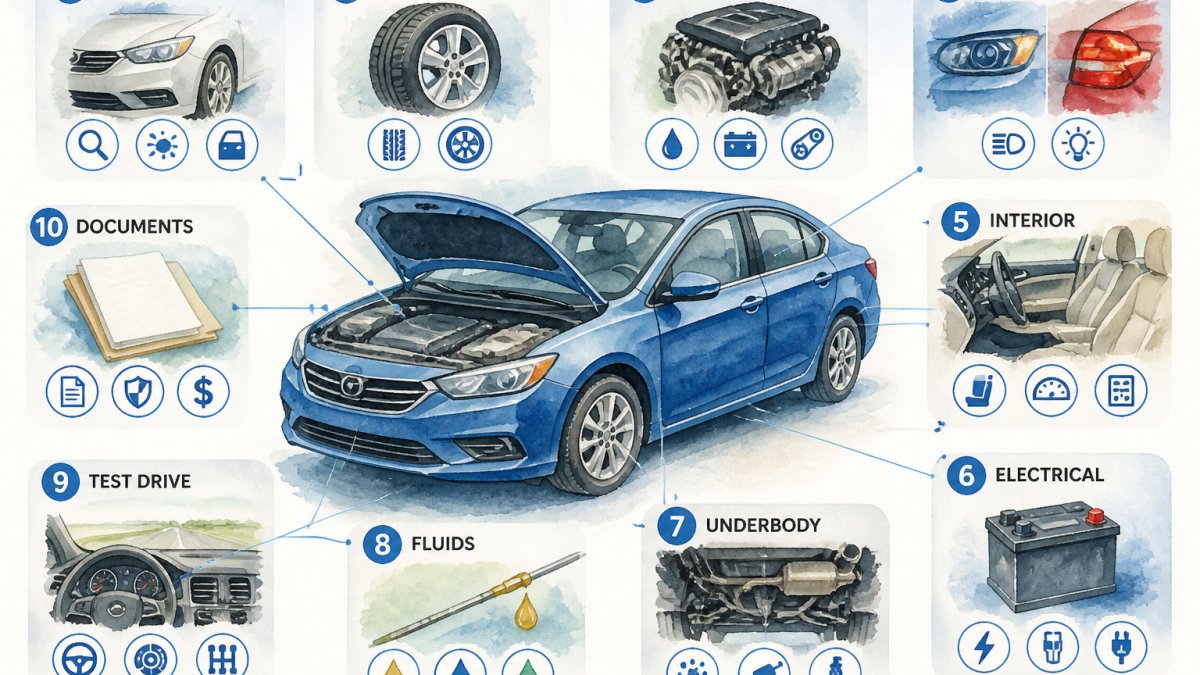
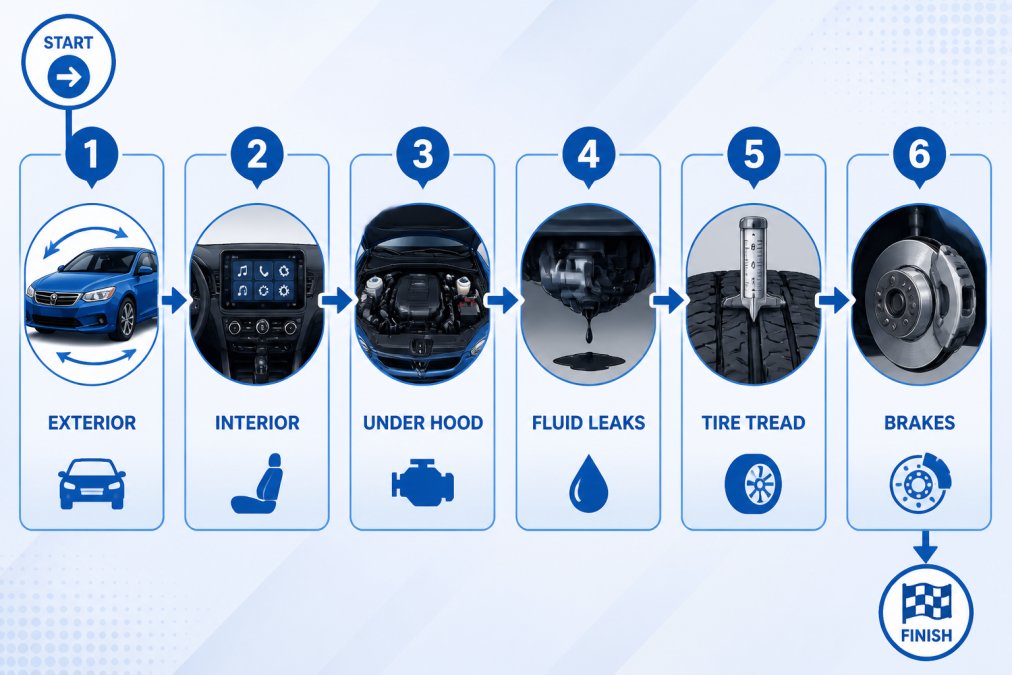
Knowing what to look for when buying used starts with a disciplined inspection, and this checklist from AutoSport USA breaks it into three passes: exterior, interior, and under the hood. A pre-purchase inspection is a systematic evaluation of a vehicle's condition before you commit to buying it, covering body panels, electronics, fluids, and mechanical components. Work through them in order, and bring a flashlight, a tire tread gauge, and a magnet.
Exterior Body Condition and Rust Damage
Walk the entire vehicle in daylight and check body panel alignment, paint mismatch, and rust damage. Gaps between panels should be even; uneven gaps often signal prior collision repair. Run a magnet wrapped in cloth along lower doors, wheel arches, and rocker panels, where rust damage hides and bubbling paint is the early warning sign. Check that the windshield has no chips in the driver's line of sight and that all lights work.
Interior Features and Electronics Check
Sit in every seat and test everything you can touch: power windows, locks, mirrors, seat adjustments, air conditioning, heating, and the infotainment system. Dashboard warning lights should illuminate briefly at startup and then go out; any light that stays on deserves an explanation. Check the odometer reading against wear on the pedals and driver's seat, a very low reading paired with a worn-out interior is a classic sign of odometer rollback.
Under-the-Hood Mechanical Inspection
Open the hood with the engine cold and look for fluid leaks, coolant levels, and belt and hose wear. Fresh oil spots beneath the car or a low coolant reservoir mean something needs attention. Squeeze the belts and hoses; they should feel firm, not cracked or spongy. Pull the dipstick: dark, gritty oil suggests deferred maintenance, while a milky appearance can indicate a serious internal problem. Check tire tread depth with a gauge, anything under 2/32 of an inch is legally worn out in most states (nhtsa.gov).
How to Check Used Car Engine Health Before You Buy
You check used car engine health by combining a cold start, a visual fluid inspection, and a scan for stored fault codes. Start the engine cold, because cold starts reveal problems that disappear once the engine is hot. Listen for knocking, ticking, or rough idling, and watch the exhaust: blue smoke points to burning oil, white smoke to coolant entering the combustion chamber, and persistent black smoke to a rich fuel mixture. Ask for maintenance records and cross-check the dates and mileage against the odometer.
Test Drive Procedures and Vehicle History Report Analysis
A test drive is a diagnostic tool, not a formality. Plan for at least 20 to 30 minutes, drive a fixed route with the engine cold if possible, and turn the radio off.
Stage 1, Parking lot, engine off. Before you move, pump the brake pedal; it should feel firm, not spongy or sinking. Turn the wheel lock-to-lock and listen for clunks. Check that the parking brake holds the car on a slight incline.
Stage 2, Surface streets. Accelerate gently and firmly, watching for hesitation, surging, or a transmission that flares between gears. Shift manually through every gear if the car allows it, including reverse. At low speed, listen over speed bumps and driveway aprons, clunks point to worn sway bar links, struts, or control arm bushings.
Stage 3, Highway. Merge at full throttle. A healthy engine pulls smoothly to highway speed; a slipping transmission lets RPMs climb without matching acceleration. Hold a steady 60-70 mph and check for steering wheel shimmy (tire balance or bent wheel) and vibration through the seat (driveshaft or rear suspension).
Stage 4, Braking and maneuvers. Find an empty lot and perform a firm, straight stop from about 40 mph. The car should stop straight without pulling, pulsing, or grinding. Then do a few tight circles in both directions and listen for clicking from the CV joints.
Stage 5, After the drive. Park on clean pavement, leave the engine running for a minute, then shut it off and look underneath for fresh drips. Recheck the coolant and oil. Smell for a sweet, syrupy odor (coolant) or a burnt, acrid odor (transmission or clutch).
| Check | What to Look For | Red Flag |
|---|---|---|
| Cold start | Quick, smooth idle | Rough idle, ticking, blue smoke |
| Acceleration | Linear pull, no hesitation | Surging, delayed downshift |
| Transmission | Smooth shifts all gears | Flaring, slipping, hard shifts |
| Brakes | Firm, straight stop | Pulling, pulsing, grinding |
| Steering | Centered, no wander | Shimmy, vibration, play |
| Suspension | Quiet over bumps | Clunks, rattles, bottoming out |
| Post-drive leaks | Dry pavement | Fresh oil, coolant, or trans fluid |
Reading a Vehicle History Report Without Getting Fooled
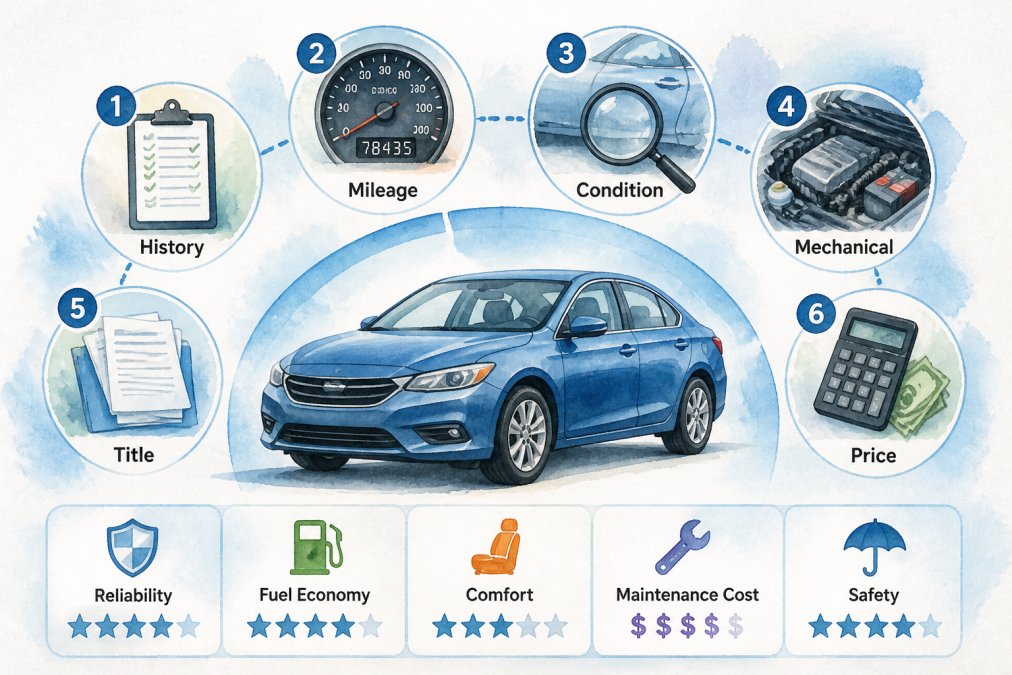
Pull the report yourself using the 17-character vehicle identification number (VIN), never rely on a printout the seller hands you, because pages can be missing. The VIN appears through the windshield on the driver's side and on the driver's door jamb sticker; confirm both match the title and the report. A mismatch is a walk-away signal.
A history report aggregates data from state motor vehicle agencies, insurance carriers, auction houses, and service shops. No single report is complete, so cross-check two sources when the stakes are high. Look for:
- Title brands. "Salvage," "rebuilt," "flood," "lemon," and "junk" are branded titles. A rebuilt title can be legal to drive but is hard to insure and harder to resell. Flood-branded vehicles often develop electrical gremlins months later.
- Odometer readings over time. A jump backward, or a long gap with no readings, is a rollback red flag. Compare the highest reading on the report to the current odometer.
- Accident and damage records. Not every accident is reported, so a clean report is not proof of a clean car. But a reported airbag deployment or frame damage is a hard stop for most buyers.
- Service history. Regular oil change and maintenance entries suggest an owner who cared. A blank service history on a high-mileage car means you are buying unknowns.
- Open recalls. Run the VIN through the National Highway Traffic Safety Administration (NHTSA) recall lookup (nhtsa.gov). Open safety recalls are free to fix at a franchised dealer, but they are the current owner's responsibility until repaired.
Questions to Ask When Buying a Used Car
The questions to ask when buying a used car should uncover maintenance history, accident records, and why the vehicle is being sold. Ask how many owners it has had, whether it has been in any accidents, and whether there is a safety recall outstanding on the VIN. Request maintenance records for oil changes, timing belt service, and major repairs. Ask directly whether the title is clean and in the seller's name. A hesitant or vague answer is itself information.
Ask the seller to meet at a mechanic of your choosing for an independent pre-purchase inspection. Sellers who refuse are usually hiding something, and the inspection fee is cheap insurance against a costly repair.
Budgeting, Financing, and Avoiding Hidden Fees
Budget for the out-the-door price, not the sticker price. The out-the-door price includes sales tax, title transfer, registration, and any dealer fees, and it is the only number that matters. Get pre-approved through your bank or credit union before you shop so you know your real budget and have negotiation leverage. Depreciation hits hardest in the first few years, so a slightly older model often delivers better value. AutoSport USA offers online financing tools and trade-in valuations to help you factor your current car into the deal.
Private Seller vs. Dealer: What to Look for When Buying Used
The two channels carry different risks, different paperwork, and different negotiation leverage. Treat them as separate playbooks.
Buying From a Private Seller
Private-party sales usually price lower because there is no dealer overhead, but you absorb the paperwork risk and get no warranty unless the manufacturer's remaining coverage transfers.
What to verify before money changes hands:
- Title in the seller's name. The name on the title must match the seller's driver's license. If it is in someone else's name, a relative, a deceased parent, a lienholder, the seller cannot legally transfer it without additional documents.
- Lien check. A title can look clean while a lender still holds a lien. Ask for a lien release letter, or verify with the state motor vehicle agency. If a lien exists, the payoff must be handled at the transaction, not promised later.
- Bill of sale. Get a signed, dated bill of sale listing the VIN, odometer reading, sale price, and both parties' names and addresses. Some states require it; all states accept it as a record.
- Odometer disclosure. Federal law requires an odometer statement on most transfers (nhtsa.gov). Make sure the number on the statement matches the dash.
- Payment safety. Do not hand over cash at a parking lot meetup. Complete the transaction at the seller's bank or your own, or use a verified wire, cashier's checks can be forged.
- Smog or safety inspection. Some states require a passing inspection or smog certificate at the time of sale. Confirm the requirement before you buy, because the cost can fall on you.
Negotiation leverage with a private seller: You have the inspection report, the history report, and any needed repairs as concrete talking points. Private sellers are usually motivated by a deadline, a move, a new car already purchased, a divorce. Ask why they are selling and how soon they need it gone.
Buying From a Dealer
A dealer handles title transfer, registration paperwork, and often financing, and may offer a limited warranty or a certified pre-owned (CPO) program, convenience baked into the price.
What to verify before signing:
- The out-the-door price in writing. Ask for it itemized: sale price, sales tax, title and registration fees, documentation fee, and any add-ons. Compare that number, not the advertised price.
- The CPO inspection report. If the car is sold as certified pre-owned, ask to see the completed inspection checklist and confirm what the extended coverage includes, powertrain only, or bumper-to-bumper.
- Add-ons you can decline. Paint protection, fabric protection, VIN etching, and nitrogen tire fills are almost always optional. Say no unless you specifically want them.
- Financing terms. Compare the dealer's rate against your pre-approved bank or credit union rate. Dealers can mark up the rate, so the difference is real money over the loan term.
The Modern Check Neither Channel Tells You About
Two concerns cut across both private and dealer sales, and most guides skip them entirely.
Digital data privacy. A modern vehicle stores the previous owner's paired phones, home and work addresses, garage door codes, call logs, and sometimes saved payment cards in the infotainment system. Before you drive away, perform a factory reset and delete all paired Bluetooth devices, on a dealer lot, ask them to do it in front of you. If the car has a connected app tied to the previous owner's account, it must be unlinked at the manufacturer level; a factory reset alone may not sever it.
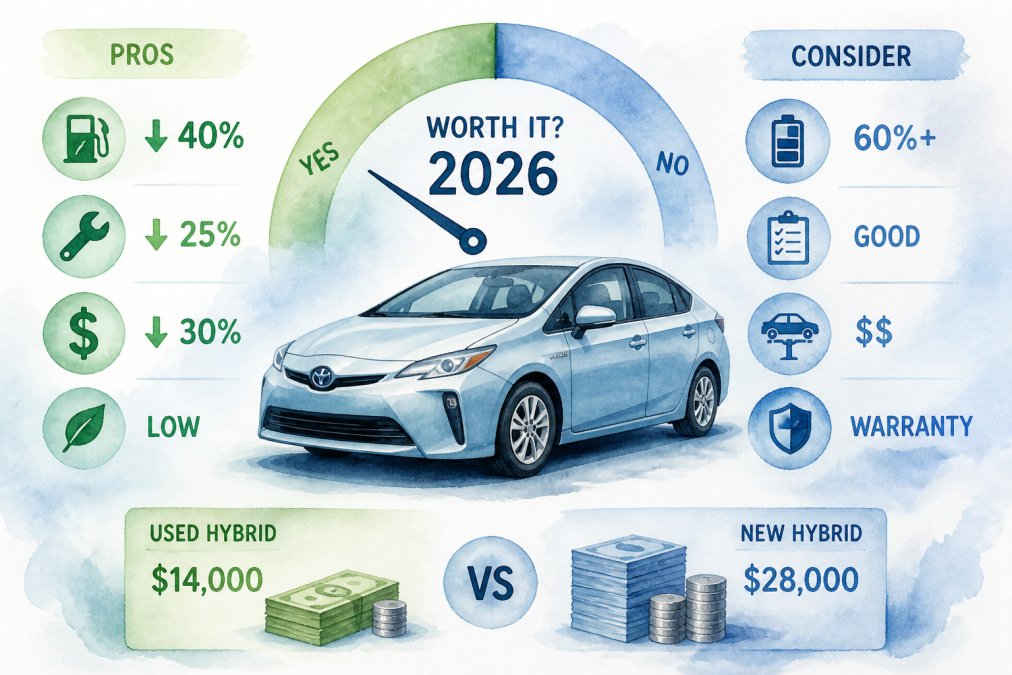
Battery health on electrified vehicles. If the car is a hybrid or electric vehicle, the high-voltage battery matters more than the engine. Ask for a battery state-of-health (SOH) reading, which most franchised dealers can pull from the diagnostic system. SOH typically drops a few percent in the first couple of years and then declines slowly; a steep drop for its age is a warning sign, as are range loss, slow charging, and frequent battery cooling fan noise. Battery replacement on an EV can cost thousands, so request a battery health report even on a used hybrid.
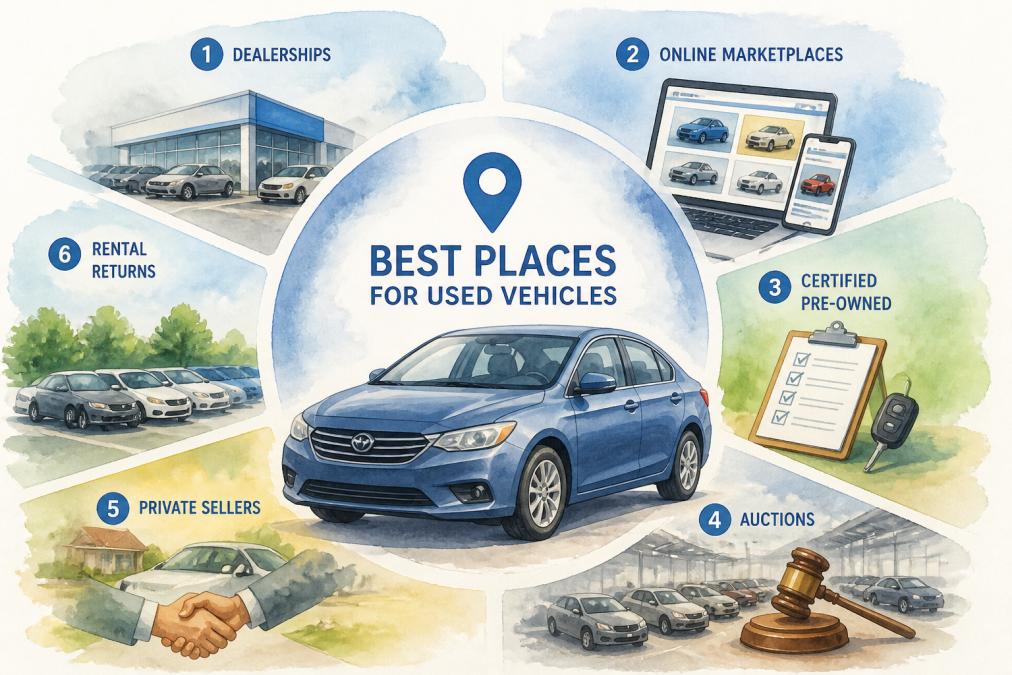
Buyers who want paperwork handled, financing options, and a warranty should lean toward a dealer. Buyers chasing the lowest price and comfortable with the paperwork and inspection work can save with a private-party sale, but only if they verify the title, lien, and odometer themselves.
Conclusion
The gap between a good used car and a money pit usually comes down to how thoroughly you inspected it before signing. AutoSport USA offers a diverse inventory of quality used vehicles, online financing tools, and trade-in valuations to make the process straightforward. Browse the inventory, get pre-approved online, and apply online to start your purchase with confidence.
Frequently Asked Questions
What are the most common red flags when buying a used vehicle?
Watch for odometer rollback signs like worn pedals with low mileage, paint mismatch across body panels, and a salvage title. Dashboard warning lights, fluid leaks under the car, and exhaust smoke also signal trouble. A seller who refuses a pre-purchase inspection or won't provide maintenance records is another major red flag. Always run a VIN check before committing.
Is it worth paying for a pre-purchase inspection on an older used car?
Yes. A pre-purchase car inspection typically costs $100 to $200 and can reveal hidden problems like frame rust, transmission issues, or electrical faults that a test drive won't show. For any vehicle over five years old or with more than 75,000 miles, an independent mechanic's inspection is the cheapest insurance against a costly surprise after you buy.
Is there a reliable way to check engine health during a test drive?
During your test drive, watch for rough idling, hesitation during acceleration, and transmission shifting delays. Check the dashboard for warning lights, especially the check engine light. After the drive, inspect engine oil condition on the dipstick (dark or gritty oil is a concern) and look for coolant levels and belt and hose wear. Any unusual noise or exhaust smoke warrants a professional inspection.
What questions should I ask when buying a used car from a private seller?
Ask about the vehicle's accident history, whether it has a clean title or salvage title, and how many owners it has had. Request maintenance records and ask when the last oil change, brake service, and timing belt replacement occurred. Also ask if there are any safety recall notices and whether they've been addressed. A seller with documentation and straightforward answers is a better sign.
How do I avoid hidden fees and dealer markup when buying used?
Ask for the out-the-door price in writing before you negotiate. That figure should include taxes, title transfer, registration, and any dealer documentation fees. Compare financing options from your bank or credit union before accepting dealer financing. Knowing your budget and having a pre-approval gives you negotiation leverage and protects you from surprise charges at signing.
Buying used does not have to be a gamble when you inspect methodically and ask the right questions. AutoSport USA combines a quality used vehicle inventory with online financing tools and trade-in valuations so you can move from research to keys in hand without the runaround. Apply online today and let our team help you get top value for your investment.