 listicle
Best Used SUV for Daily Commute: 2026 Guide
Table of Contents
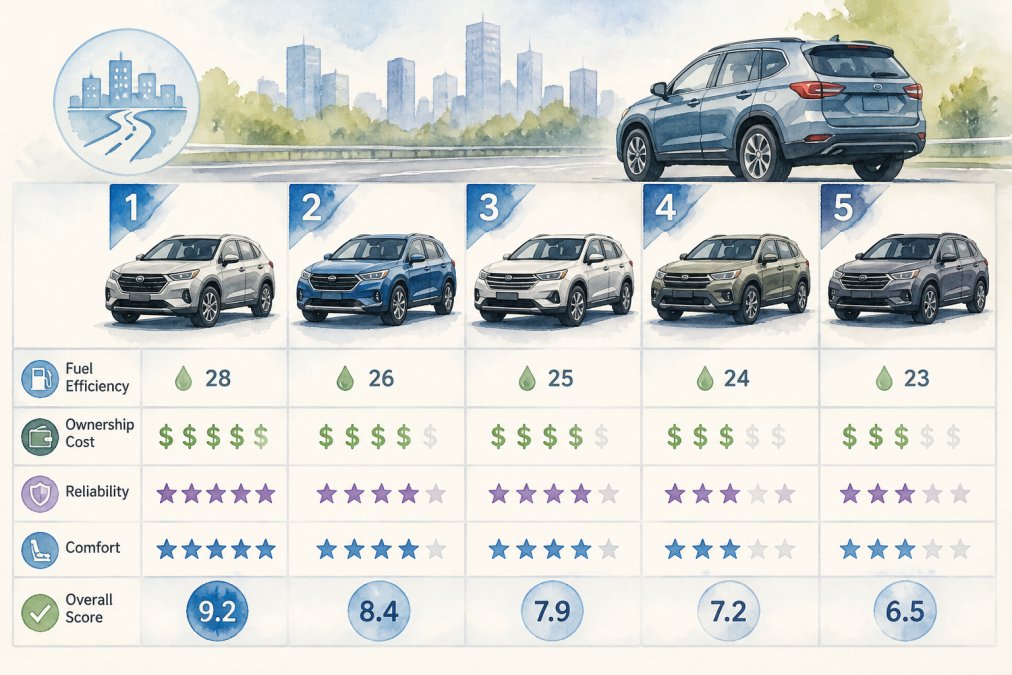
- Best Used SUVs for Daily Commuting: Quick Comparison
- Top Used SUV Recommendations for Commuters
- Toyota RAV4: Reliability and Fuel Economy Leader
- Honda CR-V: Spacious and Comfortable Daily Driver
- Mazda CX-5: Premium Feel with Lower Maintenance
- Hyundai Tucson: Value and Warranty Protection
- Nissan Rogue: Comfort and Modern Safety Tech
- Subaru Forester: All-Wheel Drive Standard
- Chevrolet Equinox: Affordable and User-Friendly
- Ford Escape: Hybrid Options for Maximum Efficiency
- Fuel Efficient Used SUVs for Commuting
- Most Reliable Used SUVs Under 20k
- How to Inspect a Used SUV Before Buying
- Total Cost of Ownership for Commuter SUVs
- Compact vs. Midsize SUV for Daily Commuting
- What to Look for When Buying a Used SUV
Last Updated: August 28, 2026
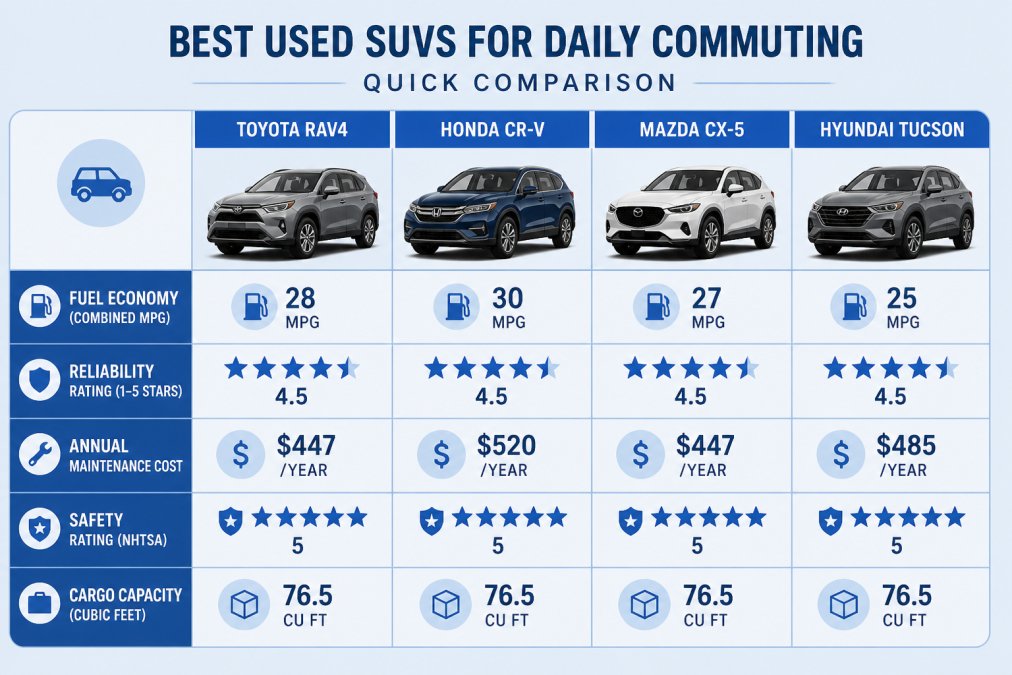
Best Used SUVs for Daily Commuting: Quick Comparison
Finding the best used SUV for daily commuting requires balancing fuel efficiency, reliability, comfort, and long-term ownership costs. The vehicles on this list consistently deliver on three core fronts: they won't strand you on the highway, they won't drain your wallet in maintenance, and they're comfortable enough for extended stop-and-go traffic.
Top Used SUV Recommendations for Commuters
Toyota RAV4: Reliability and Fuel Economy Leader
The Toyota RAV4 is the gold standard for commuters. It delivers exceptional reliability, with many owners reporting trouble-free operation well beyond 200,000 miles. Fuel economy sits at 28 combined MPG for standard gas models, with hybrid versions pushing toward 40 MPG combined. Over a five-year commute covering 60,000 miles, that efficiency difference translates to real savings.
The RAV4's cabin prioritizes durability over flash, with practical materials designed to withstand years of daily use. What sets it apart is resale value: used RAV4s command premium prices because buyers know what they're getting. If you upgrade in three or four years, you'll recover a significant portion of your initial investment.
The drawback: RAV4s on the used market often carry higher price tags than comparable competitors, leaving less negotiating room. However, that reputation exists for a reason.
Honda CR-V: Spacious and Comfortable Daily Driver
The Honda CR-V prioritizes comfort for long commutes. The cabin feels more spacious than the RAV4, with better rear legroom and a more refined driving experience. For commuters spending 10+ hours weekly in their vehicle, this matters.
Reliability tracks closely with the RAV4, though CR-V ownership costs run slightly higher at around $520 annually. Fuel economy sits at 30 combined MPG for standard models. The infotainment system on 2016 and newer models feels modern; older CR-Vs have dated interfaces that frustrate daily users.
Honda's all-wheel drive system engages smoothly for varied weather conditions without sacrificing fuel economy.
Mazda CX-5: Premium Feel with Lower Maintenance
The Mazda CX-5 splits the difference between the RAV4's reliability and the CR-V's comfort, while delivering lower maintenance costs than both at around $447 annually. Fuel economy sits at 27 combined MPG. The CX-5's interior uses higher-quality materials than competitors at similar price points, reducing fatigue on long drives.
Mazda's infotainment system ranks among the best in the compact SUV class, with intuitive interfaces and seamless smartphone integration. The CX-5's handling is more engaging than typical competitors, with responsive steering and better-controlled body roll.
Hyundai Tucson: Value and Warranty Protection
The Hyundai Tucson offers exceptional value for budget-conscious commuters. Used Tucsons command $3,000-$5,000 less than equivalent RAV4s or CR-Vs. Reliability has improved dramatically in recent model years; prioritize 2021 and newer models and avoid 2016-2017 years.
Fuel economy averages 28 combined MPG for front-wheel drive models. The compelling advantage: Hyundai's powertrain warranty (10-year/100,000-mile coverage) often transfers to second owners, covering major repairs even on used vehicles. Annual maintenance costs run about $426, among the lowest in this category.
Nissan Rogue: Comfort and Modern Safety Tech
The Nissan Rogue delivers strong fuel economy at 33 combined MPG for front-wheel drive models, making it appealing for commuters focused on gas savings. Reliability is solid on 2017 and newer model years. The CVT transmission delivers smooth acceleration without gear hunting, beneficial for daily commuting.
Safety technology on newer Rogues is comprehensive, including adaptive cruise control, lane-keeping assist, blind-spot monitoring, and automatic emergency braking. The interior feels comfortable for long drives, though materials are less premium than the CX-5. The weakness: resale value doesn't hold as well as Toyota or Honda.
Subaru Forester: All-Wheel Drive Standard
The Subaru Forester stands alone in offering all-wheel drive as standard across all trims. For commuters in areas with snow, ice, or unpredictable weather, this is a meaningful advantage. Reliability is strong, though annual maintenance costs run higher at around $595 per year. Fuel economy sits at 26 combined MPG, the lowest in this category.
EyeSight Driver Assist Technology on newer models provides excellent safety features. The Forester's visibility from the driver's seat is exceptional. For commuters in harsh climates who prioritize all-weather confidence, the standard all-wheel drive justifies the higher ownership costs.
Chevrolet Equinox: Affordable and User-Friendly
The Chevrolet Equinox offers solid value for commuters unconcerned with brand prestige. Used Equinoxes typically cost $2,000-$4,000 less than equivalent RAV4s. Fuel economy averages 27 combined MPG. Reliability ratings are average compared to category leaders. Annual maintenance costs around $512.
The interior is comfortable and spacious without pretension. The drawback: resale value doesn't hold as well as Japanese competitors.
Ford Escape: Hybrid Options for Maximum Efficiency
The Ford Escape stands out for offering hybrid and plug-in hybrid powertrains. The hybrid version delivers excellent fuel economy for commuters prioritizing gas savings. Newer Escape models show improved reliability; avoid 2013-2014 and 2020 gas models, which had transmission issues.
Annual maintenance costs average around $580, higher than most competitors, but justified by significantly better fuel economy for long daily drives. Ford Co-Pilot360 safety technology on 2020+ models provides comprehensive driver-assist features.
Fuel Efficient Used SUVs for Commuting
Fuel efficiency matters for commuters because it compounds over years of daily driving. A 5 MPG improvement across a 60,000-mile commute saves approximately 600 gallons of fuel.
The Nissan Rogue leads this category with 33 combined MPG for front-wheel drive models. The Honda CR-V follows at 30 combined MPG. Toyota RAV4 hybrids push toward 40 combined MPG, though used hybrid models command premium prices. For commuters with long daily drives (40+ miles), the hybrid efficiency gain justifies the higher upfront cost.
Maintenance costs sometimes offset fuel savings on more complex powertrains. Run the total cost of ownership calculation before assuming a fuel-efficient model saves money overall.
Most Reliable Used SUVs Under $20k
The Toyota RAV4 (2010-2014 generation) frequently appears under $20k with 100,000+ miles, delivering the reliability RAV4s are known for. The Honda CR-V (2012-2015 generation) also appears under $20k. The Hyundai Tucson represents the best value play under $20k, with recent model years (2018-2020) often falling below $20k and offering modern features with warranty protection.
The Chevrolet Equinox and Nissan Rogue also frequently appear under $20k. When shopping under $20k, prioritize lower mileage (under 100,000 miles) and complete service history. A $18k RAV4 with 120,000 miles and full maintenance records is more reliable than a $16k RAV4 with 140,000 miles and spotty service history.
How to Inspect a Used SUV Before Buying
A thorough inspection takes 30-45 minutes and can prevent thousands in unexpected repairs.
Pre-Purchase Inspection Checklist
Start with a visual inspection. Look for mismatched paint indicating previous accidents, rust in wheel wells and undercarriage, and uneven tire wear suggesting alignment issues. Open the hood and inspect for fluid leaks. Check fluid levels: oil, coolant, and brake fluid should be adequate. Examine belts and hoses for cracks or fraying.
Start the engine and listen for unusual noises. Test all electrical components: windows, locks, lights, wipers, air conditioning. Test the infotainment system thoroughly.
During the test drive, accelerate smoothly and listen for transmission hesitation. Brake feel should be firm and responsive. Steering should be smooth. Listen for clunking sounds over bumps indicating suspension wear.
Service History and Maintenance Records
Request complete service history before making an offer. Regular maintenance intervals prove the owner invested in the vehicle's longevity. Red flags: long gaps between oil changes (more than 6 months or 6,000 miles), repeated repairs for the same component, or major repairs shortly before the sale.
Request maintenance records for the transmission, brakes, suspension, and cooling system. Ask specifically about timing belt replacement if the vehicle exceeds 100,000 miles.
For vehicles purchased from AutoSport USA, we provide complete service history documentation and pre-purchase inspections on all inventory.
Total Cost of Ownership for Commuter SUVs
Purchase price tells only part of the ownership cost story. Fuel, maintenance, insurance, and depreciation combine to create the true cost of ownership.
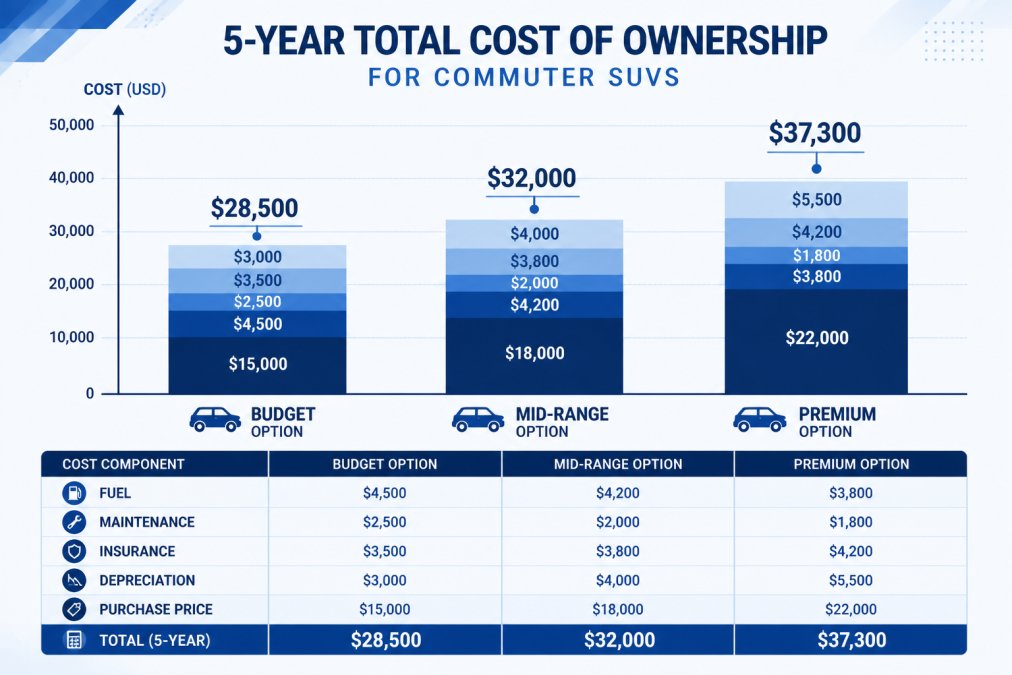
For a typical commuter driving 12,000 miles annually, fuel costs range from $1,800-$2,400 over five years. Maintenance costs vary by brand: Japanese brands average $400-$600 annually, American brands average $500-$700 annually. Insurance typically ranges from $750-$1,000 annually.
Depreciation represents the largest ownership cost. A $25,000 new vehicle typically depreciates 50-60% over five years. A used vehicle depreciates more slowly. An $18,000 used vehicle might depreciate only 25-30%, losing $4,500-$5,400 in value.
A $25,000 new vehicle costs $37,500-$42,500 over five years when factoring in all ownership costs. An $18,000 used vehicle costs $28,000-$32,000 over the same period. For commuters planning to keep their vehicle 7+ years, purchase price becomes less important. A reliable used vehicle kept long-term costs significantly less per mile than trading every three years.
Compact vs. Midsize SUV for Daily Commuting
Compact SUVs deliver better fuel economy, typically 26-33 combined MPG, and are easier to park and maneuver in congested traffic. Midsize SUVs offer more interior space and third-row seating but suffer in fuel economy, typically 22-26 combined MPG.
For daily commuting, compact SUVs make more sense. You're trading unused interior space for better fuel economy and easier maneuverability. Unless you regularly transport families or haul cargo, the compact size is optimal.
What to Look for When Buying a Used SUV
Prioritize reliability over features when buying a used SUV for commuting. Check the vehicle's history report through Carfax or AutoCheck for accident and title history. Look for single-owner vehicles with complete service records. Avoid vehicles with salvage titles, flood damage, or major accidents.
Test drive the vehicle on varied terrain: city streets, highway, and rough roads. A 30-minute test drive reveals issues that a quick spin around the lot misses.
Negotiate based on market value using Kelley Blue Book for used vehicle pricing or NADA Guides for market value estimates.
Get a pre-purchase inspection from an independent mechanic before committing. This $100-$200 investment prevents $2,000-$5,000 repair surprises. Consider certified pre-owned vehicles when available; they typically cost $500-$1,500 more but include manufacturer warranty coverage and documented inspection.
At AutoSport USA, our vehicle finder tool helps you compare specific models, review detailed maintenance history, and schedule test drives online. Our online loan calculator shows exactly what your monthly payment will be before you visit. We offer guaranteed credit approval and transparent pricing, no hidden fees or surprise charges. Apply online to start your search for the best used SUV for your daily commute.
Finding the right used SUV for daily commuting requires balancing reliability, fuel efficiency, comfort, and total ownership costs. The Toyota RAV4, Honda CR-V, and Mazda CX-5 represent the most practical choices for commuters who value dependability and reasonable maintenance costs. At AutoSport USA, we specialize in helping commuters find vehicles that deliver real value, with simplified online financing, trade-in valuations, and our vehicle finder tool. Get started today and discover why thousands of commuters trust us to find their perfect daily driver.
Frequently Asked Questions
Q: What is the best used SUV for a daily commute?
A: The best used SUV for daily commuting depends on your budget and priorities. Toyota RAV4 and Honda CR-V lead in reliability and resale value, making them excellent long-term investments. Mazda CX-5 offers a more premium feel with lower maintenance costs. For budget-conscious buyers, Hyundai Tucson and Nissan Rogue provide modern features and good fuel economy. Consider fuel efficiency, maintenance history, safety technology, and total cost of ownership when making your decision.
Q: Which used SUVs are most fuel efficient for commuting?
A: Fuel efficient used SUVs for commuting include the Toyota RAV4 Hybrid (up to 40+ MPG combined), Honda CR-V with good baseline efficiency, and Ford Escape Hybrid models. Nissan Rogue and Chevrolet Equinox also deliver respectable fuel economy around 27-33 MPG combined. Hybrid and plug-in hybrid options significantly reduce fuel costs on long daily commutes. Check the specific model year and powertrain, as efficiency varies considerably across generations.
Q: What are the most reliable used SUVs under 20k?
A: Most reliable used SUVs under 20k typically include 2015-2017 model year Toyota RAV4, Honda CR-V, and Mazda CX-5. Hyundai Tucson (2021 and newer) and Nissan Rogue (2017 and newer) also offer solid reliability at this price point. Focus on vehicles with complete service history, lower mileage, and no major accident history. Have any used SUV inspected by a trusted mechanic before purchase to verify mechanical condition and identify potential repairs.
Q: How do I inspect a used SUV before buying?
A: Start with a pre-purchase inspection covering engine condition, transmission fluid, brakes, tires, suspension, and electronics. Check service records for regular maintenance like oil changes and scheduled repairs. Look for rust, accident damage, and interior wear. Test all safety features including blind-spot monitoring, adaptive cruise control, and lane-keeping assist. Have a certified mechanic perform a comprehensive inspection to identify hidden issues. Review the vehicle history report for past accidents or title problems before committing to purchase.
Q: Should I buy a compact or midsize SUV for commuting?
A: Compact SUVs like Toyota RAV4 and Honda CR-V are ideal for most daily commuters, offering better fuel economy, easier parking, and lower purchase prices. Midsize SUVs provide more cargo space and passenger room, beneficial if you regularly transport families or equipment. Compact models dominate the used market with strong reliability records and resale value. Consider your commute distance, cargo needs, and budget. Compact SUVs typically deliver 25-33 MPG combined, while midsize models average 20-26 MPG, impacting long-term fuel costs significantly.
This article was written using GrandRanker