 how-to
How to Negotiate a Used Car Price Like a Pro
Table of Contents
- Research Fair Market Value Before You Walk In
- Get Pre-Approved Financing to Strengthen Your Position
- Inspect the Vehicle and Document Condition for Use
- Understanding Out-the-Door Price Calculation
- Using Trade-In Value as a Negotiation Tool
- Negotiation Scripts That Work in Real Situations
- How to Handle Dealer Add-Ons and Fees
- Know When to Walk Away From a Bad Deal
- Frequently Asked Questions
Last Updated: September 23, 2026
Research Fair Market Value Before You Walk In
Know what a used car is actually worth before you shop, this is your foundation for how to negotiate a used car price like a pro.
Check Kelley Blue Book and NADA Guides for fair market value based on year, make, model, mileage, and condition. Write down the price range, this becomes your anchor.
Check what similar vehicles sell for locally, as prices vary by region.
Pull a vehicle history report from Carfax or AutoCheck to identify accidents, title issues, and service gaps, these give you leverage to negotiate lower.
Key research steps:
- Check Kelley Blue Book for fair market value
- Review NADA Guides for regional pricing
- Look at 5-10 similar cars for sale locally
- Pull a vehicle history report
- Note any accidents or service gaps
When you walk in knowing the fair market value, you're not guessing. You're negotiating from facts, not emotions.
Get Pre-Approved Financing to Strengthen Your Position
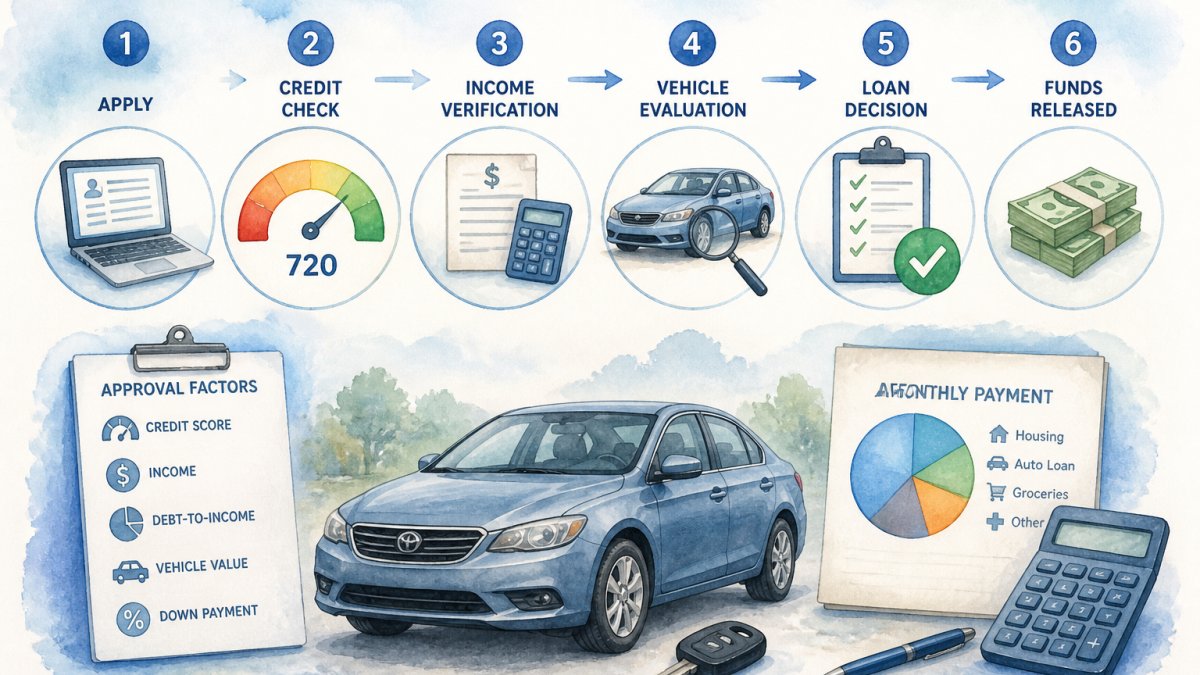
Pre-approval is one of the strongest tools when learning how to negotiate a used car price like a pro, it shows dealers you're serious and ready to buy.
Contact your bank or credit union before shopping. They'll check your credit and provide a pre-approval letter with a specific loan amount and interest rate.
Pre-approval locks in your interest rate, shows dealers you have outside financing, and gives you a clear budget limit.
When you show pre-approval, dealers know they can't trap you with a bad loan deal, shifting power to your side.
Pre-approval advantages:
- Locks in your interest rate
- Shows dealers you're serious
- Gives you a clear budget limit
- Reduces finance office pressure
Don't mention your pre-approval immediately. Wait until the dealer asks how you're financing. Then you can decide whether to use their financing or yours.
Inspect the Vehicle and Document Condition for Use
A pre-purchase inspection finds problems you can use to negotiate the price down.
Hire a trusted mechanic to inspect the car ($100-200). They'll check the engine, transmission, brakes, suspension, and electrical systems and provide a written report.
Walk through the inspection with the mechanic if possible. Get repair cost estimates, these become your negotiation points.
Take photos of any damage. Dents, scratches, worn tires, stains inside. Document everything. When you sit down to negotiate, you have proof of every issue.
If the inspection finds major problems, walk away or use the repairs to justify a lower price.
Inspection documentation:
- Get a written mechanic's report
- Take photos of all damage
- Note repair costs for each issue
- Use findings to justify lower offers
We recommend always getting an inspection, even if you buy from a dealer with a warranty. You're protecting your investment.
Understanding Out-the-Door Price Calculation
The out-the-door price is what you actually pay, not the sticker price, but everything combined.
The out-the-door price includes the vehicle price, sales tax, title and registration fees, dealer fees, and any add-ons.
Sales tax is typically 5-8% of vehicle price. Title and registration fees run $100-300. Dealer fees (doc fees, prep, advertising) can add $500-1,500.
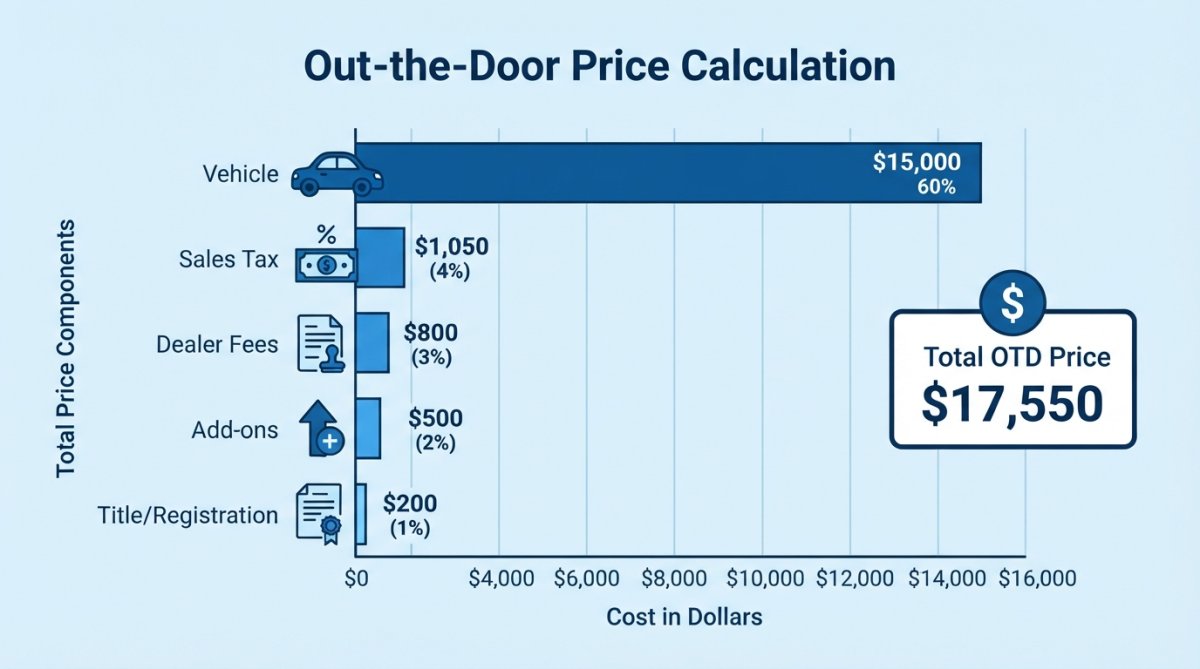
Ask for an itemized breakdown before negotiating so you can challenge individual fees.
Out-the-door price components:
- Vehicle purchase price
- Sales tax (5-8%)
- Title and registration fees
- Dealer doc fees
- Add-on packages
- Extended warranties
The sticker price is just the start. The out-the-door price is what matters. Always ask for the total before you commit to anything.
Using Trade-In Value as a Negotiation Tool
Most buyers don't understand how dealers value trade-ins, so they leave money on the table.
Get your trade-in appraised before shopping. Check Kelley Blue Book and visit 3+ dealers to compare offers.
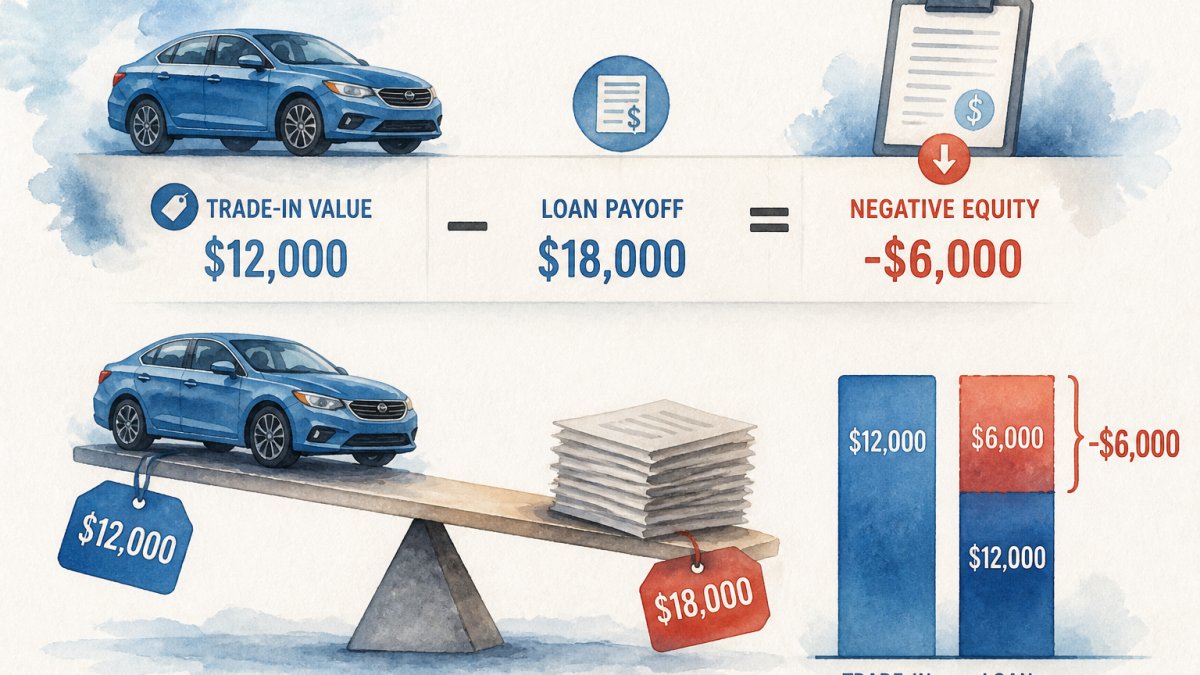
Dealers often undervalue trade-ins. If your car is worth $8,000, a dealer might offer $6,500, a $1,500 loss.
Negotiate the new car price first, then negotiate your trade-in separately so you can push back with your research.
Some dealers hide the real deal by offering a great trade-in but charging more for the new car. Always negotiate vehicle price first, then trade-in.
Trade-in strategy:
- Get appraisals from 3+ dealers
- Know your car's fair market value
- Negotiate new car price first
- Then negotiate trade-in value
- Don't let dealers bundle them together
We provide transparent trade-in valuations. You can see what your current vehicle is worth before you shop.
Negotiation Scripts That Work in Real Situations
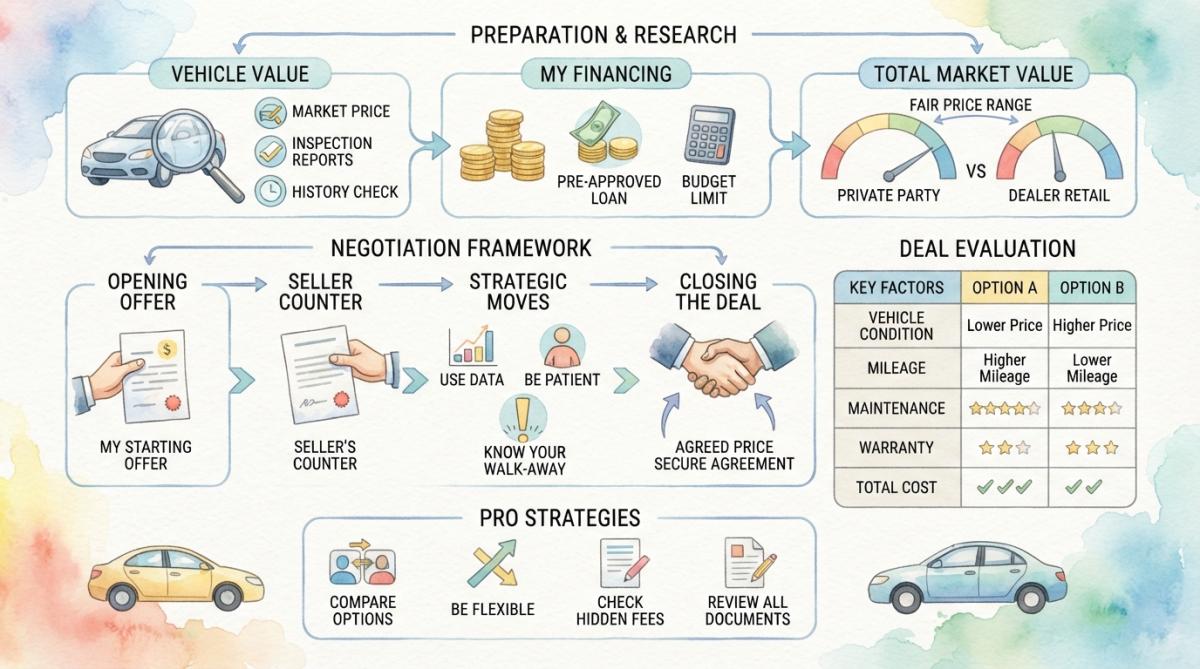
Psychology, not scripts, wins negotiations. Understanding key tactics shifts power in your favor.
Anchoring: Set the First Number
Whoever sets the first number anchors the entire negotiation. Set your anchor first, not the dealer.
Set a low but defensible anchor backed by research. If fair market value is $14,500, open with $13,800: "I've researched comparable vehicles. Similar cars are priced $13,800 to $14,200. I'd like to start at $13,800 based on the inspection findings."
Silence: Your Most Powerful Tool
Mirroring: Match Their Energy and Pace
Emotional Detachment: Separate Yourself From the Car
The Takeaway Script
Combine these tactics into a real conversation:
You: "I've researched this car thoroughly. Comparable vehicles are selling for $13,800 to $14,200. Your asking price is $15,200. I'd like to start at $13,900 based on the inspection findings." [Then you stop and wait.]
Dealer: "That's too low. I can do $14,800."
[You pause. You don't respond immediately.]
[Silence again. You wait.]
Common Mistakes That Kill Your Position
- Over-explaining: Short, factual statements are stronger than long justifications.
- Showing emotion: Stay calm and measured.
- Accepting the first counter: Negotiate back and forth; dealers expect it.
- Negotiating monthly payment: Always negotiate out-the-door price, not payment. Dealers extend loans to lower payments, costing you thousands in interest.
How to Handle Dealer Add-Ons and Fees
Dealers make most profit in the finance office. You can lose negotiated savings here if you're not careful.
The Finance Office Trap
Once you sign, backing out is difficult and costly.
The Contract Review Checklist
Vehicle Information Section
- Verify year, make, model, mileage, and VIN
- Check color and trim level
- Confirm odometer reading
Price Breakdown Section
- Vehicle price: Match your negotiated price, not the asking price
- Trade-in value: Match your separate negotiation
- Sales tax: Verify by multiplying vehicle price by your state's rate
- Title and registration: Match your state's standard fees
- Doc fees: Standard is $75-$200. Challenge anything higher; many dealers will reduce if you push back
- Dealer prep: Should be $0-$300. Anything higher is negotiable
- Advertising fees: Challenge these; often not required
- Dealer-installed add-ons: If you didn't agree to them, they shouldn't be on the contract
Financing Section
- Loan amount: Verify it equals vehicle price plus taxes and fees, minus trade-in and down payment
- Interest rate: Should match your pre-approval or be lower. If higher, ask why, dealers sometimes mark up rates
- Loan term: Verify it matches your negotiation (36, 48, 60, or 72 months)
- Monthly payment: Verify the math with an online calculator
- Total amount financed: Should be clearly stated
Add-Ons and Extended Warranties Section
- Extended warranty: Decline unless you want third-party coverage
- Gap insurance: Get from your lender, not the dealer (dealer charges 50-100% more)
- Paint/fabric/wheel protection: Decline unless you specifically want them
- Service contracts: Rarely worth the cost; decline unless buying high-mileage luxury vehicle
Red Flags That Mean You Should Not Sign
- Vehicle price is higher than negotiated
- New fees appear that weren't mentioned
- Interest rate is higher than pre-approval
- Add-ons you didn't agree to are listed
- Contract language is unclear
- Finance manager is rushing you
- Monthly payment is higher than quoted
What to Do If Something Is Wrong
After You Sign
The Bottom Line
Know When to Walk Away From a Bad Deal
Your willingness to walk away is your most powerful negotiation tool.
Stand up, say "I'm not interested," and leave.
Walk-away checklist:
- Price exceeds your budget
- Major repairs needed
- Dealer won't negotiate fairly
- You feel pressured
- Finance terms are worse than pre-approval
- Gut feeling says something's wrong
| Negotiation Step | Purpose | Timing |
|---|---|---|
| Research fair market value | Set your price anchor | Before shopping |
| Get pre-approved financing | Show you're serious | Before shopping |
| Inspect vehicle | Find repair issues | After selecting a car |
| Calculate out-the-door price | Know total cost | Before negotiating |
| Negotiate vehicle price | Lower the base price | First negotiation |
| Negotiate trade-in value | Maximize your trade | Second negotiation |
| Decline add-ons | Avoid profit padding | During finance office |
| Know your walk-away point | Stay disciplined | Throughout process |
Frequently Asked Questions
How much can you realistically negotiate off a used car price?
Negotiation range depends on the vehicle's age, condition, and market demand. Typically, you can negotiate 5-15% off the asking price on used cars, with older or higher-mileage vehicles offering more room. The key is knowing the fair market value before entering negotiations. Pre-purchase inspections and vehicle history reports give you concrete leverage to justify lower offers based on needed repairs or maintenance.
What's the difference between negotiating the out-the-door price versus the monthly payment?
Always negotiate the out-the-door price first. Dealers often lower the monthly payment while extending loan terms or inflating add-ons, costing you more overall. Out-the-door price includes the vehicle price, sales tax, title, registration, and all fees. Once you lock in that number, financing terms follow naturally. Monthly payments are a distraction that hides the true cost of the vehicle.
Does having a pre-approved loan help with price negotiations?
Yes, significantly. Pre-approval from your bank or credit union removes dealer financing leverage and shows you're a serious buyer with cash backing. You can walk away if the dealer won't match your approved rate or terms. It also speeds closing and gives you negotiating power because the dealer knows you have options. Even if you ultimately finance through the dealer, the pre-approval puts you in control.
What should I do if the dealer adds hidden fees at the final stage?
Stop and ask for an itemized breakdown of every fee. Legitimate charges include doc fees, title transfer, registration, and sales tax. Questionable add-ons like extended warranties, gap insurance, or dealer prep should be negotiable or removable. If fees weren't disclosed upfront, push back firmly. You have the right to walk away, and dealers know this. Many will drop or reduce fees rather than lose the sale.