 comparison
Trade In Value vs Private Sale: 2026 Comparison Guide
Table of Contents
- Trade In Value vs Private Sale: The Quick Comparison Table
- Trade-In Pros and Cons: Instant Liquidity vs Wholesale Value
- Private Sale Pros and Cons: Retail Value vs Time and Risk
- The Math: Trade-In Value vs Private Sale Net Proceeds
- Tax Benefits of Trading In a Car: How the Sales Tax Credit Works
- Get Trade In Appraisal Online: Tools and What to Expect
- How to Prepare Car for Private Sale (And Hybrid Strategies)
- Frequently Asked Questions
Last Updated: September 13, 2026
Trade In Value vs Private Sale: The Quick Comparison Table
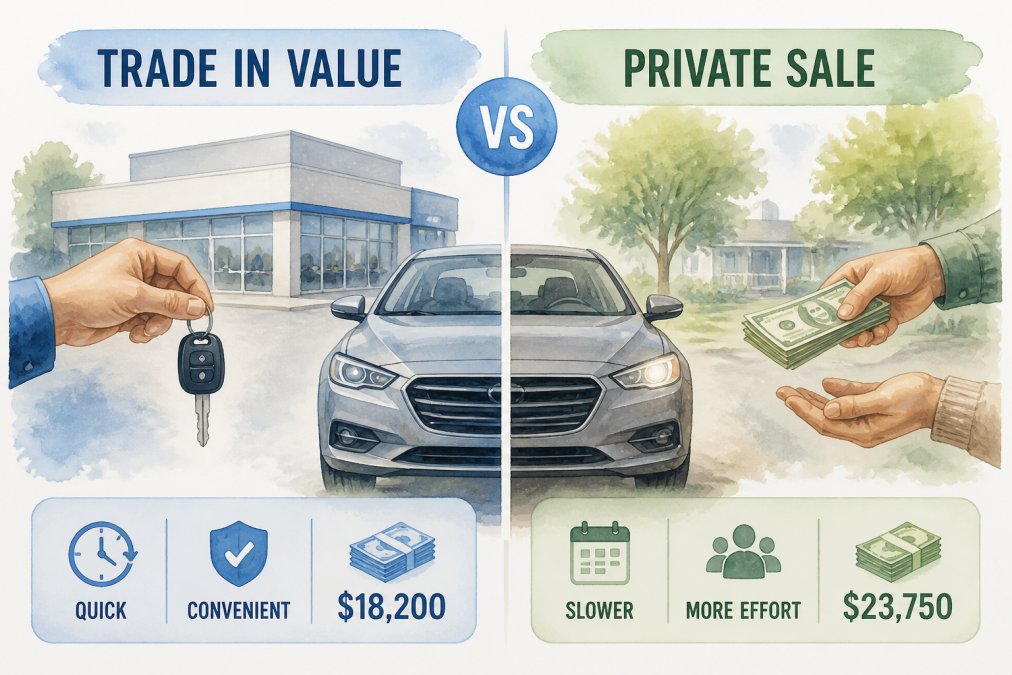
The trade in value vs private sale decision comes down to a simple trade-off: a private sale typically nets more money, while a dealer trade-in delivers speed, security, and a sales tax credit. The right answer depends on your tolerance for tire-kickers and paperwork.
Trade-in value is the amount a dealership pays for your vehicle, usually based on wholesale market data. A private party sale is what an individual buyer pays you directly, typically closer to retail value.
| Factor | Dealer Trade-In | Private Sale |
|---|---|---|
| Typical payout | Wholesale value | Retail value |
| Time to close | Same day | Days to weeks |
| Sales tax credit | Yes | No |
| Paperwork | Dealer handles | You handle |
| Safety risk | Minimal | Buyer vetting required |
That table is the short version. The long version involves tax math, liability, and your calendar.
Trade-In Pros and Cons: Instant Liquidity vs Wholesale Value
Instant liquidity is the trade-in's strongest selling point. You sign, you hand over the keys, and the dealer applies the value directly to your next vehicle. No strangers at your door, no cashier's checks to verify.
The trade-off is wholesale pricing. Dealers buy low because they carry reconditioning and resale risk. According to Kelley Blue Book's trade-in valuation guidance, trade-in offers generally land below private-party figures for the same vehicle.
- Pro: Same-day transaction speed
- Pro: Dealer manages title transfer and lienholder payoff
- Pro: Sales tax credit reduces your taxable purchase amount
- Con: Lower raw dollar amount
- Con: Limited negotiation use once you're at the desk
Private Sale Pros and Cons: Retail Value vs Time and Risk
Retail value is the private sale's payoff. You set the asking price against fair market value and keep the difference the dealer would have captured.
What you pay for that upside is time and risk. You'll field lowball offers, arrange test drives, and manage a bill of sale. A vehicle history report and honest as-is condition disclosure protect you, but buyer vetting still falls on you. FTC guidance on vehicle sales reminds sellers that misleading representations about condition carry legal exposure.
- Pro: Higher net proceeds
- Pro: You control pricing and negotiation
- Con: Advertising fees and detailing costs come out of pocket
- Con: Test drive safety and payment fraud are real concerns
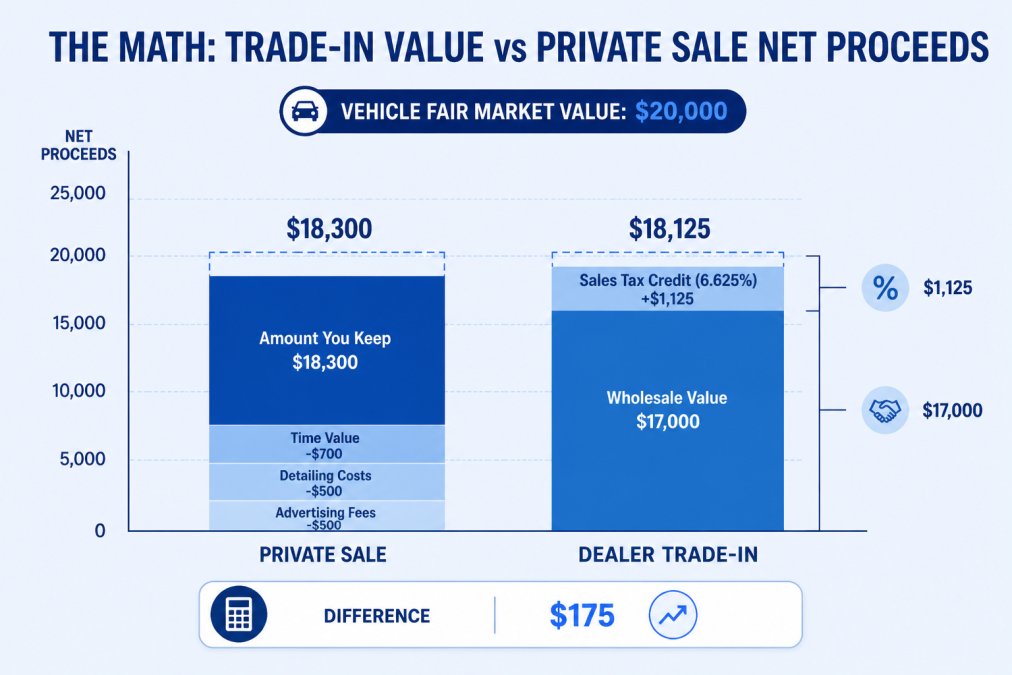
The Math: Trade-In Value vs Private Sale Net Proceeds
Net proceeds, not sticker price, decide this comparison. Most guides show one example and stop. The useful version is a formula you can run with your own numbers in about two minutes.
The break-even formula
Let:
P= realistic private-party sale price (not your asking price, the price cars like yours actually close at)T= written dealer trade-in offerr= your state and local sales tax rate on the replacement vehicle (as a decimal)C= total private-sale costs (advertising, detailing, history report, temporary insurance, time value)L= liability and fraud exposure you assign to a private transaction (a judgment call, not a hard number)
The private sale wins when:
P - C - L > T + (T x r)
Rearranged, the trade-in wins whenever:
P - T < C + L + (T x r)
That last line is the whole decision. The private sale only beats the trade-in when your price premium over the dealer offer exceeds your out-of-pocket costs, your risk tolerance, and the tax credit combined.
A worked example
Assume a vehicle with a $20,000 fair market value, a $17,000 dealer trade-in offer, and a 6.625% combined sales tax rate on the replacement purchase.
- Tax credit value: $17,000 x 0.06625 = $1,126
- Private sale gross: $20,000
- Private sale costs: $150 advertising, $200 detailing, $40 history report, plus your time
- Private sale net before risk: $19,610
- Trade-in net equivalent: $17,000 + $1,126 = $18,126
The private sale still wins here, but by roughly $1,484, not the $3,000 the sticker prices suggest. Add a single week of missed work, a failed inspection, or a buyer who walks after a test drive, and the gap compresses further.
Where the math flips
The trade-in wins when any of these is true:
- Your realistic private price is less than about 8-10% above the dealer offer in a state with a sales tax credit
- Your vehicle needs reconditioning a private buyer will negotiate down on
- You are in a no-credit state, which removes the $1,126 from the trade-in side entirely
- Your replacement purchase is large enough that the tax credit scales with it
Hidden costs most sellers forget
- Advertising that renews weekly whether or not the car sells
- Detailing that has to be redone after every serious test drive
- A second vehicle's insurance and registration while you wait
- Payment fraud risk on cashier's checks and peer-to-peer transfers
- The opportunity cost of holding a depreciating asset for three extra weeks
Tax Benefits of Trading In a Car: How the Sales Tax Credit Works
The tax benefits of trading in a car hinge on one mechanic: in states that allow it, the trade-in value reduces the taxable price of your replacement vehicle. Trade in a $17,000 car toward a $30,000 purchase, and you pay sales tax on $13,000, not $30,000.
The formula
Tax credit = trade-in value x combined sales tax rate
Taxable amount on new purchase = purchase price - trade-in value
Use the combined rate, state plus county plus city, because the credit applies against whatever rate your jurisdiction charges on the new vehicle. A 6.625% combined rate on a $17,000 trade-in produces a $1,126 credit. The same trade-in in a 9.5% jurisdiction produces $1,615.
Why the credit is not universal
A minority of states do not allow a trade-in tax credit at all, and a few apply it only to dealer sales, only to new vehicles, or only up to a cap. Some states also require the trade-in and the purchase to occur in the same transaction, which rules out selling privately first and buying later. Because these rules change, verify the current treatment with your state department of revenue before you commit to either path.
The trap most sellers fall into
Selling privately and then buying within a short window does not restore the credit in most states. Once the vehicle is titled to an individual, the dealer cannot apply it as a trade-in. There is no retroactive fix.
How to compare the credit against a higher private offer
Divide the credit by the private sale premium you expect:
Break-even premium = tax credit / private sale price
If the credit is $1,126 and your realistic private price is $20,000, the credit alone offsets about 5.6% of the private sale. Any private premium above that percentage is real gain; anything below it is a loss dressed up as a higher sale price.
Documentation to keep
- The dealer's written trade-in offer showing the applied value
- The purchase agreement showing the reduced taxable amount
- The title transfer or lien release confirming the trade-in was credited
- Your state's current guidance on trade-in credits, saved or printed
IRS guidance on vehicle sales and taxable transactions is a useful starting point for how vehicle transactions are treated federally, but the trade-in credit itself is a state sales tax rule, not a federal one.
Get Trade In Appraisal Online: Tools and What to Expect
Getting a trade-in appraisal online takes minutes and gives you a baseline before you negotiate. Tools like Kelley Blue Book and CarSaver generate instant estimates from your VIN, mileage, and condition.
Expect a range, not a final number. Online appraisals use market data; a physical inspection confirms it. AutoSport USA provides financing tools to show how equity applies to your next vehicle.
| Tool | Best For | Cost |
|---|---|---|
| Kelley Blue Book | Baseline valuation | Free |
| CarSaver | Trade-in vs private comparison | Free |
| AutoSport USA | Firm local appraisal | Contact for quote |
How to Prepare Car for Private Sale (And Hybrid Strategies)
Preparing a car for private sale means maximizing curb appeal while protecting yourself legally. Clean it thoroughly, gather service records, pull a vehicle history report, and price it against real market listings.
The hybrid strategy is the one most sellers overlook: get a dealer trade-in offer first, then list privately at a higher price. If your car doesn't sell within your window, you still have a guaranteed backup and a documented floor for negotiation.
- Wash, wax, and detail interior
- Gather maintenance records and spare keys
- Obtain a vehicle history report
- Get a written dealer trade-in offer as your floor
- Draft a bill of sale with as-is language
- Meet buyers in a public, well-lit location
Frequently Asked Questions
Is it better to trade in or sell privately?
It depends on your priority. A private sale usually nets more cash because you capture retail value instead of wholesale value. But a dealer trade-in is faster, eliminates test drive safety risks, and in most states reduces the sales tax you pay on your next vehicle. Run both numbers, including the tax credit, before deciding.
What are the tax benefits of trading in a car?
In most states, the trade-in value is subtracted from the purchase price of your new vehicle before sales tax is calculated. If you trade in a car worth $15,000 toward a $30,000 purchase and your tax rate is 6%, you pay tax on $15,000 instead of $30,000. That saves you roughly $900, which often closes much of the gap between trade-in and private sale offers.
Why is trade-in value lower than private sale value?
Dealers buy at wholesale value because they need margin to recondition the car, cover overhead, and resell it at retail. A private buyer pays closer to retail because they are the end user. That spread between wholesale and retail is the core reason trade-in offers come in lower, not because the dealer is undervaluing your car.
How long does a private car sale take compared to a trade-in?
A dealer trade-in can be completed in a few hours during your purchase. A private sale typically takes two to six weeks from listing to cash in hand, depending on your price, vehicle demand, and local market timing. You also handle buyer vetting, test drives, title transfer, and bill of sale paperwork yourself.
What documents do I need to prepare for a private sale versus a trade-in?
For a private sale, you need the title (or lienholder release if financed), a bill of sale, a vehicle history report, and maintenance records. For a trade-in, the dealer handles title transfer and paperwork, but you should bring your title or loan payoff information, registration, and both sets of keys.
Deciding between a trade-in and a private sale shouldn't cost you weeks of uncertainty. AutoSport USA offers professional trade-in appraisals, online financing tools to calculate your equity, and a diverse inventory of quality used vehicles to apply your value toward. Get started with AutoSport USA and turn your current car into your next one with a predictable, transparent process.