 how-to
Used Car Trade In Value Factors: Get a Fair Offer
Table of Contents
- How Dealerships Calculate Your Trade In Value
- 7 Key Used Car Trade In Value Factors
- How to Maximize Trade In Value Before You Visit
- Your Used Car Appraisal Checklist
- Why You Should Get a Trade In Appraisal Online First
- Common Trade-In Mistakes That Cost You Money
- Conclusion
- Frequently Asked Questions
Last Updated: September 8, 2026
Trading in a used car often feels like a guessing game where the dealership holds all the cards. Understanding the used car trade in value factors that appraisers actually use is the difference between accepting a lowball offer and driving away with a fair deal. Understanding the used car trade in value factors that appraisers actually use is the difference between accepting a lowball offer and driving away with a fair deal.
Below, we'll break down how dealerships calculate your offer, walk through the seven factors that matter most, and give you a practical checklist to use before you visit.
How Dealerships Calculate Your Trade In Value
A dealership's first offer is a business calculation built around what the dealer expects to sell the car for, minus the costs to make it market-ready, minus the profit they need to keep the lights on.
Trade-in value is the wholesale price a dealer expects to pay, not the retail price you see on a lot. The gap covers reconditioning costs, detailing, certification, advertising, and operating expenses, explaining why your offer will always sit below similar online listings.
Wholesale vs. Retail Pricing and Dealer Profit Margin
Dealers use valuation tools and live auction data to establish a wholesale baseline, what the vehicle would fetch at a dealer-only auction. From there, they add estimated reconditioning costs and a target profit margin to arrive at the retail asking price.
Your trade offer starts near that wholesale figure. If your car needs new tires, has a dented bumper, or shows heavy wear, the dealer subtracts those reconditioning costs. This is why two identical cars can receive wildly different trade-in values. A realistic expectation is an offer between the wholesale price and the retail price, minus the dealer's profit margin (federalreserve.gov).
7 Key Used Car Trade In Value Factors
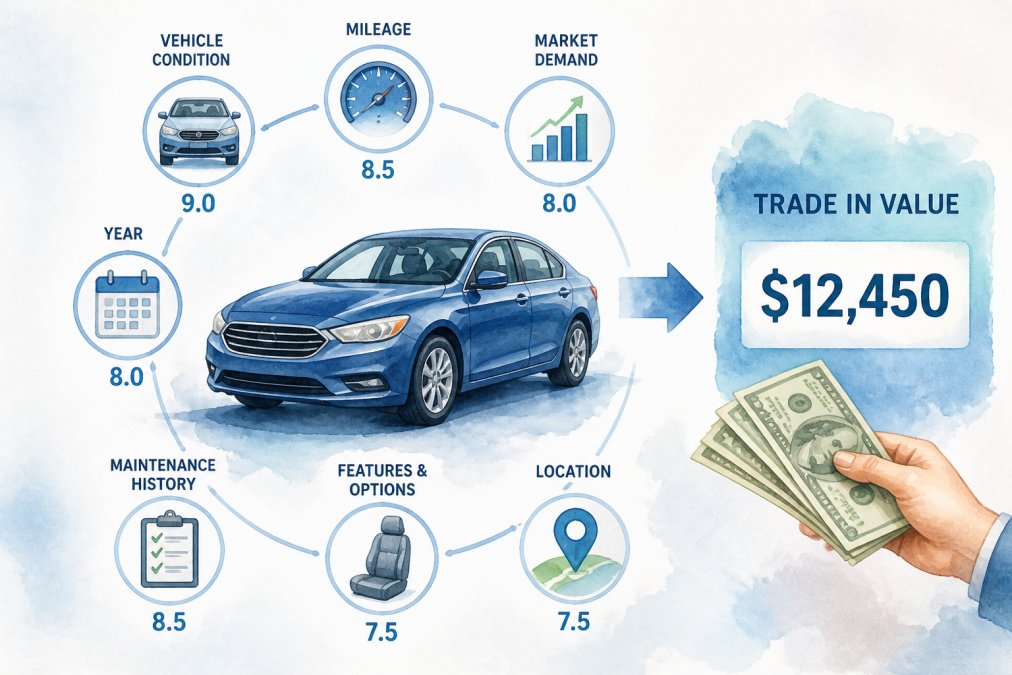
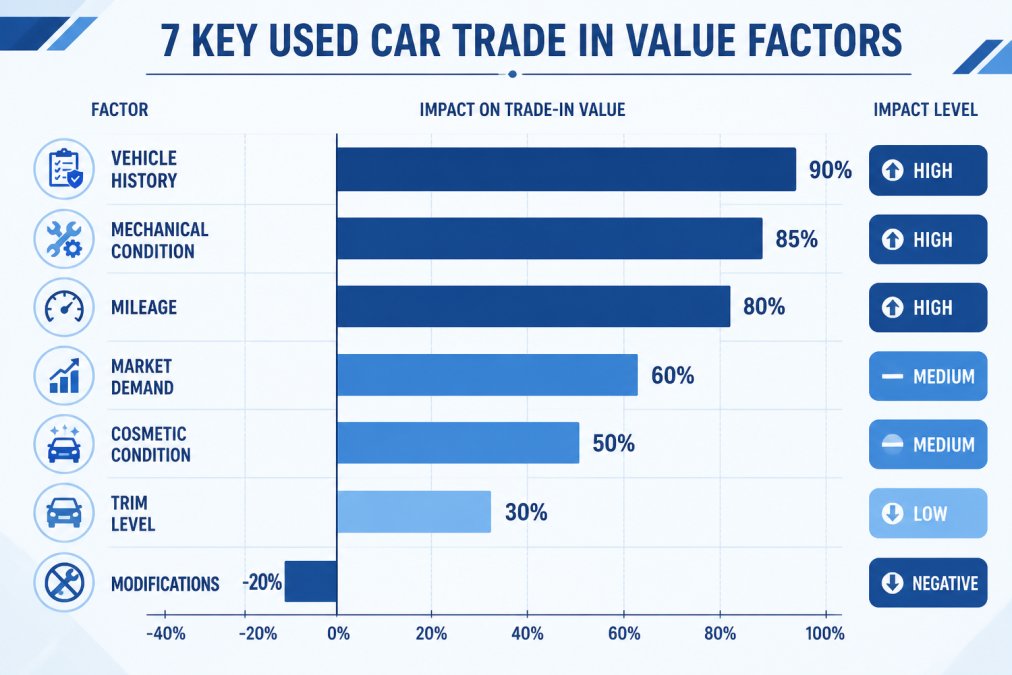
Not all factors carry equal weight. Dealerships prioritize mechanical and historical concerns over cosmetic preferences, so understanding this hierarchy helps you focus your preparation where it pays off.
Mileage, Condition, and Vehicle History
The three heaviest hitters are mileage, mechanical condition, and vehicle history. A lower odometer reading signals less wear on the engine, transmission, and brakes, translating to a higher resale value. While the dollar impact varies by make and model, a car with significantly fewer miles than average will always command a premium.
Mechanical condition goes beyond how the car sounds on a test drive. Appraisers check engine performance, transmission smoothness, brake condition, and tire tread depth. A vehicle with documented service records and a clean title tells a story of responsible ownership (consumer.ftc.gov). Conversely, a salvage title or reported accident can cut the offer dramatically, as it limits the dealer's ability to sell and often affects financing options.
Market Demand, Trim Level, and Aftermarket Modifications
Supply and demand operate at the regional level. A fuel-efficient sedan holds more trade-in value where gas prices are high, while a four-wheel-drive truck is worth more in regions with harsh winters. Dealers pay attention to what moves quickly on their lots, and consumer demand shapes how aggressively they bid.
Trim level matters more than most owners realize. Factory features like leather upholstery, a sunroof, or a premium audio package add value because they represent a higher original MSRP. However, aftermarket modifications rarely add value and often hurt it, since they appeal to a narrow buyer pool and many dealers expect a longer time on the lot. Consider whether returning your car to stock condition is worth the effort before trading it in.
How to Maximize Trade In Value Before You Visit
Preparation is the only part of the trade-in process you fully control. A few hours of work can add real dollars to your offer, but the single most overlooked lever is when you trade in. Dealerships operate on monthly, quarterly, and seasonal quotas that directly affect how aggressively they bid.
Timing the Trade-In Cycle for Maximum Leverage
Dealer sales targets reset monthly, and pressure intensifies in the final week (edmunds.com). A sales manager facing a shortfall on the 28th is far more willing to stretch on a trade-in allowance than on the 3rd. If your schedule is flexible, aim for a weekday visit during the last five business days of the month, ideally Monday or Tuesday when lot traffic is light.
Seasonality matters just as much. Convertibles and sports cars peak in late spring; four-wheel-drive trucks and SUVs command their strongest numbers in late autumn. Trading a convertible in November or a 4x4 in July means selling against the seasonal demand curve. Fuel-efficient sedans and hybrids spike when gas prices are elevated, so monitor regional fuel trends and time your trade accordingly.
There is also a model-year effect. When the next model year's vehicles arrive, typically late summer through early fall, dealers prioritize clearing current-year inventory, translating into more competitive offers on outgoing models. If your vehicle is about to be superseded by a redesign, trade it before the new generation lands, as the previous generation's wholesale value drops noticeably once the newer version is on the lot.
The Two-Week Preparation Sprint
Once you have picked your target window, use the two weeks before it for a focused preparation sprint. A spotless interior, a freshly detailed engine bay, and a vacuumed trunk signal that the car has been cared for, subtly influencing an appraiser's perception of its mechanical condition. Address minor cosmetic damage where it makes financial sense, a cracked windshield or burned-out headlight is a quick, inexpensive fix that removes an obvious deduction. Compare the cost of a $200 dent repair against the $400 deduction it would trigger; the math usually favors fixing it.
Gather your paperwork before you arrive. A folder with service records, the title, and any warranty documentation demonstrates a maintenance history that reduces the dealer's perceived risk. If you have a vehicle history report, bring it to confirm the clean title status. Finally, research your car's current market value using online tools, but set your expectations around the wholesale range rather than retail listings.
Your Used Car Appraisal Checklist
Bring this checklist with you to ensure you have addressed every factor that influences the final offer.
- Clean the interior and exterior thoroughly, including the trunk and engine bay.
- Fix minor issues like burned-out bulbs, cracked mirrors, and worn wiper blades.
- Document all service records and arrange them in chronological order.
- Locate the title and confirm there are no outstanding liens.
- Remove all personal items from the glovebox, trunk, and under the seats.
- Check tire tread depth and inflate all tires to the recommended pressure.
- Note your car's trim level and list any factory options it includes.
- Get a current odometer reading and compare it to average mileage for the model year.
- Research your car's wholesale value using a reputable valuation tool.
- Obtain a vehicle history report to verify a clean title and no accident records.
Working through this list takes about an afternoon, but it positions you as a prepared seller and removes the easy objections a dealer might raise.
Why You Should Get a Trade In Appraisal Online First
The traditional model requires you to drive to a dealership, wait for a manager to inspect your car, and negotiate face-to-face. An online appraisal flips that dynamic, giving you a baseline number before you invest time in a visit and letting you compare offers from multiple dealers. The real value lies in understanding why the online number and the final offer rarely match, and how to use that gap to your advantage.
Why Online Estimates Differ from Final Dealer Offers
Online valuation tools like Kelley Blue Book's Instant Cash Offer, CarMax's online appraisal, and Carvana's instant offer rely on the information you provide: year, make, model, trim, mileage, and condition. They generate a number based on regional market data and recent auction sales, a starting point, not a promise. When the dealer physically inspects your car, they verify your self-reported condition against a standardized checklist. A scratch you did not mention, a tire with 3/32nds of tread, or a check-engine light that just appeared will trigger deductions the online tool could not see.
There is also a structural difference in how the two numbers are built. Online instant offers from national buyers like Carvana or Carmax are often binding, valid for a set period (typically 7 to 30 days) and representing a firm purchase commitment. A dealership's online estimator, by contrast, is usually a soft quote the sales manager can adjust after inspection, factoring in their specific reconditioning costs, local inventory needs, and target profit margin.
Using the Discrepancy as a Negotiation Tool
This gap is not a flaw; it is leverage. When you arrive with a documented online offer from a national buyer, you have a concrete, third-party-validated number that anchors the conversation. If the dealer's inspection-based offer comes in lower, ask them to walk through each deduction line by line. Dealers will often match or beat a competing written offer rather than lose the sale, especially if you are also purchasing a vehicle from them. Present the online offer as a baseline, not a threat: "I have a firm offer from CarMax for $14,500. Can you get close to that?" rather than "Your number is too low."
Getting a trade in appraisal online is particularly valuable for understanding the range your car should command. When you receive an offer that seems low, you have a documented starting point for the conversation. Getting a trade in appraisal online is particularly valuable for understanding the range your car should command. When you receive an offer that seems low, you have a documented starting point for the conversation.
Common Trade-In Mistakes That Cost You Money
The most expensive mistake is accepting the first offer without question. Dealers expect negotiation, and there is almost always room to move, especially if you have done your homework on your car's wholesale value.
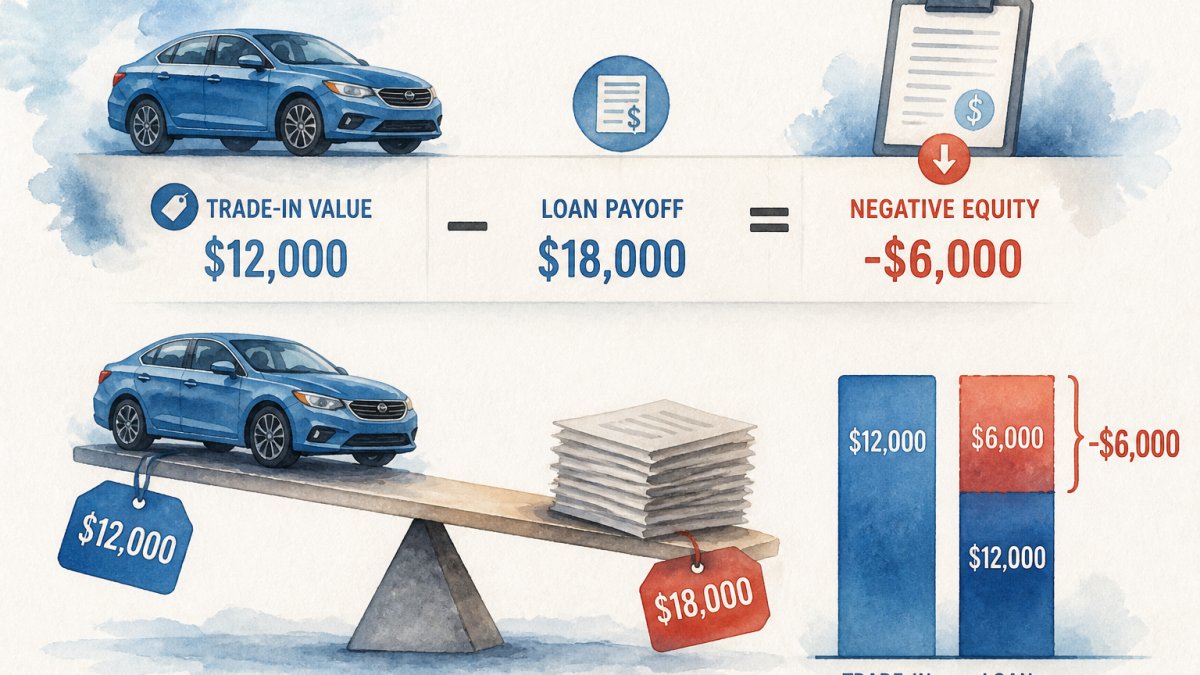
Another frequent error is focusing solely on the monthly payment rather than the total deal structure. A dealer can inflate your trade-in value while raising the price of the car you are buying, creating the illusion of a good deal. Always negotiate the trade-in value and the purchase price as separate numbers. Finally, know the loan balance on your current car, if you owe more than it is worth, you have negative equity, which gets rolled into your new loan.
Conclusion
Understanding the used car trade in value factors is the surest path to a fair offer. Mileage, mechanical condition, vehicle history, and market demand drive the number, while preparation and timing give you leverage. The process does not have to be adversarial, a dealer that provides transparent pricing and a straightforward appraisal process is worth its weight in gold.
At AutoSport USA, we believe the trade-in experience should be as seamless as the purchase. Our online financing tools and trade-in valuations are designed to give you clarity before you step onto the lot, and our team is committed to helping you get top value for your investment. Apply online today and see how straightforward a fair trade-in offer can be.
Frequently Asked Questions
How do dealerships calculate trade-in value?
Dealerships start with your car's wholesale value, which is what they expect to pay for it at auction. From that base, they subtract estimated reconditioning costs for any mechanical or cosmetic repairs needed to make it retail-ready. They then factor in your vehicle's mileage, age, condition, and local market demand. The final number also accounts for the dealer's profit margin and how much they want to sell the new car you're buying.
Does vehicle mileage significantly impact trade-in offers?
Yes, mileage is one of the strongest used car trade in value factors. Every 10,000 miles above the average for your vehicle's age reduces its wholesale value noticeably. A car with 60,000 miles is worth considerably more than the same model with 90,000 miles. Dealerships use mileage to predict future maintenance costs and resale risk, so it directly affects the offer you receive. Check your odometer reading against the market average before you negotiate.
How can I prepare my car to get the best trade-in value?
Start by gathering your service records to prove regular maintenance. A car with a documented history is easier to price at its top value. Address minor issues like burnt-out bulbs, low tire pressure, and a dirty interior, since these signal neglect. A thorough wash and vacuum costs little but improves the first impression. Get a trade in appraisal online first to establish a baseline, then compare it against in-person offers to maximize trade in value.
What is the $3000 rule for cars?
The $3000 rule is a guideline for buying, not selling. It suggests that any used car priced under $3,000 will likely need at least that much in immediate repairs. This logic applies to trade-ins in reverse: dealers assume an older, high-mileage car will require significant reconditioning to be resold. That assumption is built into their offer, which is why a car that runs well but looks rough still gets a low trade-in quote.