 ultimate-guide
Transparent Used Car Pricing Guide: 2026 Buyer's Playbook
Table of Contents
- What Transparent Used Car Pricing Actually Means for Buyers
- How Used Car Price Valuation Tools Work
- The Factors That Move a Transparent Market Value
- Hidden Fees in Used Car Sales and How to Spot Them
- How to Negotiate Used Car Price with Real Market Data
- Post-Purchase Price Protection: What Happens After You Sign
- Private Seller Transparency Checklist
- Conclusion
- Frequently Asked Questions
Last Updated: September 16, 2026
What Transparent Used Car Pricing Actually Means for Buyers
Transparent used car pricing is the practice of showing buyers the full, itemized cost of a vehicle before they commit, including the asking price, mandatory fees, and any add-ons, rather than revealing charges at the finance desk. This guide from AutoSport USA breaks down how used car pricing really works so you can walk into any deal knowing the numbers.
How Used Car Price Valuation Tools Work
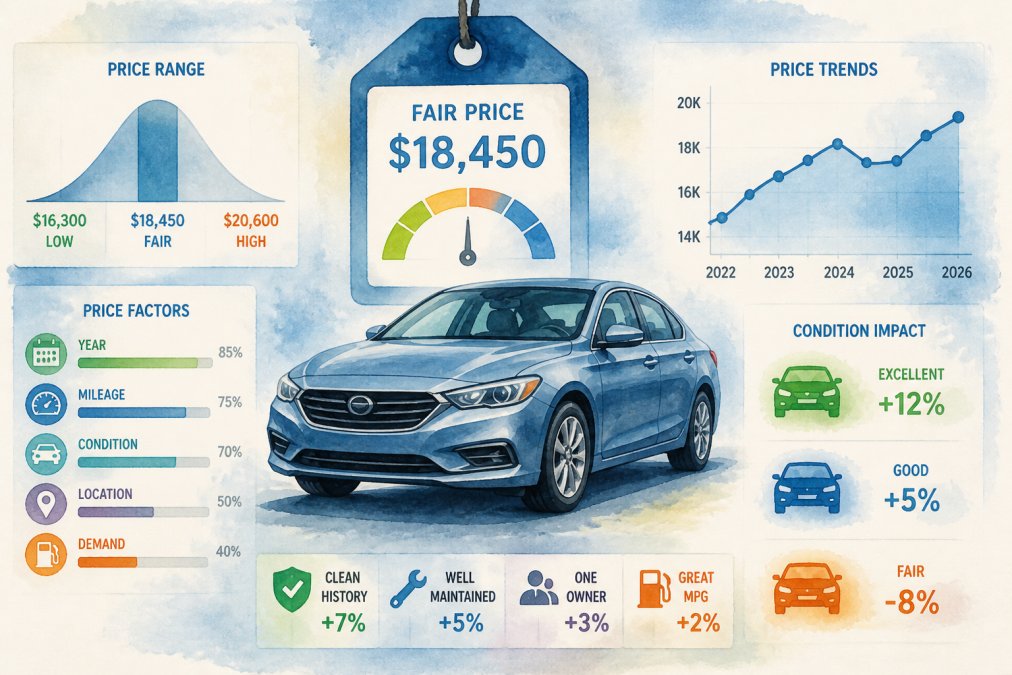
A vehicle appraisal tool estimates what a specific car is worth by combining its VIN, odometer reading, and vehicle condition with recent transaction data from regional auctions and listings. The output is a fair market range, not a single fixed number.
Here's the sequence a typical valuation algorithm follows:
- Decode the VIN to confirm trim, engine, and factory options
- Pull the odometer reading and adjust for above- or below-average mileage
- Score vehicle condition, including accident history and title status
- Compare against recent regional sales for the same model year
- Apply a regional market adjustment for local supply and demand
Free vs. Paid Valuation Tools: What You Get
Free tools give you a ballpark trade-in value and a rough private party value. Paid tools add VIN lookup history, auction-level transaction data, and a market value index you can track over time.
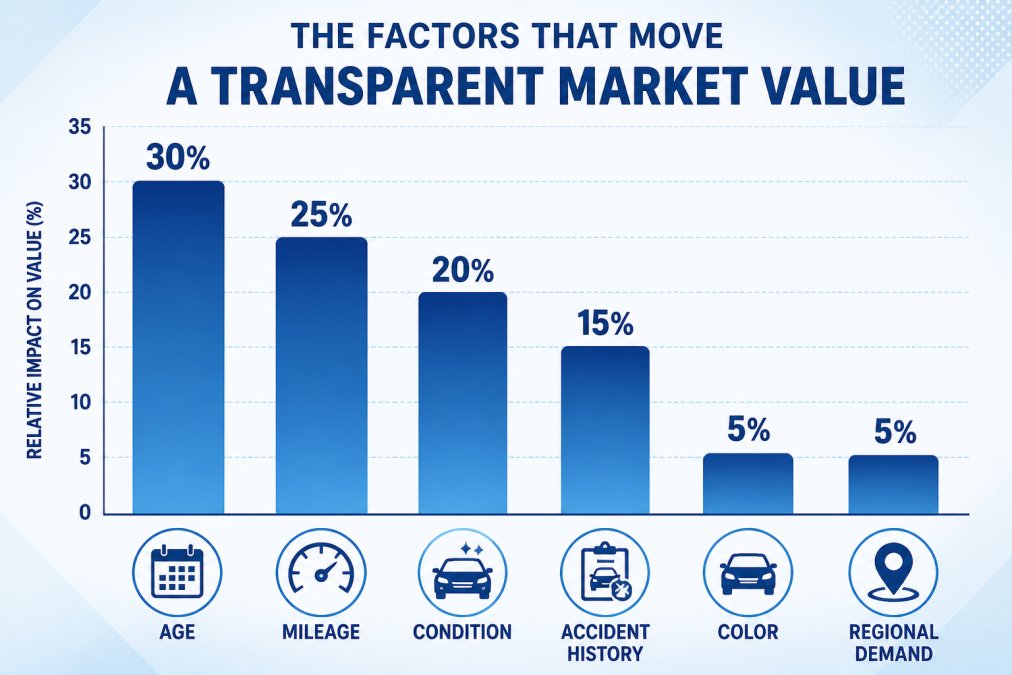
The Factors That Move a Transparent Market Value
Depreciation isn't random. It follows a predictable curve, and knowing which factors carry the most weight tells you where to push back in a negotiation.
VIN Lookup and Vehicle History Reports
A VIN lookup confirms the car's identity, while a vehicle history report reveals title status, accidents, odometer rollovers, and prior use as a rental or fleet vehicle. Both are non-negotiable before you agree on a price.
Hidden Fees in Used Car Sales and How to Spot Them
Hidden dealership fees are charges added after you've agreed on a price, and they're the single most common reason a "great deal" stops being one. The fix is to demand an all-in, out-the-door price in writing before you discuss financing terms.
Watch for these, and ask whether each is mandatory:
- Documentation or "doc" fees
- Dealer preparation and reconditioning charges
- Market adjustment or "additional dealer markup"
- VIN etching, paint sealant, or fabric protection
- Nitrogen tire fills and wheel locks
- Extended warranty pressure at the finance desk
How to Negotiate Used Car Price with Real Market Data
The best negotiators arrive with three numbers: the fair market range, the private party value, and a competing offer. But knowing the numbers is only half the job. To negotiate from real strength, you also need to understand why the dealer's number looks the way it does.
The Psychology Behind Dealer Markups
Dealer pricing is not arbitrary. It follows a few predictable patterns, and once you can name them, you can neutralize them.
- Anchoring on the asking price. The listed price is designed to be the first number in your head. Every subsequent discount feels like a win, even when the final figure is still above fair market. Counter by opening with your own anchor: the low end of the fair market range, stated plainly.
- Payment packing. The finance desk focuses on the monthly payment because a smaller payment feels cheaper, even when a longer term raises the total cost. A common pattern is stretching a loan from 60 to 72 or 84 months to shave the payment while adding hundreds or thousands in interest.
- The four-square worksheet. Dealers often present price, trade-in, down payment, and monthly payment as four moving parts. When one number is flexible, the others can be quietly adjusted to protect the dealer's margin. Refuse to negotiate more than one variable at a time.
- Scarcity framing. "This one won't last the weekend" is a sales tactic, not market data. Regional supply genuinely affects price, but a single unit's urgency is manufactured. If the car sells, another comparable unit exists.
- Add-on bundling at the finance desk. Extended warranties, gap insurance, and protection packages carry high margins and are presented after you've emotionally committed. Treat each as a separate purchase decision, not part of the car.
A Data-Driven Negotiation Framework
Use this framework to keep the conversation anchored to verifiable numbers:
| Data Point | What It Tells You | How to Use It |
|---|---|---|
| Fair market range | The realistic price band | Anchor your offer at the low end |
| Private party value | What a direct seller would get | Justify a lower dealer offer |
| Trade-in value | What your current car is worth | Keep it separate from the purchase price |
| Vehicle history report | Condition and title risk | Discount for any branded title |
| Competing quote | Your walk-away alternative | Strengthen negotiation use |
When to Walk Away
Negotiation use comes from a credible alternative. If the dealer will not put the out-the-door price in writing, will not itemize mandatory versus optional fees, or will not separate the trade-in from the purchase, you are not negotiating, you are being managed. A competing quote from another dealer or a private seller is the single most effective tool you have, and it costs nothing to obtain.
Post-Purchase Price Protection: What Happens After You Sign
Price protection after signing is rare, and that's the part most buyers learn too late. Once the contract is signed, the price is generally final unless your state's law provides a specific cooling-off right, which most do not for standard vehicle sales.
What you can still do:
- Confirm the contract matches the agreed out-the-door price before you leave
- Verify any promised reconditioning was actually performed
- Check whether the financing terms match what you were quoted
- Keep every document, including the buyer's order and add-on disclosures
Private Seller Transparency Checklist
Buying from a private seller can beat dealer pricing, but it shifts the verification work onto you. Curbstoning, where a dealer poses as a private seller to move problem cars, is a real risk, so treat transparency as something you verify rather than something you're told.
Why Private Sales Carry More Risk
A private sale removes the dealer's legal obligations around disclosure, financing, and warranty. In most states, private sales are sold "as-is" with no implied warranty, and cooling-off rights generally do not apply. That means the entire burden of due diligence falls on you. The upside is real, private party prices typically sit below dealer retail, but the discount is compensation for the risk you are accepting.
The Verification Checklist
Run this checklist before you hand over money:
- Match the VIN on the title, the dashboard, and the vehicle history report
- Confirm the seller's name matches the name on the title
- Request a pre-purchase inspection from an independent mechanic
- Check the odometer reading against the history report for rollover
- Ask directly whether the car has a branded title, and verify it yourself
- Confirm there's no outstanding lien on the vehicle
- Get a written bill of sale with the agreed price and date
- Meet at a safe, public location and never pay in full before the title transfers
If a seller resists any of these, that's your answer.
Red Flags That Signal an Opaque Seller
Beyond the checklist, watch for behavioral patterns that suggest the seller is hiding something:
- Reluctance to allow an independent inspection. A legitimate seller welcomes a mechanic's eyes. A seller who insists on "their guy" or refuses altogether is protecting something.
- Title not in the seller's name. This is the classic curbstoning signal. If the title is in someone else's name, the seller may be flipping a car they never registered.
- Pressure to close quickly. Urgency is a tool for preventing inspection and reflection. A real seller can wait a day.
- Vague or shifting answers about accident history. Ask the same question twice in different ways and listen for inconsistency.
- Cash-only, no receipt. A written bill of sale protects both parties and is required for registration in most states. A seller who refuses one is a problem.
- Price far below market. A deal that looks too good usually is. Compare against a fair market range before you get excited.
How to Verify a Private Seller's Claims
You do not have to take the seller's word on anything. A vehicle history report confirms title status, accident records, and odometer readings. A lien check through your state's motor vehicle agency confirms whether the title is clear. An independent pre-purchase inspection confirms mechanical condition. Each of these costs a modest amount and can save you thousands.
Conclusion
Getting a fair deal comes down to one habit: verify the price with your own data before you commit. Buyers who arrive with a fair market range, a vehicle history report, and a written out-the-door quote consistently pay less and avoid the fees that show up at the last minute.
Frequently Asked Questions
How can I verify if a used car price is fair?
Check at least three valuation sources: a free tool like Kelley Blue Book or Edmunds, a paid report from Carfax or Autocheck, and a market comparison on AutoTrader or Cars.com. Look at the fair market range, not a single number. Then compare the dealer's out-the-door price against that range. If it's within 5% and fees are itemized, it's likely fair. If not, ask for a breakdown.
What hidden fees should I look out for in a used car transaction?
Common hidden fees in used car sales include documentation fees (often $200-$800), dealer preparation fees, advertising fees, and mandatory add-ons like nitrogen tires or VIN etching. Some dealers also sneak in a 'market adjustment' that isn't on the sticker. Ask for an out-the-door price in writing before you negotiate. Legitimate fees are disclosed upfront and are the same for every customer.
What's the difference between trade-in value and private party value?
Trade-in value is what a dealer will give you for your car, factoring in their need to recondition and resell it for a profit. Private party value is what you could get selling directly to another person. Typically, private party value is 10-20% higher, but it takes more time and effort. Dealers often use trade-in value to offset the price of your new car, so negotiate the new car price first, then the trade-in separately.
How does vehicle history impact transparent pricing?
A clean vehicle history report (no accidents, one owner, regular maintenance) supports a higher price. Accident history, especially frame damage, can lower value by 10-30%. A branded title (salvage, flood, lemon) drops value even more. Always get a VIN lookup and review the report before agreeing on a price. If the seller won't provide one, that's a red flag.
This article is for general informational purposes only and does not constitute legal, financial, or tax advice. Pricing practices, mandatory fees, and consumer protection rules vary by state. Verify current requirements with your state's consumer protection office or a licensed professional before completing a purchase.