 ultimate-guide
Used Car Dealership Fees Explained Clearly
Last Updated: November 1, 2026
Quick Summary
Used car dealership fees are charges added on top of a vehicle's sticker price, including government charges like sales tax and title fees, dealer-imposed charges like documentation fees, and optional add-ons. Because these charges often decide whether a deal is fair, buyers should review every line of the paperwork before signing.
- Mandatory government charges are set by law and go to a state or local agency.
- Dealer-imposed charges, such as the documentation fee, are set by the dealership and may be negotiable.
- Optional add-ons like extended warranties can be declined before the paperwork is finalized.
- Ask for a written out-the-door price that lists every fee before comparing dealers.
- Any charge that was never mentioned during negotiation is worth questioning before you sign.
Table of Contents
- What Used Car Dealership Fees Are and Why They Exist
- Dealer Documentation Fee: What It Covers and Whether You Can Negotiate It
- Government Fees Versus Dealer-Imposed Charges
- Reading a Used Car Buyer's Order Line by Line
- Understanding the Used Car Out-the-Door Price
- Optional Dealer Add-Ons and How to Decline Them
- Your Fee Review Checklist Before You Sign at Silverton Motors
- Frequently Asked Questions
Used car dealership fees are the charges added on top of a vehicle's sticker price, and they often decide whether a deal is fair. This guide helps buyers read every line of a deal before signing. Most buyers focus on the vehicle price and the monthly payment, but the total you pay depends on fees that appear later in the paperwork.
What Used Car Dealership Fees Are and Why They Exist
Dealership fees are charges a dealer adds to a sale beyond the vehicle price. Some pass money to the state, some cover the dealer's cost of processing the sale, and some are optional products the dealer offers. The paperwork for a used car sale involves title transfers, registration, and sales tax, and dealers typically charge for handling all of it.
Not every fee works the same way. Government fees are set by the state and must be paid. Dealer-imposed fees are set by the dealership, and the amount and whether they are negotiable can vary. Knowing which category a charge falls into is the first step in judging whether it belongs on your bill.
Dealer Documentation Fee: What It Covers and Whether You Can Negotiate It
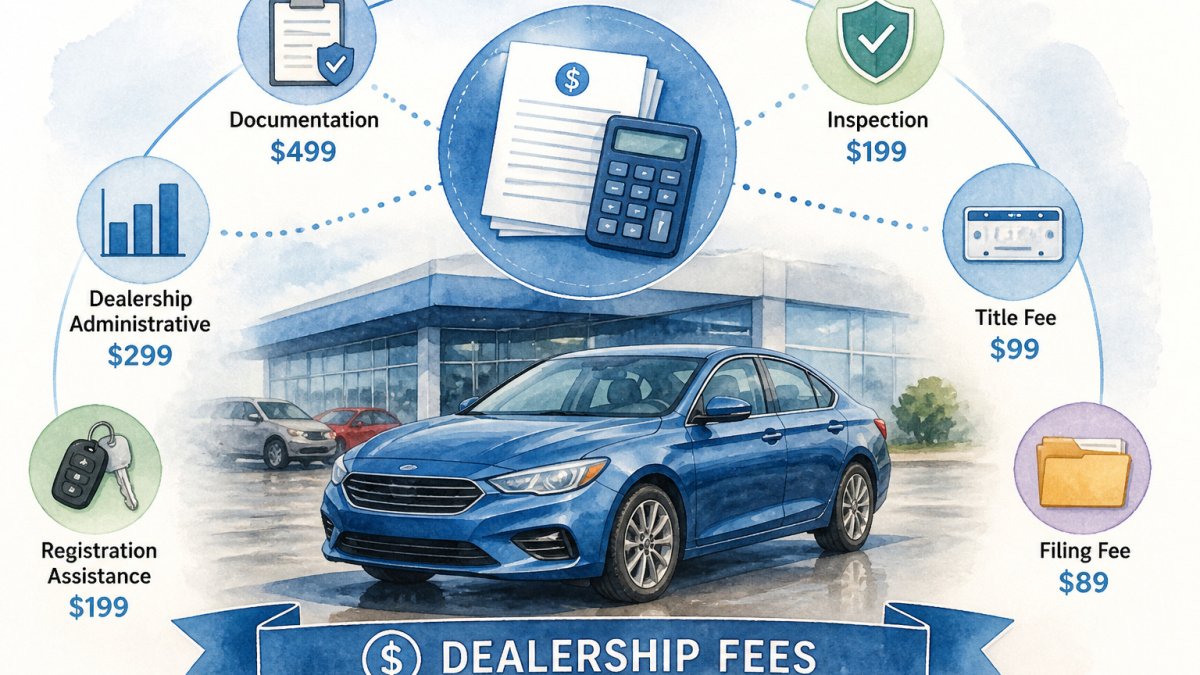
The documentation fee, often called the doc fee, pays for the dealer's work preparing the sale paperwork. That includes the purchase agreement, title application, and registration filings. It is one of the most common dealer charges on a used car purchase.
Whether you can negotiate it depends on your state and on the dealer. Ask the amount before you agree to a price, not after.
Government Fees Versus Dealer-Imposed Charges
The fastest way to judge a fee is to sort it into one of three categories: mandatory government charges, negotiable dealer charges, and optional add-ons. Buyers who confuse these categories often pay for dealer products thinking they are required, or try to negotiate a charge that is set by law.
Mandatory government charges. These include sales tax, title fees, and registration or license plate charges. The amounts are set by state and local law, and the money goes to a government agency. You can confirm them with your state motor vehicle agency rather than relying on the dealer's figure. These charges are not negotiable, but they should match the published amounts.
Negotiable dealer charges. These include documentation fees, dealer service or processing fees, and electronic filing or tag agency fees that are retained by the dealer. They are set by the dealership. Ask the amount before you agree to a price, not after.
Optional add-ons. These include extended warranties, paint and fabric protection, gap coverage, and similar products. They are not required to buy the car, and you can decline them. Confirm that any add-on you decline has been removed from the buyer's order.
A useful test is to ask which agency receives each line item. If the answer is a state or local agency, the charge is a government fee. If the answer is the dealer, the charge is a dealer fee and is worth questioning. If the answer is "it's a product you're buying," it is an add-on and can be declined.
Reading a Used Car Buyer's Order Line by Line
A buyer's order is the itemized statement that lists every charge in your deal. It is the document that turns a negotiated vehicle price into an out-the-door total, and it is where most surprises appear. Read it line by line before signing, and ask the dealer to walk you through each entry.
A used-car buyer's order typically includes these line items:
- Vehicle price, the negotiated selling price of the used car, before fees and taxes.
- Documentation fee, a dealer-imposed charge for preparing the purchase agreement, title application, and registration filings.
- Dealer service or processing fee, a dealer-imposed charge for administrative processing; sometimes combined with the doc fee, sometimes separate.
- Electronic filing or tag agency fee, a charge for submitting title and registration paperwork electronically; in some states this is a pass-through to a tag agency, in others it is dealer-retained.
- Sales tax, set by state and local law, based on the vehicle price and any taxable fees.
- Title fee, a government charge for issuing a new title.
- Registration and license plate fees, government charges set by the state motor vehicle agency.
- Optional add-ons, extended warranties, paint and fabric protection, gap coverage, and similar products; these are not required to buy the car.
To judge each line, classify it into one of three buckets:
- Mandatory government charges, sales tax, title, and registration. These are set by law and go to a state or local agency. You can confirm the amounts with your state motor vehicle agency rather than relying on the dealer's figure.
- Dealer-imposed charges, documentation, service, processing, and similar fees. These are set by the dealership and may be negotiable.
- Optional products, add-ons you can decline. They should appear only if you agreed to them.
Watch for these red flags on the buyer's order:
- A charge that appears but was never mentioned during negotiation.
- The same service listed twice under different names (for example, a "processing fee" and an "administrative fee" for the same work).
- An add-on you declined still showing on the final sheet.
- A tax or registration figure that does not match your state agency's published amount.
![Stacked bar chart of a sample used car buyer's order showing vehicle price, documentation fee, sales tax, title and registration fees, and optional add-ons]
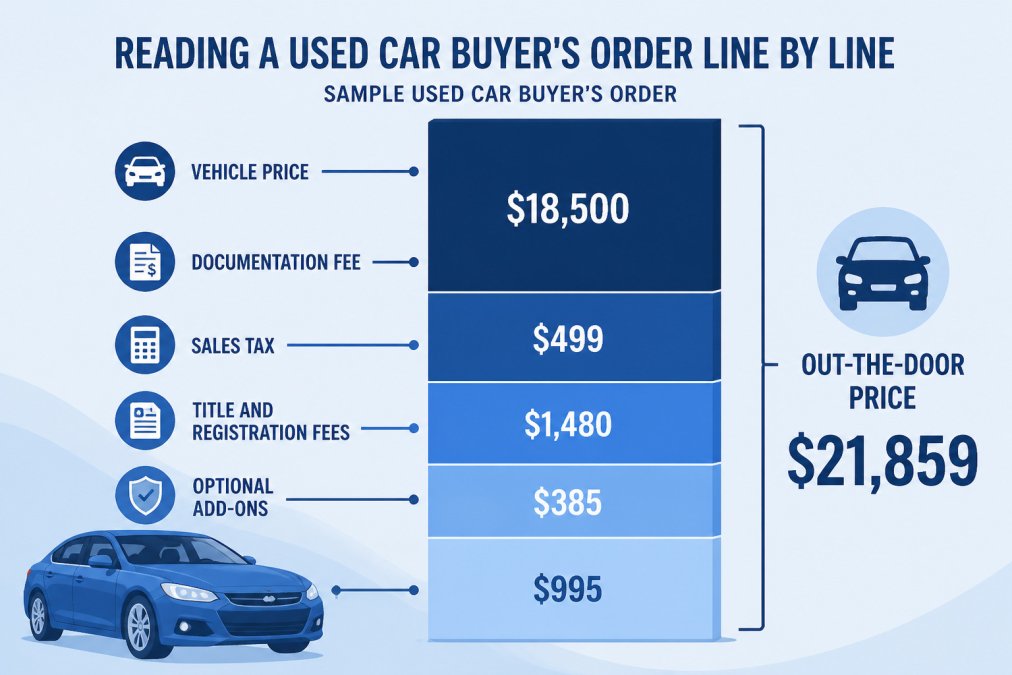
Each line on a used car buyer's order falls into one of three categories, and the table below sorts the common charges so you can check them quickly.
| Line item | Category | What to check |
|---|---|---|
| Vehicle price | Negotiated price | Matches your agreed figure |
| Documentation fee | Dealer-imposed | Ask the amount and whether it is negotiable |
| Dealer service or processing fee | Dealer-imposed | Confirm it is not a duplicate of the doc fee |
| Electronic filing or tag agency fee | Varies by state | Check whether it is dealer-retained |
| Sales tax | Government | Confirm against state agency amount |
| Title and registration fees | Government | Confirm against state agency amount |
| Optional add-ons | Optional product | Should appear only if you agreed to them |
Understanding the Used Car Out-the-Door Price
The out-the-door price is the total you pay to drive away, including the vehicle price, all fees, taxes, and any add-ons. It is the number that matters most when comparing offers. Two dealers may quote the same vehicle price, yet one total can be far higher once fees are added.
Ask every dealer for an out-the-door quote in writing. Comparing those totals gives a fair picture of which deal costs less.
Optional Dealer Add-Ons and How to Decline Them
Optional add-ons are products the dealer offers beyond the vehicle itself. Examples include extended warranties, paint protection, and gap coverage. These are not required to buy the car, and you can decline them.
To decline an add-on, say so clearly before the paperwork is finalized, and confirm that it has been removed from the buyer's order. If you are also weighing a trade-in, see whether trading in an older vehicle is worth it.
Your Fee Review Checklist Before You Sign at Silverton Motors
Before you sign, work through this checklist:
- Request a written out-the-door price that lists every fee
- Confirm which fees are government charges and which are dealer charges
- Ask the documentation fee amount and whether it is negotiable
- Remove any add-ons you did not agree to
- Check that the vehicle price matches your negotiated figure
- Confirm the sales tax and title and registration amounts with your state agency
When you are ready to move forward, you can apply online and start your purchase.
Frequently Asked Questions
Are dealer documentation fees negotiable?
In most cases the documentation fee itself is set by the dealership and is often not negotiable in the way the vehicle price is. Some states cap or regulate these fees, and rules differ across New Jersey and the rest of the country. Readers should check the buyer's order before signing, ask for the fee to be shown as an itemized line, and compare the total out-the-door price across dealers. Negotiation usually happens on the vehicle price, which can offset the fee's impact on the total.
What fees should I expect when buying a used car from a dealership?
Typical charges include the vehicle price, sales tax, title and registration fees, a dealer documentation fee, and any dealer service or processing fee. Government fees are set by the state and are generally required. Dealer-imposed charges vary and should be identified on the buyer's order. Optional products such as extended warranties, paint protection, or gap coverage are separate and can be declined. Reviewing each line item helps show the real cost of the purchase.
What does an out-the-door price include?
The out-the-door price is the full amount a buyer pays to drive the vehicle away. It combines the agreed vehicle price with sales tax, title and registration costs, documentation or dealer fees, and any add-ons the buyer accepts. Asking for an out-the-door quote in writing makes it easier to compare dealerships fairly, since advertised prices often exclude some of these charges.
Can I refuse add-ons on a used car?
Yes. Optional dealer add-ons such as extended service contracts, theft protection, and protective coatings are generally not required to complete a purchase. A buyer can ask for them to be removed from the buyer's order before signing. Declining an add-on does not usually change the vehicle price or financing terms, but a lender may require certain coverage, such as physical damage insurance, so buyers should confirm what their loan requires.
What should I check on a used car buyer's order before signing?
Review the vehicle price, each government fee, the dealer documentation fee, any dealer service charges, the sales tax calculation, and every optional product. Confirm that the total matches the out-the-door price discussed and that no add-on was included without your agreement. Ask questions about any line you do not understand, and do not sign until the final figure is correct.
Ready to find a used vehicle with transparent pricing? Silverton Motors offers a wide selection of pre-owned cars, trucks, and SUVs, with clear out-the-door quotes and a team that answers your fee questions before you sign.