 comparison
Financing vs. Paying Cash for a Used Car
Table of Contents
- Financing vs. Paying Cash for a Used Car: The Core Differences
- Paying Cash for a Used Car: Pros and Cons
- Understanding Used Car Financing Options
- Used Car Down Payment: How Much Should You Put Down?
- Getting a Used Car Loan Preapproval Before You Shop
- Using a Used Car Loan Calculator to Compare Your Options
- Key Factors to Consider When Choosing Between Financing and Cash
- Frequently Asked Questions
Last Updated: October 19, 2026
Financing vs. Paying Cash for a Used Car: The Core Differences
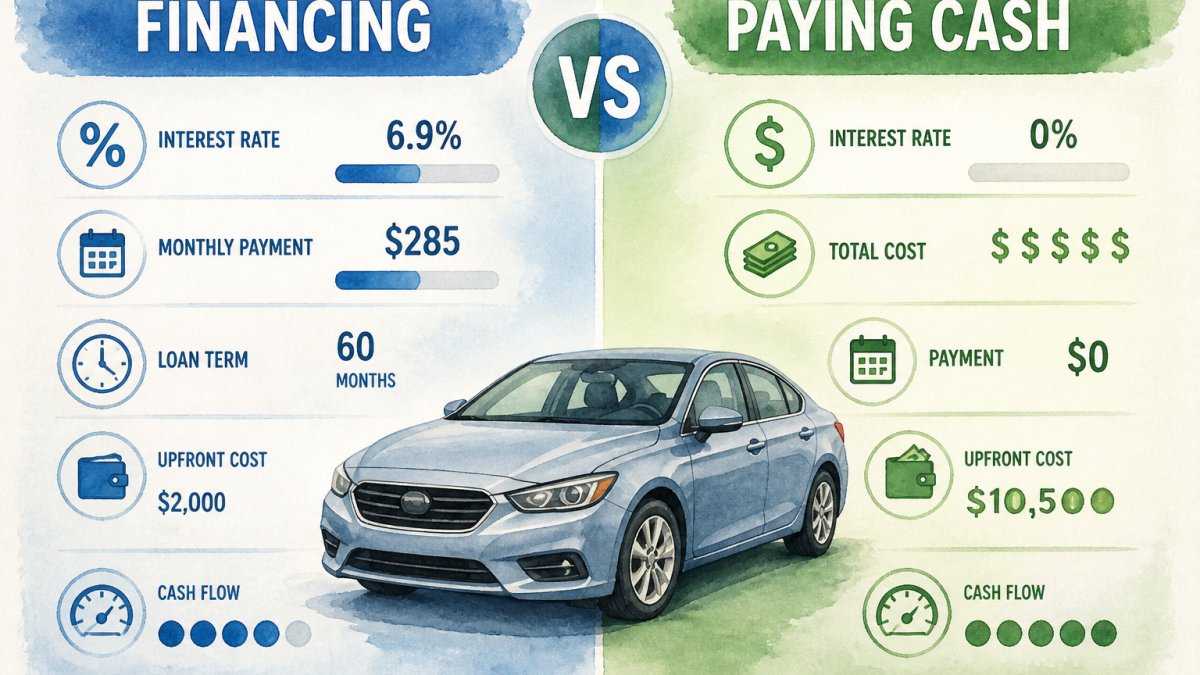
Deciding between financing vs paying cash for a used car is one of the biggest financial choices you'll make as a buyer. Both approaches have real trade-offs, and the right choice depends on your specific situation, credit profile, and financial goals.
Paying cash means you own the vehicle outright from day one. You avoid interest charges, monthly payments, and lender requirements. Financing spreads the cost over time through a loan, which lets you preserve cash but means paying interest and building a payment obligation into your monthly budget.
The tension between these two options isn't about which is objectively "better." It's about which aligns with your financial health, your immediate needs, and your priorities. At AutoSport USA, we work with buyers who choose both paths, and we help you understand what each decision actually costs and what it gives you in return.
Here's what matters most: the total cost of ownership, your monthly cash flow, the impact on your credit, and how much flexibility you want if circumstances change. Below, we'll walk you through each option so you can make the decision that fits your situation.
Paying Cash for a Used Car: Pros and Cons
Paying cash eliminates debt and simplifies the buying process. You walk away from the dealership with no monthly obligation hanging over your head.
The main advantages:
- No interest charges. You pay only the actual vehicle price, not a markup for borrowing money.
- Full ownership immediately. The title is yours. No lender has a claim on the vehicle.
- No credit requirements. Your credit score doesn't matter. You can buy today if you have the cash.
- Simpler transaction. Fewer paperwork steps, faster closing, no loan approval process to wait through.
- Flexibility. You can walk away from a deal or negotiate harder because you're not dependent on lender approval.
The drawbacks:
- Depletes your savings. A used car purchase can drain a significant portion of your liquid assets, leaving you vulnerable if an emergency arises.
- No credit-building opportunity. Paying cash doesn't help your credit score. A financed loan, paid on time, actually improves your credit profile.
- Opportunity cost. The money you spend on a car could have been invested elsewhere or kept as an emergency fund.
- Less negotiating power in some cases. Some dealerships offer better deals to financed buyers because lenders pay them fees.
Many first-time buyers assume paying cash is always the smarter move. It's not. If you have limited savings or an unstable emergency fund, financing might actually protect you better financially.
Understanding Used Car Financing Options
Used car financing comes in two main forms: dealership financing and bank or credit union loans. Each has different terms, approval processes, and costs.
Dealership financing is the most convenient option. The dealership arranges the loan through partner lenders, handles all paperwork, and you drive away the same day. The downside: dealership loans often carry higher interest rates because the dealership takes on some risk and earns a commission from the lender.
Bank or credit union loans typically offer lower interest rates because these institutions have stricter underwriting standards and less overhead than dealership finance departments. You get pre-approved before shopping, which strengthens your negotiating position. The trade-off is a longer approval process and the need to secure your own financing before visiting the dealership.
According to New Jersey Federal Credit Union's guidance on car financing, credit unions often provide competitive rates and more flexible terms for borrowers with less-than-perfect credit histories. This matters if you've had past credit challenges, a credit union may approve you when traditional banks won't.
The interest rate you receive depends on several factors: your credit score, the loan term (36, 48, or 60 months), the vehicle's age and mileage, and the lender's current rates. A higher credit score unlocks lower rates. A longer loan term lowers your monthly payment but increases total interest paid.
Used Car Down Payment: How Much Should You Put Down?
Your down payment is the cash you contribute upfront. The lender finances the remainder. A larger down payment reduces the amount you borrow, which lowers your monthly payment and total interest cost.
Common down payment amounts:
- 10-15% of the vehicle price is typical for buyers with good credit
- 20% or more significantly reduces your monthly payment and interest charges
- 0% down is possible but results in higher monthly payments and more interest paid overall
Here's the practical math: on a $15,000 used car with a 60-month loan at standard interest rates, a 10% down payment ($1,500) versus a 20% down payment ($3,000) creates a monthly payment difference of roughly $30-40. Over five years, that $1,500 difference in down payment saves you several hundred dollars in interest.
The question isn't "how much can I put down?" but "how much should I put down without depleting my emergency savings?" If putting 20% down leaves you with less than three months of living expenses in reserve, a smaller down payment makes more financial sense. You need a safety net.
Getting a Used Car Loan Preapproval Before You Shop
Preapproval is one of the most underrated steps in used car buying. It means a lender has reviewed your financial situation and agreed to loan you up to a specific amount at a specific interest rate.
Why preapproval matters:
- You know your budget. You shop only for vehicles you can actually afford.
- Stronger negotiating position. Sellers and dealerships take you more seriously when you're pre-approved.
- Lock in your rate. You know the interest rate before you find the car, so no surprises at closing.
- Faster closing. Preapproved buyers complete purchases days faster than those applying for financing after selecting a vehicle.
- Comparison shopping. You can get preapproved through multiple lenders and compare rates before committing.
The preapproval process typically takes 24-48 hours. A lender reviews your credit report, income, employment history, and existing debt. They then issue a letter stating the maximum loan amount and interest rate you qualify for.
At AutoSport USA, we work with buyers who arrive with preapproval letters, and it simplifies the entire process. You know exactly what you can spend, and we help you find the right vehicle within that range.
Using a Used Car Loan Calculator to Compare Your Options
A used car loan calculator helps you visualize the financial impact of different financing scenarios. Tools like the Allstate Cash for a Car vs. Car Financing Calculator let you input different down payments, loan terms, and interest rates to see how each affects your monthly payment and total cost.
What a calculator shows you:
- Monthly payment at different loan terms (36, 48, 60 months)
- Total interest paid over the life of the loan
- How a larger down payment reduces your monthly obligation
- The cumulative cost difference between paying cash and financing
Using a calculator removes guesswork. You can see that extending your loan from 48 to 60 months lowers your monthly payment by $50 but costs you an extra $1,200 in interest. That clarity helps you decide whether the lower payment is worth the extra interest.
Many buyers skip this step and regret it later. Spend 10 minutes with a calculator before you visit a dealership. It's the difference between making an informed decision and being surprised by payment amounts you didn't anticipate.
Key Factors to Consider When Choosing Between Financing and Cash
The decision between financing vs paying cash depends on six key dimensions: total cost, monthly cash flow impact, credit-building opportunity, flexibility, interest paid, and vehicle ownership timeline.
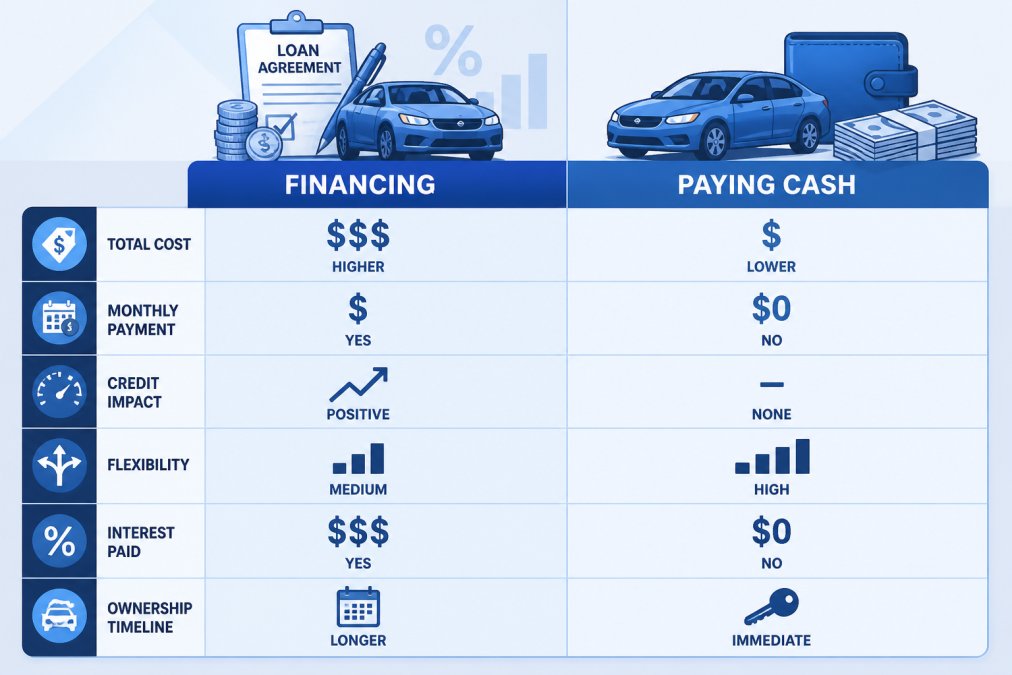
| Factor | Paying Cash | Financing |
|---|---|---|
| Total Cost | Vehicle price only | Vehicle price + interest |
| Monthly Impact | No payment obligation | Fixed monthly payment |
| Credit Building | No credit benefit | Improves credit if on-time |
| Flexibility | Can walk away anytime | Locked into loan term |
| Interest Paid | $0 | Varies by rate and term |
| Ownership | Immediate and complete | Gradual (lender holds title initially) |
Your emergency fund matters most. If you have less than three months of living expenses saved, financing protects you better than depleting your cash reserves on a car. An emergency, a medical bill, job loss, major home repair, becomes a crisis if you have no cushion.
Your credit score shapes your decision. If your credit is strong, financing at a low rate costs less total interest than you might expect. If your credit is challenged, paying cash avoids the risk of being denied or facing predatory rates. At AutoSport USA, we work with lenders who specialize in all credit profiles, so financing remains an option even if your history is imperfect.
Your income stability matters. If your income is predictable and stable, a monthly payment is manageable. If you're self-employed, freelance, or in a volatile industry, holding cash reserves becomes more important. A missed payment damages your credit and can lead to repossession.
Your timeline and vehicle needs shape the math. If you plan to keep the car for 8-10 years, financing the purchase and building equity over time often makes sense. If you trade vehicles every 3-4 years, paying cash might be smarter because you avoid being underwater on a loan (owing more than the car is worth).
Frequently Asked Questions
Is it better to finance a used car or pay cash?
It depends on your financial situation. Paying cash eliminates interest costs and debt, but financing a used car preserves your savings for emergencies and can build credit history. Use a used car loan calculator to compare the total cost under your specific circumstances, including your available savings, interest rates, and credit goals.
What are the pros and cons of paying cash for a used car?
Paying cash means no monthly payments, no interest charges, and full ownership immediately. However, you deplete savings that could cover emergencies, lose potential investment growth, and miss an opportunity to build credit. The decision hinges on whether you have adequate emergency reserves beyond the purchase price.
Can I get preapproved for a used car loan before visiting a dealership?
Yes. Many banks and credit unions offer used car loan preapproval, which shows you your approved loan amount and interest rate before you shop. Preapproval strengthens your negotiating position and lets you focus on vehicles within your budget. Bring your preapproval letter when you visit to compare it against dealership financing offers.
How much should I put down on a used car?
A larger down payment reduces your monthly payment and total interest paid. Aim for at least 10-20% of the vehicle's purchase price if possible. A higher down payment also improves your loan approval odds and may qualify you for better interest rates, especially if your credit is fair or limited.
Deciding between financing and paying cash isn't a one-size-fits-all answer. It's a personal calculation based on your financial stability, credit profile, and priorities. At AutoSport USA, we help you explore both paths with our online financing tools and transparent pricing. Whether you choose to finance through us or bring cash to the table, our team is committed to helping you find the right vehicle at a fair price. Apply online today to get preapproved and start shopping with confidence.