 how-to
How to Negotiate Used Car Financing Terms
Table of Contents
- Get Pre-Approved Before You Shop
- Research Fair Market Value and Set Your Budget
- Separate the Car Price from Financing Negotiations
- How to Negotiate Car Loan Interest Rate and APR
- Use a Car Financing Negotiation Script
- Compare Dealer Financing with Bank and Credit Union Offers
- Calculate Total Interest Cost with a Used Car Loan Calculator
- Common Mistakes to Avoid
- Frequently Asked Questions
Last Updated: October 10, 2026
Get Pre-Approved Before You Shop
Learning how to negotiate used car financing starts with getting pre-approved for a loan, your first power move.
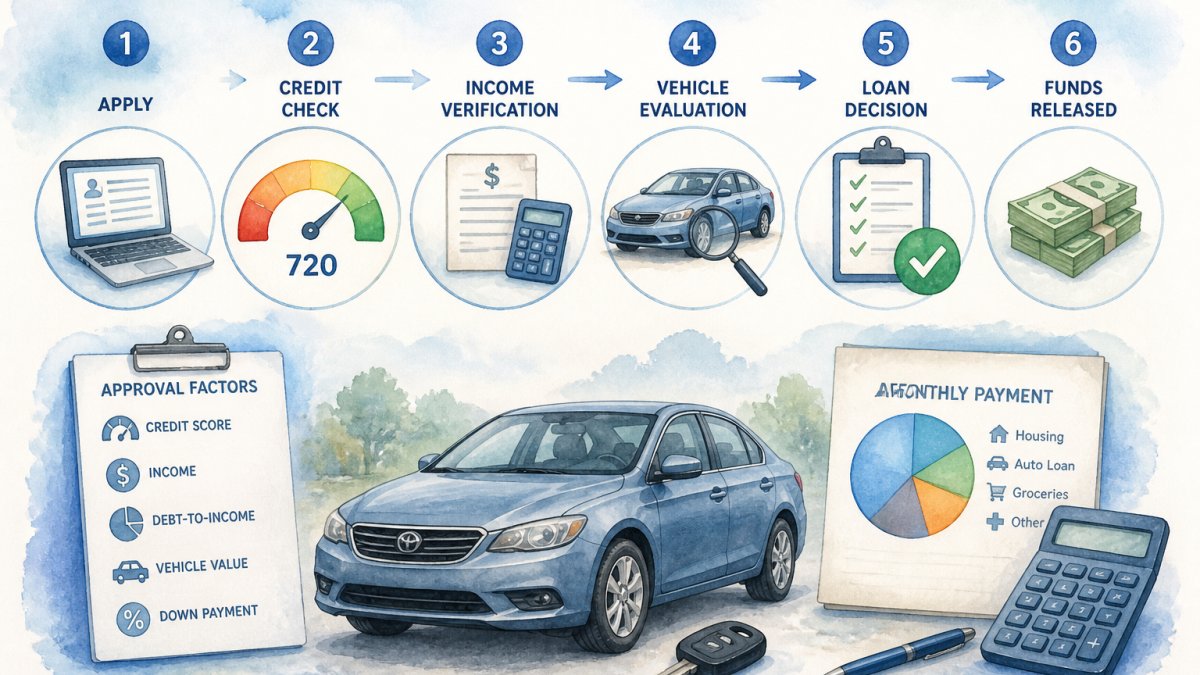
Pre-approval works like this: a lender reviews your credit, income, and debt. They give you a maximum loan amount and interest rate. You walk in knowing your number.
Start with your bank or credit union. They know your history and often offer better rates than dealer financing. Get multiple pre-approvals. Compare the offers.
Research Fair Market Value and Set Your Budget
Know what the car is worth before you negotiate used car financing terms. Use resources like Kelley Blue Book to check fair market value based on the vehicle's condition, mileage, and location.
Set a realistic budget. Take your pre-approved loan amount. Subtract your down payment. That's your maximum purchase price. Write it down. Don't exceed it, no matter what the dealer says.
Budget also includes taxes, registration, and dealer fees. These add 5-10% to your purchase price. Factor them in now, not at signing.
Separate the Car Price from Financing Negotiations
This is where most buyers lose use. They negotiate the car price and financing at the same time. That's a mistake.
Negotiate the car price first. Get the best deal on the vehicle itself. Only after you agree on price should you discuss financing. Separating these conversations gives you control.
Tell the dealer: "I have pre-approval financing. I'm interested in seeing your rates, but let's nail down the car price first." This keeps the dealer from bundling a bad price with tempting financing terms.
How to Negotiate Car Loan Interest Rate and APR
Your interest rate directly affects how much you pay. A 1% difference on a $20,000 loan over five years costs roughly $1,000 more in interest. But before you negotiate, you need to understand how dealer financing works and what's actually negotiable.
Understanding Dealer Financing Mechanics
When a dealer arranges financing, they don't lend you the money directly. Instead, they partner with lenders (banks, credit unions, captive finance companies). Here's what happens behind the scenes:
Lender Buy Rate: The lender approves you at an interest rate based on your credit score, income, and loan-to-value ratio. This is the lender's actual rate, let's say 4.5%.
Dealer Reserve (Rate Markup): The dealer can mark up that rate and keep the difference as profit.
Origination Fees: The lender may charge an origination fee (typically 0.5% to 1% of the loan amount). The dealer may also add their own documentation or processing fees.
Understanding this structure matters because it tells you what's negotiable. The lender's buy rate is fixed, you can't change it. But the dealer's markup? That's where negotiation happens.
How to Negotiate the Rate
When the dealer offers financing, ask for the rate in writing. Compare it to your pre-approval. If the dealer's rate is higher, ask why. Here's what to say:
"My bank pre-approved me at 4.5%. Your offer is 5.2%. Can you explain the difference? Is that your lender's rate, or is there a dealer markup?"
Most dealers won't break down the buy rate versus markup, they'll just say "that's the rate." Push back. Tell them: "I have a competing offer at 4.5%. Can you match it or get closer?"
Sometimes the dealer can reduce the markup. Sometimes they can't, the lender may have set the rate based on your credit profile, and the dealer has no flexibility. But you won't know unless you ask.
APR Versus Interest Rate
APR (Annual Percentage Rate) includes the interest rate plus fees. It's the true cost of borrowing. A loan might have a 4.5% interest rate but a 4.8% APR because of origination fees.
Always compare APRs, not just rates. If the dealer offers a lower interest rate but charges $500 in fees, the APR might actually be higher than a competitor's offer with a slightly higher rate but no fees.
Example:
- Dealer A: 4.5% interest rate, $500 origination fee → 4.8% APR
- Dealer B: 4.7% interest rate, $0 origination fee → 4.7% APR
Dealer B's APR is lower, even though the interest rate is higher. This is why APR matters.
Negotiating Fees
Fees are often more negotiable than rates. Ask the dealer to waive or reduce origination fees, documentation fees, or processing fees. Say: "Can you waive the $75 documentation fee if I move forward today?"
Dealers often will, especially if you're a strong buyer with good credit. Fees are pure profit with no cost to the lender, so dealers have room to negotiate them.
Use a Car Financing Negotiation Script
Walk in prepared. Use this script to stay on track:
Opening: "I'm interested in [vehicle model]. I have pre-approval financing, so I know what I can afford."
After test drive: "The car looks great. What's your best price, out-the-door?"
On price disagreement: "I researched the fair market value.
On financing: "I have pre-approval at [rate]%. What rate can you offer?
On add-ons: "I appreciate the offer, but I'm only interested in the vehicle and financing.
Walking away: "I appreciate your time. This isn't the right fit for me today.
Practice this. Dealers expect negotiation. Stay calm. Stay firm on your budget.
Compare Dealer Financing with Bank and Credit Union Offers
Dealer financing is convenient but rarely the cheapest. Banks and credit unions almost always beat dealer rates. But comparing offers isn't just about the interest rate, you need to look at the complete picture: rate, fees, term, and total interest cost.
Gather All Offers in Writing
Before you compare, get everything in writing. Ask your bank, credit union, and the dealer for a loan estimate that includes:
- Interest rate (or APR)
- Loan amount
- Loan term (in months)
- Origination fees and other upfront costs
- Monthly payment
- Total interest paid over the life of the loan
Most lenders will email or print a Loan Estimate form. If they won't, ask them to write it down. You need documentation to compare fairly and to use as leverage with the dealer.
Build a Side-by-Side Comparison
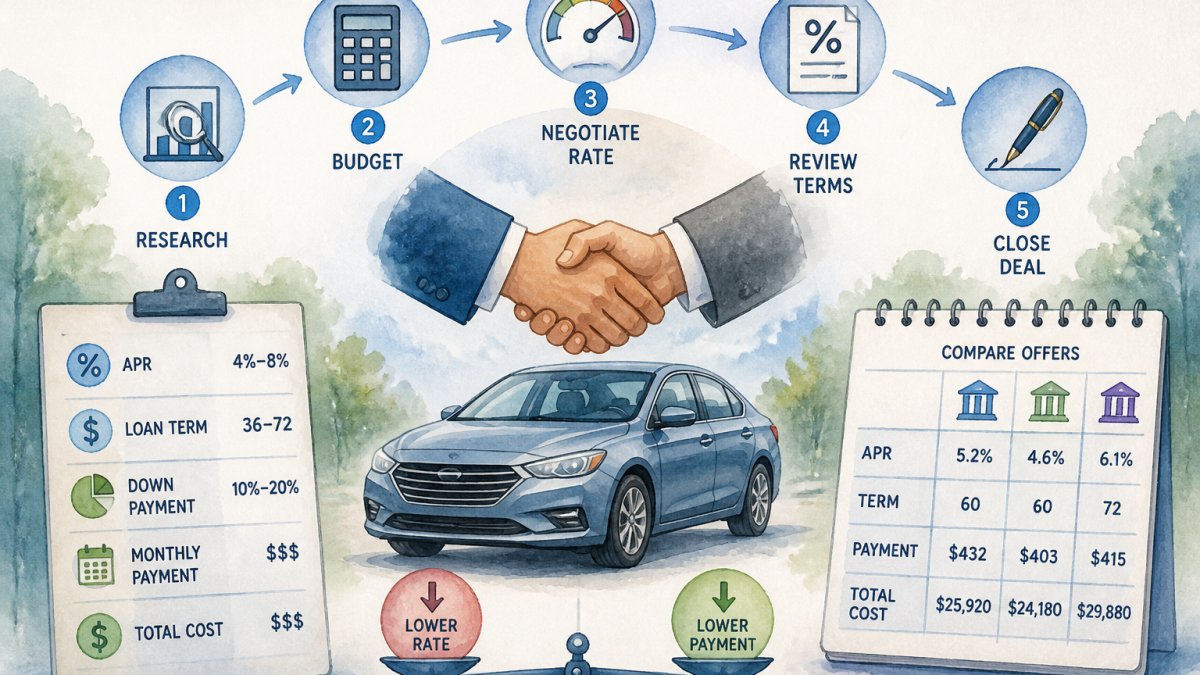
Create a simple table with your offers. Here's a realistic example for a $20,000 used car loan:
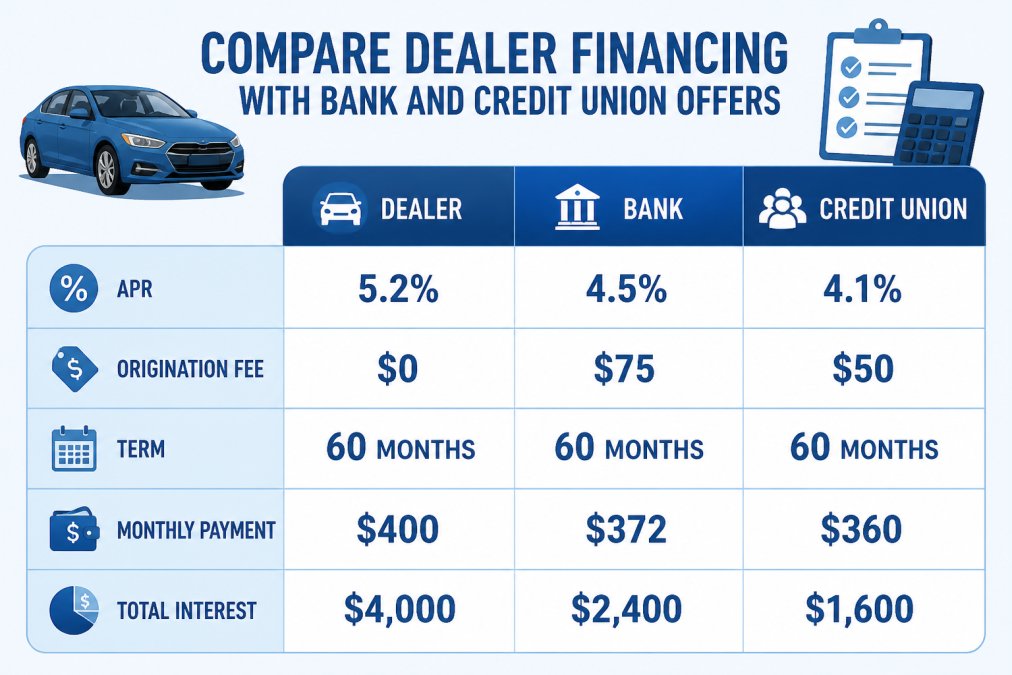
In this example, the credit union saves you $2,400 in interest compared to the dealer, even though the monthly payment difference is only $40. Over five years, that's $2,400 you keep instead of paying to interest.
The Total Interest Calculation Matters Most
Don't focus on the monthly payment. Dealers love when you focus on the payment because a low payment often means a longer loan term, which means more total interest.
Here's how to calculate total interest yourself:
Total Interest = (Monthly Payment × Number of Months) − Loan Amount
Example: $360/month × 60 months = $21,600. Minus the $20,000 loan = $1,600 in total interest.
Now compare this across all your offers. The offer with the lowest total interest is usually the best deal, assuming the term works for your budget.
Account for Prepayment Penalties
Some lenders charge a prepayment penalty if you pay off the loan early. Banks and credit unions rarely do; some dealer-arranged loans do. Ask each lender: "Is there a prepayment penalty if I pay this off early?"
If you think you might pay off the loan ahead of schedule (e.g., from a bonus or inheritance), a lender without prepayment penalties is worth more, even if the rate is slightly higher.
Use the Comparison to Negotiate
Once you have your comparison, use it as leverage. Tell the dealer:
"My credit union approved me at 4.1% APR with no origination fee. Your offer is 5.2% APR. That's a $2,400 difference in total interest over five years. Can you match the credit union rate or get closer?"
Sometimes the dealer can buy down the rate by reducing their markup. Sometimes they can't, the lender's buy rate is what it is. But you won't know unless you ask.
If the dealer can't match the rate, ask about fees: "Can you waive the origination fee to make this more competitive?"
When Dealer Financing Might Actually Win
Dealer financing rarely beats banks or credit unions on rate, but it can win in other ways:
- Faster approval: Dealer financing closes same-day. Bank or credit union financing might take 2-3 days. If you need the car immediately, that matters.
- Easier approval: If your credit is weak, the dealer's lender might approve you when your bank won't. The rate will be higher, but you'll get approved.
- Incentives: Some manufacturers offer special financing rates (0% APR, for example) through dealer financing. If that's available, it might beat your bank's offer. Always ask the dealer if manufacturer incentives apply.
But in most cases, especially if your credit is good, bank or credit union financing wins. Use your comparison to make the decision, not the dealer's sales pitch.
Calculate Total Interest Cost with a Used Car Loan Calculator
Don't just look at the monthly payment. Calculate total interest. This number matters.
Use an online calculator. Enter the loan amount, interest rate, and loan term. It shows you total interest paid. Now change the rate by 0.5%.
Example: $20,000 loan at 4.5% over 60 months costs $2,400 in interest. At 5.5%, it costs $3,000.
Shorter terms cost less interest. A 48-month loan costs less total interest than a 60-month loan. But the monthly payment is higher.
Common Mistakes to Avoid
Mistake 1: Skipping pre-approval. You walk in blind. The dealer controls the conversation. Get pre-approved first.
Mistake 3: Negotiating price and financing together. You lose use. Separate them. Price first, then financing.
Mistake 4: Accepting the first offer. Dealers expect negotiation. Push back. Ask for better rates. Ask for fee reductions.
Mistake 5: Ignoring the APR. Interest rate and APR are different. APR is what you actually pay.
Frequently Asked Questions
Can you negotiate the interest rate on a used car loan?
Yes. Dealer interest rates are not fixed. Your credit score, loan term, down payment size, and competing offers all affect what rate you qualify for. Always ask the dealer to lower the APR, and compare their offer against pre-approved rates from banks and credit unions. Even a 0.5% reduction saves hundreds in interest over the life of the loan.
Should you get preapproved before negotiating used car financing?
Absolutely. A used car loan preapproval from a bank or credit union gives you a baseline rate and shows dealers you have competing offers. This strengthens your negotiating position and prevents dealers from inflating rates. Preapproval takes 1-3 days and does not affect your credit score permanently.
What's the difference between negotiating the car price and the monthly payment?
Negotiate the car price first, separately from financing. The dealer's finance office may try to focus on monthly payment instead of total cost, which hides higher interest rates and longer loan terms. Always know the purchase price, down payment, interest rate, and loan term independently before agreeing to a monthly payment figure.
How do you compare loan offers using total interest cost?
Use a used car loan calculator to input the purchase price, down payment, interest rate, and loan term for each offer. This shows the total amount you'll pay over the loan's life. A 5-year loan at 5% APR costs more in total interest than a 4-year loan at the same rate, even though the monthly payment is lower. Always compare total cost, not just the monthly figure.
Negotiating used car financing terms takes preparation and discipline. Start with pre-approval. Research the fair market value. Separate price from financing. Compare offers. Use a script. Calculate total interest, not just monthly payment. At AutoSport USA, we help you navigate this process with transparent pricing and online financing tools. Our team understands how to structure deals that work for you. Get started with AutoSport USA and drive home with confidence in your financing terms.