 how-to
Easy Access to Vehicle Information and Appraisal Scheduling
Table of Contents
- Why Easy Access to Vehicle Information Matters for Appraisals
- What Information Is Needed for a Car Appraisal
- Getting a Free Online Car Appraisal
- How to Schedule a Car Appraisal Online
- Online Car Appraisal vs. In-Person Appraisal: What's the Difference
- Preparing Your Vehicle Records for the Appraisal Process
- Next Steps After Your Appraisal
- Frequently Asked Questions
Last Updated: October 7, 2026
Why Easy Access to Vehicle Information Matters for Appraisals
A fair trade-in value starts with accurate vehicle information. Complete details upfront speed up the process and improve your offer through vehicle information appraisal scheduling, which has become essential to modern trade-in services.
At AutoSport USA, we know trading in a car shouldn't feel like a hassle.
The benefit goes deeper than convenience.
What Information Is Needed for a Car Appraisal
An appraiser needs specific details to calculate an accurate valuation: year, make, model, mileage, and current condition. The more complete your records, the more precise the appraisal.
Here's what you should prepare before requesting an appraisal:
- Vehicle identification number (VIN), This 17-character code tells the appraiser everything about your car's specifications and history
- Mileage, Current odometer reading; appraisers use this heavily in valuation
- Service records, Documentation of regular maintenance, repairs, and inspections
- Accident history, Any past collisions, even minor ones, affect value
- Interior and exterior condition, Notes on wear, damage, upholstery condition, and mechanical issues
- Ownership history, Whether you're the original owner or have owned the vehicle for multiple years
- Title status, Whether the title is clear or has liens
Many online appraisal platforms collect this through simple forms. Honest estimates work fine for initial online appraisals, and the in-person inspector verifies everything directly.
Organize what you know now; most appraisers pull vehicle history reports that fill gaps automatically.
Getting a Free Online Car Appraisal
A free online car appraisal is often your first step toward understanding your vehicle's trade-in value, giving you a ballpark estimate in minutes with no obligation.
Free online car appraisal tools are one of the most straightforward free options.
Other free options include valuations and comparisons, both widely used by dealers and appraisers. They're based on real market data, but they're ballpark figures, not final offers.
The advantage is both psychological and practical: you walk into a dealership knowing roughly what your car should be worth, which prevents accepting lowball offers out of uncertainty.
How to Schedule a Car Appraisal Online
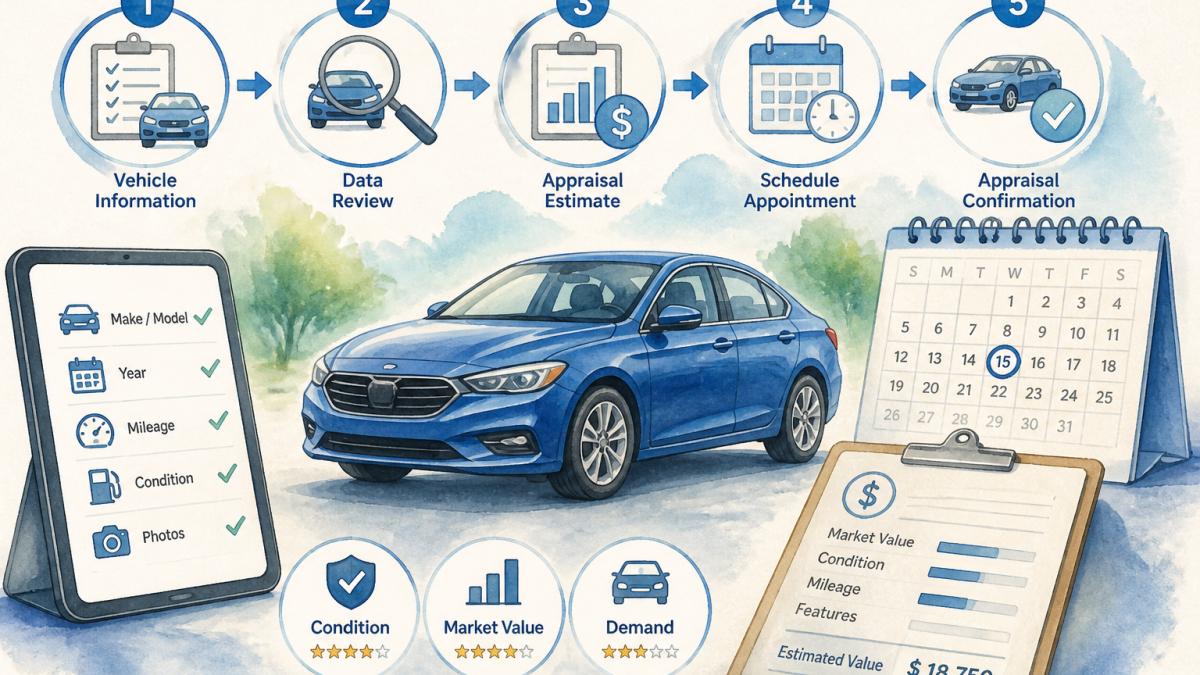
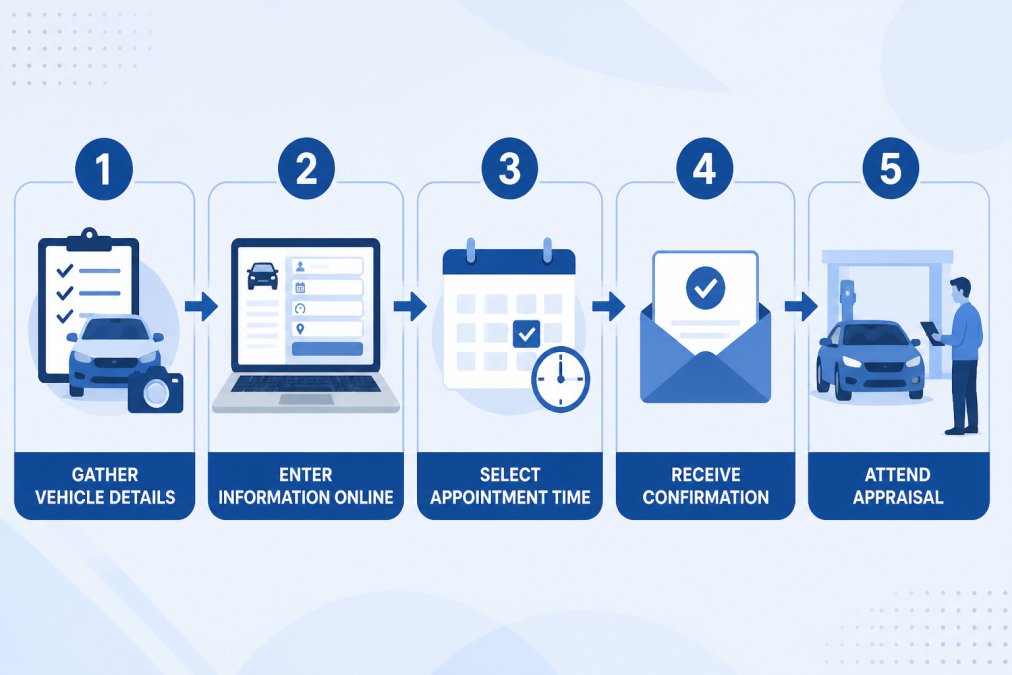
Scheduling an appraisal online takes just a few minutes. Most dealerships and appraisal services offer it through their websites, and the best systems let you book without a phone call.
The basic steps are:
-
Gather your vehicle details, Have your VIN, mileage, and condition notes ready; if you've completed a free online appraisal, you're halfway there.
-
Visit the appraisal scheduling page, AutoSport USA and similar dealerships have dedicated online appraisal request forms. You'll enter your vehicle information and contact details.
-
Select your appointment time, Most systems show available slots from a live calendar. Choose a date and time that works for you.
-
Confirm your appointment, You'll receive an email or text confirmation with the location, time, and a list of what to bring.
-
Prepare your vehicle, Clean your car inside and out so appraisers focus on actual condition rather than surface dirt.
-
Attend the appraisal, Bring your title, keys, and any service records. The appraiser will inspect your vehicle, take photos, and discuss the valuation.
What to Have Ready Before You Book
Before you open the scheduling page, have these items within reach:
- VIN (17 characters, found on the driver's-side dashboard, door jamb, or insurance card)
- Current odometer reading
- Title and registration (to confirm ownership and lien status)
- Service records or maintenance receipts, even partial ones
- Photos of any existing damage, scratches, dents, cracked glass, warning lights
If you don't have every document, book anyway. Most appraisers pull a vehicle history report to fill gaps, and the in-person inspection verifies the rest.
Rescheduling, Canceling, and Reminders
A good scheduling system makes changes easy.
- Rescheduling: Most online booking tools let you move an appointment from the confirmation email or your account dashboard via a "Manage appointment" link. If you can't find one, call the dealership directly; rescheduling is usually free with notice.
- Canceling: Cancel through the same link or by phone. Canceling early frees the slot for another customer and keeps your record clean.
- Reminders: Many systems send an automatic reminder 24 to 48 hours before your appointment by text or email. If you don't receive one, set your own calendar reminder.
- No-show policies: Some dealerships hold your slot for a short grace period (often 10 to 15 minutes) before releasing it. Arrive on time or call ahead if you're running late.
Accessibility and Mobile Booking
You should be able to book from any device. When evaluating a scheduling page, check for:
- Mobile-friendly layout with large tap targets and readable text
- Screen-reader compatibility (proper labels on form fields, not just placeholder text)
- Keyboard navigation so you can complete the form without a mouse
- Adjustable text size and sufficient color contrast
- Alternative booking channels (phone or in-person) if the online form isn't usable for you
If a scheduling page fails these checks, call the dealership to book manually. You should never be locked out of an appointment because a form wasn't built accessibly.
Online Car Appraisal vs. In-Person Appraisal: What's the Difference
Understanding the difference between online and in-person appraisals helps you choose the right approach, and the gap between the two numbers is where most surprises happen.
An online car appraisal uses the information you provide, year, make, model, mileage, and condition notes, to generate an estimate. These appraisals are quick, free, and useful for initial research, but they cannot account for specific damage, mechanical issues, or unusual wear.
An in-person appraisal involves a trained appraiser physically inspecting your vehicle, examining the engine, transmission, suspension, interior, paint, and mechanical health.
How Accurate Are Online Estimates, Really?
Online estimates are best understood as a range, not a number. They're built from aggregated market data, recent auction results, regional demand, and the trim and options you selected. What they can't see:
- Mechanical condition, a slipping transmission or worn suspension changes value more than most cosmetic issues
- Accident and repair history, even a well-repaired collision can reduce value
- Tire and brake life, worn tires can cost hundreds to replace
- Interior wear, smoke odor, pet hair, and torn upholstery are hard to price from a form
- Aftermarket modifications, some add value, many subtract it
- Local market quirks, a truck that sells fast in one region may sit in another
Typically the in-person offer lands within a few percent of the online estimate when the vehicle is in average condition with no surprises. With surprises, the gap can be larger in either direction.
What the In-Person Inspection Actually Covers
A thorough in-person appraisal is more than a walk-around. Expect the appraiser to check:
- Exterior: paint condition, panel gaps, rust, glass chips, tire tread depth
- Interior: upholstery, dashboard warning lights, infotainment and climate controls, odors
- Mechanical: engine start and idle, transmission behavior on a short drive, brakes, steering, suspension noise
- Under the hood: fluid levels and condition, visible leaks, belt and hose wear
- Documentation: VIN match, title status, lien check, service records
- Diagnostics: many shops plug in an OBD-II scanner to pull stored trouble codes
That last step is where online estimates fall short. A stored code that hasn't triggered a dashboard light can still affect the offer.
How to Interpret the Final Offer
When the in-person number comes back, compare it against three things:
- Your online estimate range, not the single number you saw on screen
- Comparable listings, what similar year, make, model, and mileage vehicles are actually selling for in your area
- The dealership's reconditioning costs, what they'll need to spend to make the car retail-ready
If the offer is lower than expected, ask the appraiser to walk through the specific deductions. Legitimate ones are itemized: tires, brakes, a dent, a code, a prior accident. A vague explanation signals you should get a second appraisal.
If the offer is higher than your online estimate, that's usually a sign of strong local demand for your vehicle, and a signal to move quickly since market conditions shift.
When Each Approach Makes Sense
- Start online if you're months away from selling, want a rough number for budgeting, or are comparing several vehicles
- Go in person when you're ready to trade or sell within weeks and need a firm, binding offer
- Do both if you're negotiating, the online number gives you a benchmark, and the in-person number gives you leverage
Consumer vehicle valuation and trade-in guidance
Preparing Your Vehicle Records for the Appraisal Process
Organized vehicle records improve your appraisal experience. An appraiser can see immediately that you've maintained your car responsibly, which builds confidence in the valuation.
Start by gathering these documents:
- Service records and maintenance receipts, Oil changes, tire rotations, filter replacements, and major repairs
- Inspection reports, Any recent safety or emissions inspections
- Warranty information, If your vehicle still has manufacturer or extended warranty coverage
- Title and registration, Proof of ownership and current registration status
- Recall completion records, Documentation that any manufacturer recalls have been addressed
If you're missing records, don't panic. Many service facilities keep digital records you can request, and even partial documentation is valuable. Appraisers want evidence of responsible ownership, not perfection.
One often-overlooked detail: photograph your vehicle from multiple angles before the appraisal, including the odometer, interior wear, and exterior condition, as a reference point if questions arise later.
Clean your vehicle thoroughly before the appointment. This presents your car in its best light and lets the appraiser assess actual condition without distraction from dirt or clutter.
Next Steps After Your Appraisal
Once you receive your appraisal offer, understanding the next steps helps you decide your vehicle's future.
If you're trading in at a dealership, the appraisal offer becomes part of your purchase negotiation, offsetting the price of a new vehicle or applying toward financing.
If you received a third-party appraisal and want to compare, get appraisals from multiple dealerships.
If the appraisal is lower than expected, ask the appraiser to explain the specific factors affecting the valuation, whether a mechanical issue you weren't aware of or shifted market conditions.
The key is moving forward with confidence.
Getting a fair appraisal starts with having your vehicle information organized and accessible. When you're ready to explore your vehicle's trade-in value or find your next car, Apply Online to get started with our team today.
Frequently Asked Questions
Where can I get my car appraised for free online?
Free online car appraisal tools like Edmunds provide quick estimates using your vehicle's year, make, model, and condition. You enter basic details, and the tool calculates an estimated value in minutes. These estimates give you a starting point, but an in-person appraisal from a dealership typically provides a more accurate final offer based on the vehicle's actual condition, mileage, and service records.
What information do I need to get an online trade-in appraisal?
For an online appraisal, have ready your vehicle's year, make, model, body style, mileage, transmission type, and overall condition. The VIN (Vehicle Identification Number) is helpful because it contains details about your vehicle's history and specifications. Include information about any recent repairs, maintenance records, and accident history. The more accurate your details, the closer your online estimate will be to the final appraisal value.
Can I schedule a vehicle appraisal online?
Yes, many dealerships now offer online appraisal scheduling. You can typically submit your vehicle information through an online form, receive a preliminary estimate, and then book an appointment at a time that works for you. This eliminates the need to call or visit in person to start the process. After scheduling, you'll receive a confirmation and can prepare your vehicle records before your appointment.
Is an online car appraisal the same as a final trade-in offer?
No. An online appraisal is an estimate based on the information you provide. A final trade-in offer comes after an in-person inspection where the dealership examines the vehicle's condition, checks the odometer, reviews service records, and assesses any wear or damage. The final offer may differ from the online estimate, but starting with an online appraisal helps you understand your vehicle's ballpark value before committing time to an in-person visit.