 comparison
Used Car Appraisal vs Dealer Offer: What to Know
Table of Contents
- How the Appraisal Process Works and Why Offers Differ
- What Do Dealers Look for When Appraising a Car?
- Trade-In Value vs. Retail Value: Understanding the Gap
- Get a Trade-In Appraisal Online Before You Visit
- How to Negotiate a Trade-In Offer That Works for You
- Tax Implications and Hidden Costs of Selling vs. Trading In
- Conclusion
- Frequently Asked Questions
Last Updated: September 17, 2026
How the Appraisal Process Works and Why Offers Differ
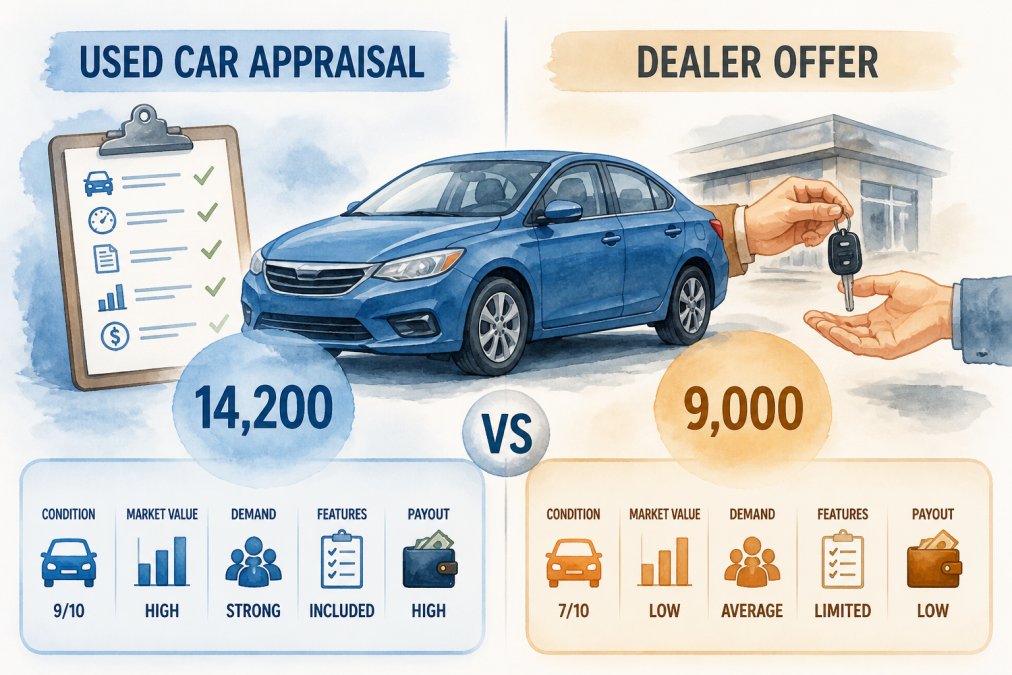
A used car appraisal is a formal assessment of your vehicle's condition and market value, typically conducted by a dealership or third-party buyer before making a purchase offer. At AutoSport USA, we understand the common frustration drivers experience when their online estimate differs from a dealer offer: "Why is this number different from what I saw online?"
Here's how the typical process unfolds:
- Online estimate: You enter your VIN, mileage, and condition into a valuation tool.
- In-person inspection: A dealer or buyer examines the vehicle, often including a test drive.
- Market adjustment: The appraiser factors in local demand, reconditioning costs, and inventory turnover.
- Written offer: You receive a firm number, usually valid for a set period such as seven days.
What Do Dealers Look for When Appraising a Car?
Dealers evaluate four core categories: condition, mileage, history, and market demand. Each one moves the offer independently, and a weakness in one area rarely gets fully offset by strength in another.
Trade-In Value vs. Retail Value: Understanding the Gap
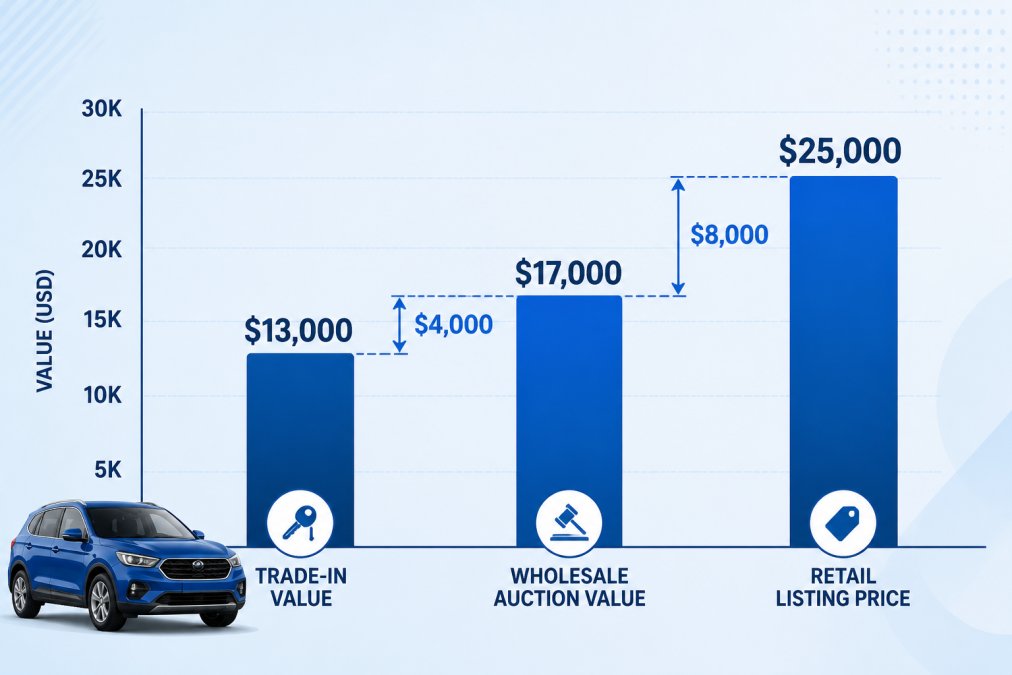
Trade-in value, wholesale price, and retail value are three different numbers for the same vehicle, and the spread between them is normal, not a scam. Trade-in value is what a dealer pays you, accounting for reconditioning and profit margin. Wholesale value is what that car fetches at auction. Retail value is what a consumer pays on the lot after the dealer has reconditioned and merchandised it.
Get a Trade-In Appraisal Online Before You Visit
Getting a trade-in appraisal online before you visit a dealership gives you a negotiation baseline and saves hours of back-and-forth. Several free tools generate estimates in minutes.
| Tool | Cost | Offer Validity | Best For |
|---|---|---|---|
| Kelley Blue Book trade-in values | Free | Estimate only | Baseline market research |
| Edmunds appraisal tool | Free | Estimate only | Comparing against dealer quotes |
| CarMax instant offer | Free | 7 days | A guaranteed written cash offer |
| CarGurus valuation tool | Free | Estimate only | Local market listing data |
| Carvana online appraisal | Free | Varies | A fully digital process |
How to Negotiate a Trade-In Offer That Works for You
Negotiating a trade-in offer works best when you separate the two transactions: the price of the car you're buying and the value of the car you're trading. Dealers sometimes blend them, which makes it hard to see where you're winning or losing. Keep them apart and you keep leverage.
Follow this sequence:
- Get your baseline first. Pull at least two online appraisals before you set foot on a lot.
- Negotiate the new car price independently. Agree on that number before you mention your trade.
- Present your trade with documentation. Service records, a clean history report, and recent repairs all support your ask.
- Ask for the offer in writing. A verbal number means nothing at signing.
- Compare against your baseline. If the offer sits well below your appraisals, ask what specifically reduced it.
- Be willing to walk. A competing written offer is the strongest negotiation tool you have.
Why Two Dealers Quote Different Numbers for the Same Car
This is the question that frustrates sellers most, and the answer is not that one dealer is cheating you. A trade-in offer is a function of what that specific store needs on that specific day.
- Inventory needs. A dealer short on used SUVs will stretch on an SUV trade and lowball a sedan it already has six of. The same car can swing by a meaningful margin depending on what's sitting on the lot.
- Reconditioning estimates. One shop's service department may quote $1,200 to bring your car to front-line ready; another may quote $2,400 for the same work. That difference comes straight out of your offer.
- Auction vs. retail intent. A dealer planning to retail your car can pay more than one planning to wholesale it at auction, because the retail path carries more margin.
- Cost of capital and floor planning. A store with expensive floor-plan financing has less room to hold a slow-moving trade, so it prices in that risk.
- Salesperson discretion. Many stores give the used-car manager or the salesperson a band, not a fixed number. Who you talk to, and how prepared you are, can move the offer within that band.
The Sales Tax Credit: The Math Most Sellers Miss
Sales tax credit is where trade-ins quietly win, and it is the single most overlooked line in the deal. In most states, when you trade a vehicle in toward a purchase from a licensed dealer, you pay sales tax only on the difference between your trade-in value and the new vehicle price, not on the full purchase price.
- Trade-in: tax applies to $15,000, so you owe roughly $900.
- Private sale: tax applies to the full $25,000, so you owe roughly $1,500.
Tax Implications and Hidden Costs of Selling vs. Trading In
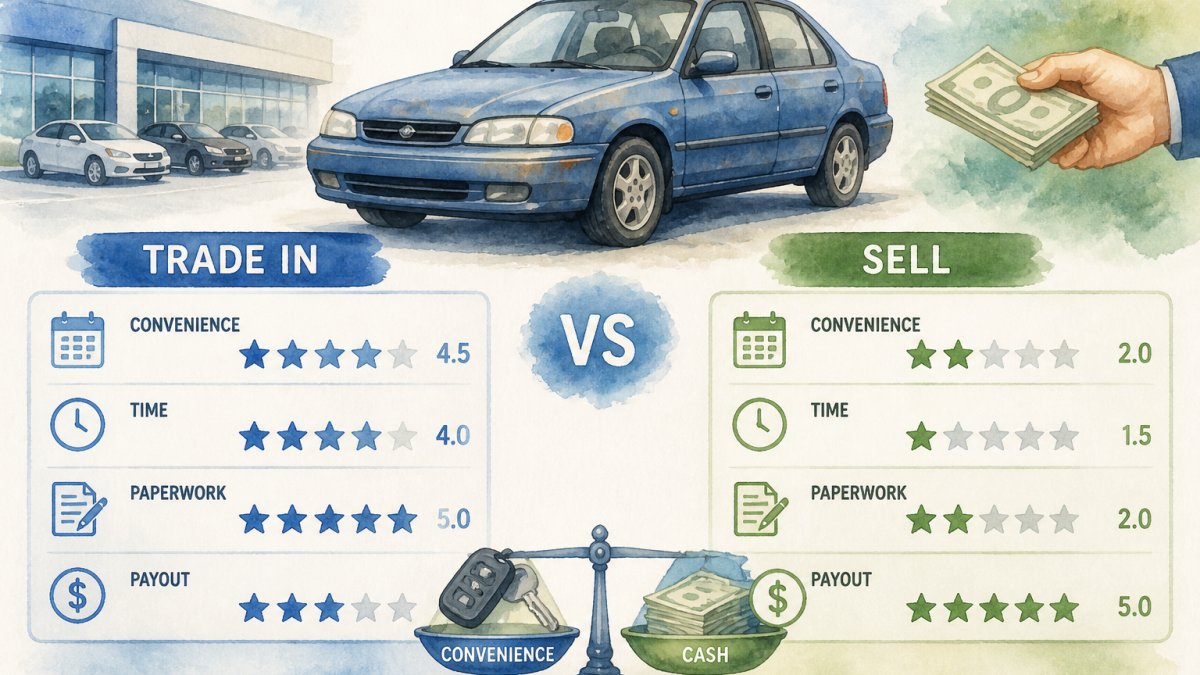
The sales tax credit is the biggest financial difference between trading in and selling privately, and most sellers overlook it entirely. But the credit is only half the story. The other half is the pile of hidden costs a private sale quietly adds, costs that rarely show up in the headline price.
The Tax Side, in Plain Terms
When you trade toward a purchase from a licensed dealer, most states tax only the difference between your trade-in value and the new vehicle price. Sell privately and you typically pay tax on the full purchase price, because there is no trade to offset it. On a $25,000 purchase with a $10,000 trade at a 6% rate, that is roughly $900 in tax versus roughly $1,500, a $600 swing in the trade-in's favor before anything else is counted.
The Hidden Costs of a Private Sale
The gross price on a private sale often looks higher. The net usually is not, once you subtract these:
- Time. Listing, answering messages, scheduling showings, and test drives routinely consume many hours across several weekends. At a typical hourly wage, that time has a dollar value.
- Listing and relisting costs. Paid listing upgrades, photo services, and re-listing after a no-show buyer add up.
- Safety risk. Meeting strangers for test drives and cash transactions carries real personal risk. Public meet-up locations and a companion help, but the risk does not disappear.
- Payment risk. Cashier's checks can be forged, personal checks can bounce, and peer-to-peer payment apps can be reversed after the buyer takes the keys. A dealer pays you through a traceable, regulated channel.
- Paperwork and title transfer. You are responsible for the title transfer, odometer disclosure, and release of liability. If the buyer delays the transfer, tickets, tolls, or liability can land back on you.
- Loan payoff complexity. If you still owe on the car, you cannot hand over a clean title until the loan is paid. Coordinating payoff with a private buyer's lender is slow and error-prone; a dealer handles the payoff directly with your lender as part of the trade.
- Post-sale disputes. A private buyer who discovers a problem has no dealer arbitration process to go through, they have you.
Why the Trade-In Often Wins on Net, Not Gross
Add the tax credit to the hidden costs and the math flips. A private buyer would typically need to beat the dealer's offer by several hundred dollars just to match the trade-in's after-tax result, and by more than that to compensate for your time and risk. Trading in also closes faster: a dealer can usually finalize the deal the same day, handle the loan payoff, and manage the title transfer and documentation fee as part of the transaction.
In a private sale, you typically remain responsible for the title transfer until it is completed. If the buyer delays, tickets or liability issues can land back on you. Dealers handle this paperwork as part of the trade.
Conclusion
The gap between an online estimate and a real dealer offer isn't a trick. It's reconditioning costs, market demand, and risk priced honestly. The smartest move is preparation: pull two or three appraisals, gather your service records, and understand your state's sales tax credit before you sit down at the table.
Frequently Asked Questions
Do online car appraisals usually match the final dealer offer?
Online appraisal tools like KBB and Edmunds provide a baseline estimate based on market data and the condition you report. The final dealer offer often differs because it accounts for in-person inspection findings, reconditioning costs, and current inventory turnover needs. CarMax offers a 7-day guaranteed written offer after inspection, which removes some uncertainty. Use online appraisals as a negotiation starting point, not a guaranteed price.
What factors cause a dealer offer to be lower than an appraisal?
A dealer offer can come in lower than an online appraisal for several reasons: undisclosed mechanical issues found during VIN inspection, higher-than-expected reconditioning costs, weak market demand for your specific model, or vehicle history report findings like prior accidents. Dealers also factor in their need to profit on resale, so the wholesale price they can get at auction sets a ceiling on what they will pay.
How much room is there to negotiate a dealer trade-in offer?
Negotiation room varies by dealer and vehicle demand. Having a competing written offer from CarMax or Carvana gives you concrete leverage. Dealers may not move much on the trade-in number itself but can adjust the sale price of the vehicle you are buying or add value through service credits. Focus on the total transaction cost, not just the trade-in figure. Some dealers, especially those with no-haggle models, do not negotiate at all.
Is the trade-in value the same as the retail value of my car?
No. Trade-in value is what a dealer pays you, which is typically below wholesale price because the dealer needs margin to cover reconditioning costs and profit. Retail value is what a dealer sells the same car for to the next buyer, often thousands more. Private party sale prices fall between the two. Understanding this gap helps you set realistic expectations and decide whether trading in or selling privately makes more financial sense.
What should you avoid saying during a car appraisal?
Avoid volunteering information that could lower your offer, such as mentioning you are in a hurry to sell or that you have not maintained the vehicle regularly. Do not speculate about problems you have not confirmed. Stick to facts: service records, accident history, and current condition. If you have a loan payoff or negative equity situation, discuss that with the sales manager, not during the initial inspection, so the appraisal stays focused on the vehicle itself.