 comparison
Gateway Toyota Alternative for Used Cars: 2026 Guide
Table of Contents
- Why Shoppers Look for a Gateway Toyota Alternative for Used Cars
- How to Compare Used Car Dealerships: An Evidence-Based Framework
- Used Car Financing: What to Know Before You Apply
- Used Car Trade-In Value: How Appraisals Differ
- Used Car Inspection Checklist: What to Verify Before You Buy
- Service Ownership Costs and After-Sales Support
- A Practical Buyer Decision Framework
- Frequently Asked Questions
Last Updated: October 17, 2026
Why Shoppers Look for a Gateway Toyota Alternative for Used Cars
Shoppers searching for a Gateway Toyota alternative for used cars usually share one goal: getting a dependable vehicle without the pressure and opaque pricing that sometimes comes with a franchise dealership. This guide walks through how to evaluate any local used car dealer on evidence, not sales talk.
The reason is practical. A franchise store's used inventory often competes with its own new-car sales targets, and advertised specials may not reflect the final out-the-door number. Independent and used-only lots approach the same buyer differently. They live or die on repeat business and review scores, so transparency becomes a survival strategy rather than a courtesy.
Below, we break down how to compare dealerships on written pricing, review patterns, financing, trade-in appraisals, and inspection practices. We'll also give you a decision framework you can apply to any lot in the area.
How to Compare Used Car Dealerships: An Evidence-Based Framework
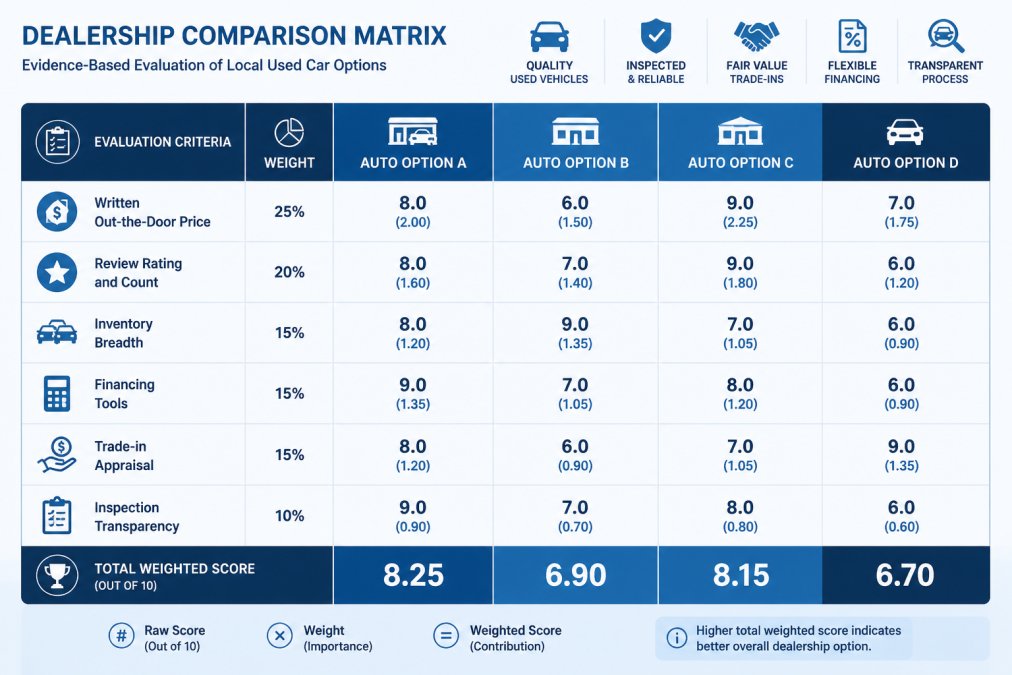
Comparing used car dealerships means scoring each one on written pricing, verified reviews, inventory depth, financing access, trade-in process, and inspection transparency. Weight the criteria that affect your total cost, not the ones that make a showroom look nice.
Start with a simple scoring sheet. Rate each dealer from 1 to 5 on the criteria below, then weight them by how much each affects your wallet.
| Criterion | Weight | What to Verify | Red Flag |
|---|---|---|---|
| Written out-the-door price | 25% | Full total in writing, fees itemized | Price only "at the store" |
| Review rating and count | 20% | Volume plus recency of reviews | Few reviews, all identical |
| Inventory breadth | 15% | Actual listings with VINs and photos | "Call for availability" |
| Financing tools | 15% | Online pre-qualification available | No credit path explained |
| Trade-in appraisal | 15% | Written offer, stated validity window | Verbal offer only |
| Inspection transparency | 10% | Checklist or report shown to buyer | "It's been checked" |
What to Check in Reviews and Reputation
Reviews matter most when you read the pattern, not the star average. A dealer with a 4.6 rating across hundreds of reviews is telling you something different than one with a 4.9 across a dozen.
Look for three things:
- Recency. Reviews from the last six months reflect current management and staffing.
- Specificity. Comments about the sales team, the service department, or financing are more useful than "great place."
- Complaint themes. Repeated mentions of dealer fees, pressure tactics, or post-sale issues are a warning worth heeding.
Third-party platforms help here. CARFAX dealership review pages aggregate customer feedback alongside hours and amenities, which makes side-by-side comparison easier than scrolling social posts.
Pricing Transparency and Out-the-Door Cost
The out-the-door price is the only number that matters. It includes the vehicle price, taxes, title and registration, documentation fees, and any add-ons. Ask every dealer for it in writing before you visit.
A common mistake is negotiating the sticker price and then discovering the fees later. Documentation fees vary widely by dealer and are set by the business, not the state, so they belong in your comparison. If a salesperson won't put the total in writing, that tells you what the rest of the process will feel like.
Used Car Financing: What to Know Before You Apply
Used car financing is a loan secured by the vehicle, and approval depends on credit history, income, down payment, and the age and mileage of the car. Knowing your numbers before you apply saves time and protects your credit score.
Get pre-qualified first. Pre-qualification typically uses a soft credit pull, so it doesn't affect your score the way a formal application does. The Consumer Financial Protection Bureau's auto loan guidance explains how to compare APR, term length, and total interest rather than shopping on monthly payment alone.
Bring these to any dealership:
- Proof of income
- Current bank statements
- Your down payment amount
- Payoff information for any trade-in
Dealers with online financing tools let you start this before you arrive. That matters if you work long hours and can't spend a Saturday in a showroom.
Used Car Trade-In Value: How Appraisals Differ
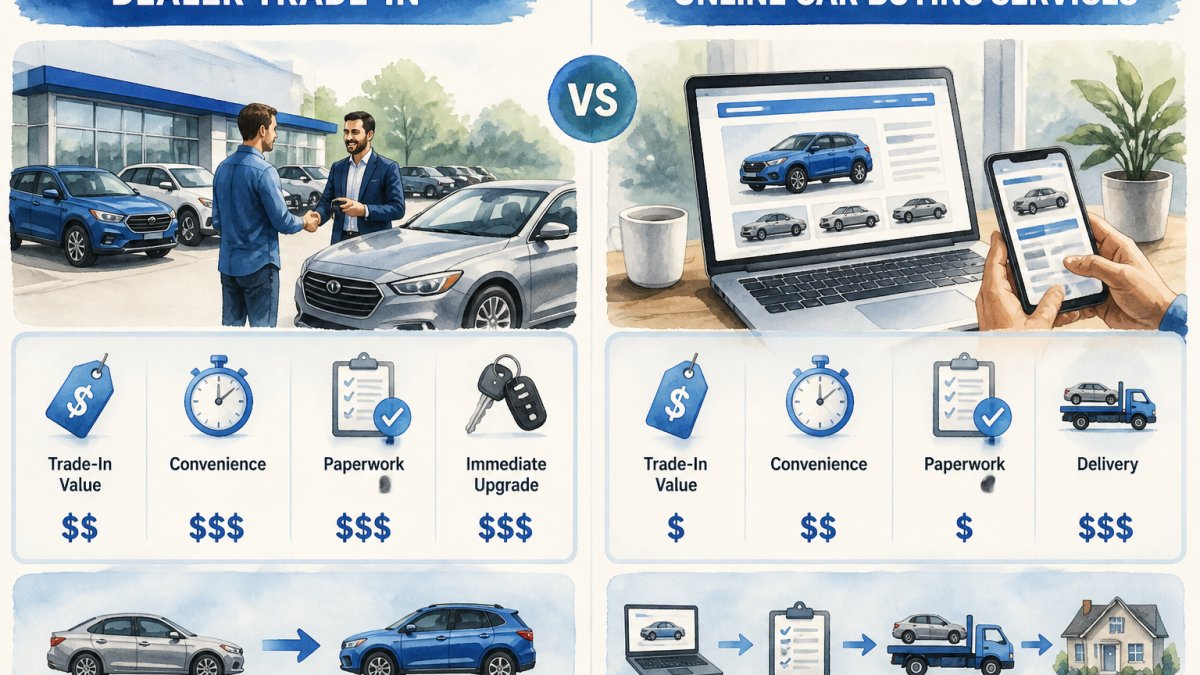
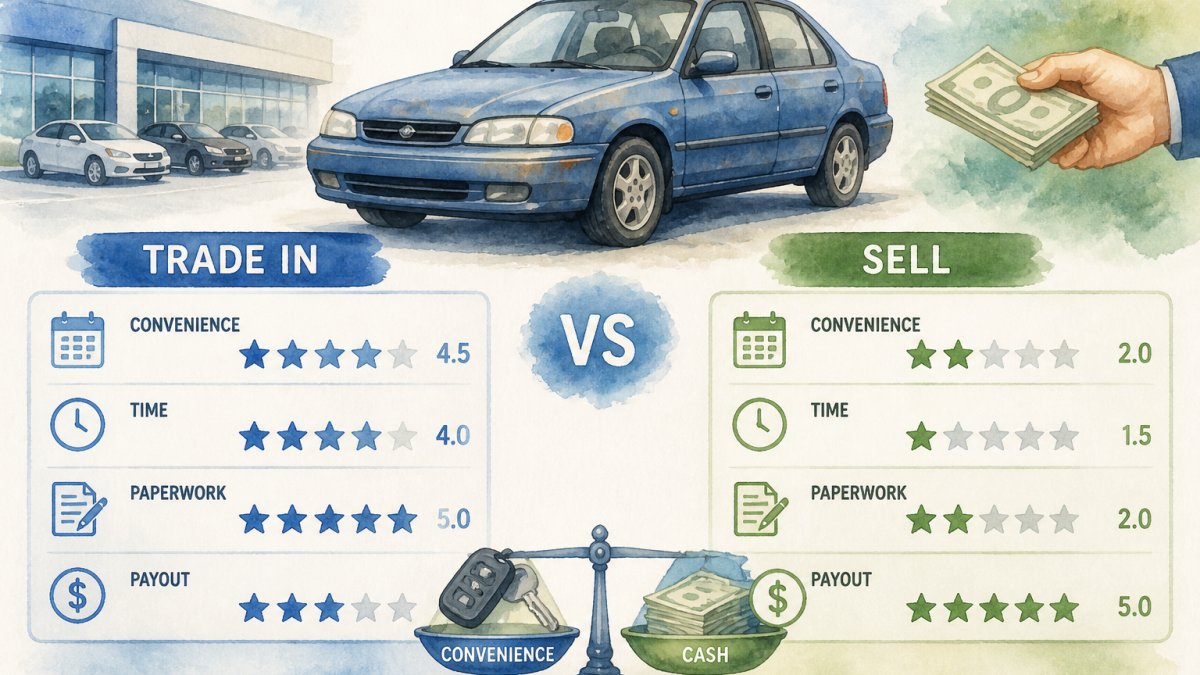
Used car trade-in value comes down to how thoroughly a dealer inspects the vehicle and what it plans to do with it. Two lots can quote very different numbers for the same car because their reconditioning costs and resale channels differ.
Appraisals typically weigh mileage, condition, accident history, service records, and local demand for that model. A dealer that retails cars on its own lot may offer more than one that sends everything to auction, since it captures the resale margin itself.
Ask for the offer in writing and confirm how long it's valid. A verbal number that expires when you walk out the door isn't an offer, it's a conversation starter.
Used Car Inspection Checklist: What to Verify Before You Buy
A used car inspection checklist protects you from inheriting someone else's problem. Run it on any vehicle, whether you're buying from a franchise store or an independent lot.
- Pull the vehicle history report and check for salvage, flood, or odometer issues
- Verify the VIN on the dashboard matches the title and the report
- Check tire tread depth and look for uneven wear
- Test every light, window, lock, and seat adjustment
- Start the engine cold and listen for knocking or rough idle
- Check for rust under the wheel wells and along the frame
- Review the fluid levels and look for leaks under the car
- Test drive at highway speed, not just around the block
- Confirm the spare tire, jack, and tools are present
Documents and History Reports
Paperwork confirms what the car has been through. Request the title, the vehicle history report, and any available service records before you commit.
The National Highway Traffic Safety Administration maintains recall lookup tools by VIN, so you can check whether open recalls apply to the specific vehicle. A dealer that hands over these documents without being asked is showing you how it operates.
Service Ownership Costs and After-Sales Support
After-sales support separates a good buying experience from a good ownership experience. Ask what happens after the sale: who handles a problem in month three, whether there is any limited warranty on the vehicle, and how a service appointment gets scheduled. Get the answers in writing rather than relying on a verbal promise.
Most dealership comparisons stop at the purchase. The more useful exercise is to price the first three years of ownership alongside the car itself. Build a second worksheet for the after-sales side of each dealer:
| After-sales item | What to ask | Why it matters |
|---|---|---|
| Limited warranty | What is covered, for how many months or miles, and what is excluded | Determines who pays for early repairs |
| Service labor rate | Posted hourly rate and whether it differs for used-car buyers | Affects the cost of every future visit |
| Maintenance schedule | Recommended intervals and estimated cost per visit | Lets you budget routine spending |
| Appointment availability | Typical wait for a scheduled service | Signals whether support is real or nominal |
| Loaner or shuttle | Available during longer repairs | Reduces downtime cost |
| Follow-up process | Who contacts you after delivery and how | Shows whether problems get resolved |
Budget for routine ownership costs beyond the purchase price. Maintenance, tires, insurance, and fuel add up, and a cheaper car with deferred maintenance can cost more over three years than a slightly pricier one that has been kept up. A practical approach is to set aside a monthly ownership reserve that covers scheduled maintenance plus one unexpected repair per year, then adjust it once you know the dealer's labor rate and warranty terms.
Warranty language is where buyers most often get surprised. A "limited warranty" may cover only certain components for a short window, and it may require that service be performed at the selling dealer to stay valid. Read the exclusions and the maintenance requirements before you sign, and confirm whether the warranty transfers if you sell the vehicle later.
At AutoSport USA, we keep a varied inventory of sedans, SUVs, and trucks, and we offer online financing tools and trade-in valuations so you can start the process before you arrive. You can review our financing and trade-in resources to see how the numbers work for your situation.
A Practical Buyer Decision Framework
Use this framework to choose between a Gateway Toyota alternative and any other used car dealer in the area. It's the same process we'd apply ourselves.
- Set your out-the-door budget first. Include taxes, fees, and a maintenance cushion.
- Get pre-qualified for financing. Know your APR and term before you shop.
- Shortlist three dealers. Score each on the six-criterion table above.
- Request written pricing. Walk away from anyone who won't provide it.
- Get your trade appraised in writing. Compare offers on the same day.
- Inspect and test drive. Use the checklist, and take a second set of eyes.
- Verify documents. Title, history report, and recall status, every time.
The dealer that answers your pricing, financing, and inspection questions in writing before you visit is usually the one worth your time. Transparency is a behavior you can observe, not a slogan.
At AutoSport USA, we keep a varied inventory of sedans, SUVs, and trucks, and we offer online financing tools and trade-in valuations so you can start the process before you arrive. You can review our financing and trade-in resources to see how the numbers work for your situation.
Frequently Asked Questions
What should I compare when choosing a used car dealership?
Compare written out-the-door pricing, review rating and review count, inventory breadth, financing options, trade-in appraisal process, and inspection transparency. Ask each dealer for a full price breakdown in writing before you visit. A dealership that provides the total cost upfront and lets you review the inspection report is easier to evaluate than one that quotes only a monthly payment. Bring the same checklist to every dealership so your comparison stays consistent.
Can I get used car financing and a trade-in estimate online before visiting a dealership?
Many dealerships now offer online financing applications and trade-in valuation tools. You can submit income and credit information, receive an estimated rate or payment range, and get a preliminary trade-in value before stepping onto the lot. Final terms still depend on the lender's review and an in-person vehicle inspection. Completing these steps online shortens the visit and gives you a baseline to compare against other offers.
How do I compare the total cost of used cars at different dealerships?
Ask for the out-the-door price in writing at each dealership. That figure should include the vehicle price, taxes, title and registration fees, dealer documentation fees, and any add-ons. Compare those totals side by side rather than comparing advertised prices, which often exclude fees. Also factor in financing terms, trade-in value, and estimated maintenance costs for the specific model you are considering.
How can I check a used car's history before buying?
Request a vehicle history report from the dealer and review it for accidents, title branding, odometer readings, and service records. Cross-check the report against the physical vehicle during your inspection. Ask whether the dealership provides a Carfax or similar report at no cost. A history report does not replace a mechanical inspection, but it reveals ownership patterns and past damage that a visual walkaround might miss.
Choosing a used car dealer is really a test of who will show you the numbers. The right lot puts pricing, financing terms, and inspection details in front of you before you ask. AutoSport USA offers an inventory of quality used vehicles, online financing tools, and trade-in valuations designed to make that comparison straightforward. Get started with AutoSport USA and apply online to see your options today.