 comparison
Gateway Toyota vs Local Dealerships: 2026 Buyer Guide
Table of Contents
- Gateway Toyota vs AutoSport USA: Quick Comparison Table
- Gateway Toyota: What to Expect from a High-Volume Franchise
- Local Dealerships Like AutoSport USA: The Independent Alternative
- Inventory and Vehicle Selection: Franchise vs Independent
- Transparency in Pricing and Fees: Who Shows Their Cards?
- Dealership Financing vs Bank Loans: Which Works for You?
- How to Read Used Car Dealership Reviews Without Getting Misled
- Negotiating Car Prices at Dealerships: Tactics That Work
- Frequently Asked Questions
Last Updated: September 9, 2026
Shopping for a used car in the Toms River area usually narrows down to a familiar choice: a high-volume franchise like Gateway Toyota versus independent local dealerships that carry a mix of brands, making the Gateway Toyota vs local decision a common starting point. Each path serves a different buyer, and the right pick depends on whether you prioritize brand-specific factory support or a broader selection of pre-owned vehicles. This guide from AutoSport USA breaks down the real differences so you can compare Gateway Toyota vs local dealerships on objective criteria rather than gut feeling.
The core tension is simple. Gateway Toyota is a franchise store that sells new Toyotas and factory trade-ins, while independents like AutoSport USA curate used inventory across many makes and models. One offers brand consistency and a full-service maintenance bay. The other offers variety and often a more personal shopping experience. Below, we'll walk through inventory, pricing transparency, financing, and review-reading so you know exactly what to ask before you sign.
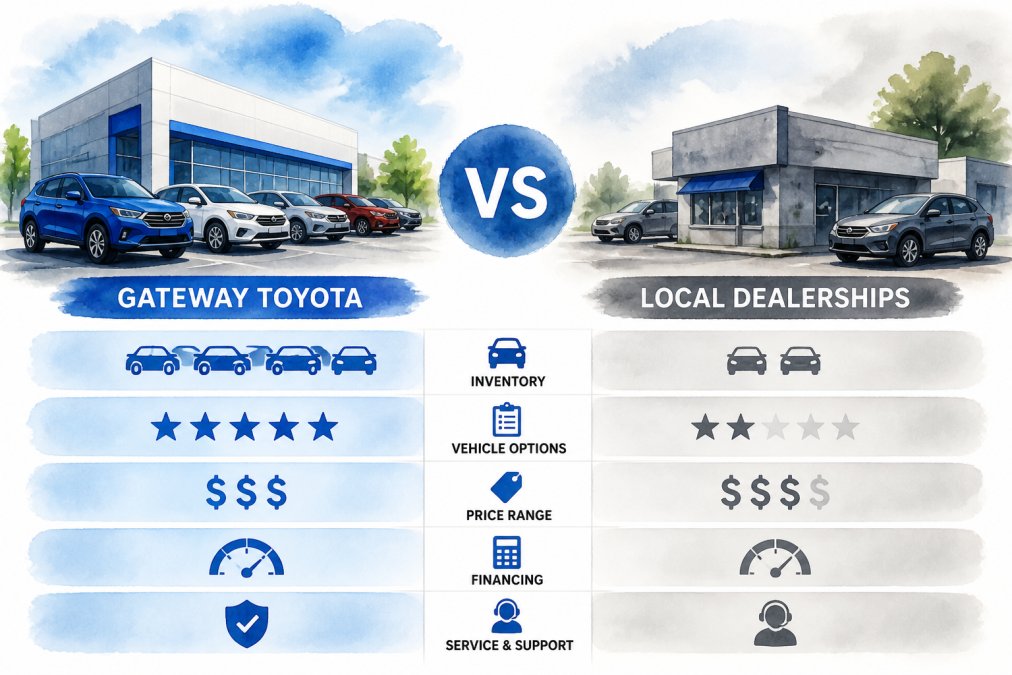
Gateway Toyota vs AutoSport USA: Quick Comparison Table
A side-by-side snapshot shows where each dealership type wins before you ever visit a lot. Gateway Toyota operates as a high-volume franchise with an extensive new and pre-owned Toyota inventory, a full-service maintenance center, and online financing tools. AutoSport USA specializes exclusively in quality used vehicles, offering a curated selection of sedans, SUVs, and trucks alongside integrated online financing applications and trade-in valuations.
| Criteria | Gateway Toyota | AutoSport USA |
|---|---|---|
| Inventory Type | New + pre-owned Toyotas | Curated used sedans, SUVs, trucks |
| Transparency Grade | Not specified | Individual vehicle retail pricing |
| Service Center | Full-service maintenance | Not specified |
| Financing Tools | Online tools available | Integrated online applications |
| Best For | Toyota loyalists needing factory service | Shoppers wanting multi-brand variety |
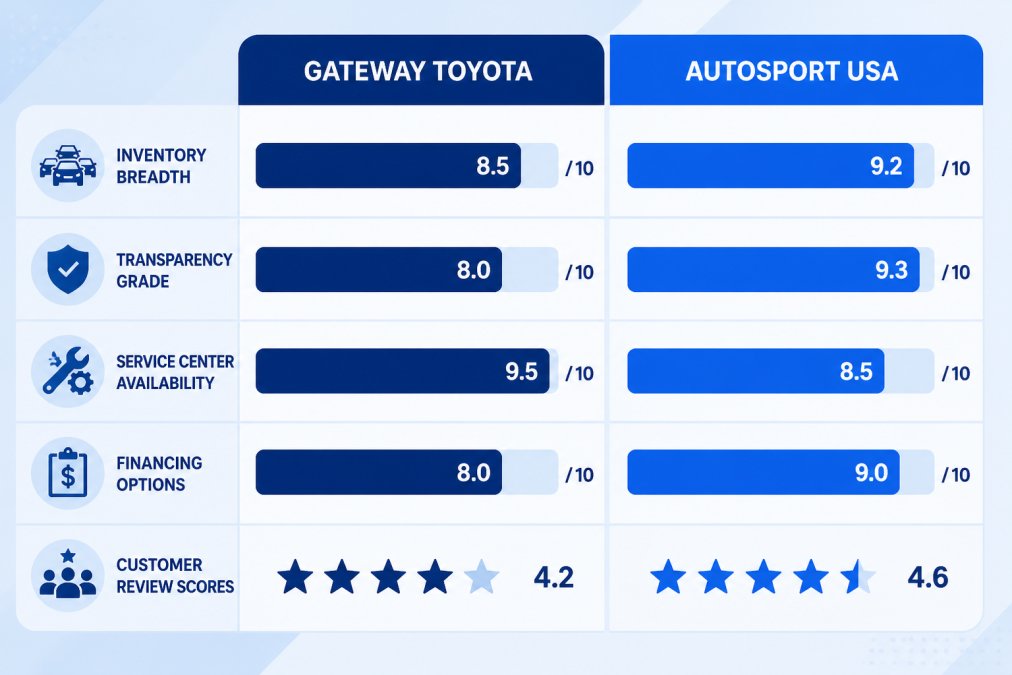
The deciding factor often comes down to whether you want a factory warranty and brand-specific service or a wider field of vehicles. If you're set on a Toyota and want factory-trained technicians handling maintenance, the franchise wins. If you want to compare a Honda against a Ford against a Toyota on the same lot, an independent dealer gives you that flexibility.
Gateway Toyota: What to Expect from a High-Volume Franchise
Gateway Toyota is a high-volume Toyota dealership in Toms River offering new and pre-owned vehicle sales, financing, and maintenance services. Their scale means a deep inventory of Toyotas at any given time, which translates to more color and trim options than a typical independent lot can match. They also hold CARFAX Top-Rated Lifetime Dealer status, a signal of sustained customer satisfaction.
Strengths of Gateway Toyota
The franchise model carries distinct advantages for the right buyer. Gateway Toyota's fee structure and add-on practices are clearer than most dealers in the region. Their full-service maintenance and repair center keeps your vehicle serviced by factory-trained technicians using genuine parts, which supports resale value over time.
Potential Drawbacks
No dealership type is perfect. Gateway Toyota's documentation fee runs slightly above the regional average, and high-volume stores sometimes add minor dealer-installed add-ons to boost per-vehicle profit. You may find yourself negotiating against a sales representative working on commission, which changes the dynamic compared to smaller lots where the owner might handle your deal directly. You may find yourself negotiating against a sales representative working on commission, which changes the dynamic compared to smaller lots where the owner might handle your deal directly.
Local Dealerships Like AutoSport USA: The Independent Alternative
Independent used car dealerships fill a different role in the market. Rather than serving one manufacturer, they source pre-owned vehicles from auctions, trade-ins, and direct purchases to build a diverse inventory. AutoSport USA, for instance, offers a curated selection of used sedans, SUVs, and trucks designed to meet many driving needs rather than pushing a single brand.
Why Shoppers Choose Independent Used Car Lots
Variety is the headline reason. A single independent lot can carry a Toyota Camry next to a Honda CR-V next to a Ford F-150, letting you test drive competing models back-to-back without driving across town. The shopping experience also tends to be more personalized, with staff focused on matching you to a vehicle that fits your budget and commute rather than clearing factory allocation targets.
Potential Limitations to Consider
The trade-off is the absence of new-car inventory and factory-backed service. You won't find a brand-new model with a full manufacturer warranty on an independent lot, and routine maintenance will need to happen at a third-party shop or the vehicle's brand dealership. Vehicle history reports become essential here, since you're buying pre-owned without the factory's certification program behind you.
Inventory and Vehicle Selection: Franchise vs Independent
The inventory question drives most buyers toward one dealership type or the other. A franchise like Gateway Toyota maintains an extensive inventory of new and pre-owned Toyotas, which is ideal if you want a specific model, trim, and color combination delivered with manufacturer support. Their online inventory tools let you check availability before visiting.
Independent dealerships counter with breadth rather than depth. Because they aren't locked to one manufacturer, they stock whatever used vehicles sell well in their region. For shoppers who value comparing the total cost of ownership across brands, including insurance rates, fuel economy, and repair costs, an independent lot offers a more practical starting point. Vehicle selection at an independent dealer rewards shoppers who arrive with an open mind about which brand fits their needs.
Transparency in Pricing and Fees: Who Shows Their Cards?
Pricing transparency separates reputable dealerships from the ones that waste your Saturday. Gateway Toyota discloses fees and add-ons clearly, though their documentation fee sits slightly above average. Independent dealers set individual vehicle retail pricing, which means the advertised price is typically the starting negotiation point rather than a take-it-or-leave-it figure.
The question every buyer should ask, regardless of dealership type, is simple: "What is the real total cost including all fees and add-ons?" A dealership that answers directly and puts it in writing earns your trust. One that deflects or adds surprise charges at the finance desk should raise a red flag. Consumer guidance on auto dealer fees from the Federal Trade Commission explains which charges are legitimate and which ones you can push back on.
Dealership Financing vs Bank Loans: Which Works for You?
Financing often decides which dealership wins your business, but the comparison isn't just about interest rates. The real difference in the Toms River market is how each type of dealership structures the digital-to-in-person financing journey, and that's where most buyers lose leverage.
The Franchise Digital Path: Gateway Toyota's Online Tools
Gateway Toyota, like most high-volume franchises, runs a fully integrated digital retailing platform. You can complete a credit application online, receive a decision in minutes, and even get a preliminary payment estimate without stepping onto the lot. Their finance department works with a national network of lenders, including captive financing through Toyota Financial Services.
The catch is the handoff. The online pre-approval you receive is a soft quote, not a binding commitment. When you arrive in person, the finance manager re-runs your application, and the rate can shift based on the vehicle you select, the loan term, and any add-ons you finance. Franchise finance managers are also under pressure to sell extended warranties, paint protection, and gap insurance, products that can add $2,000 to $4,000 to your loan principal if you're not paying attention.
The Independent Digital Path: AutoSport USA's Approach
Independent dealers like AutoSport USA operate with a leaner digital infrastructure but a more transparent handoff. Their online financing application captures your basic information and credit profile, and a finance specialist contacts you directly with a pre-qualification before you visit. Because independents don't have a captive lender, they shop your file across a smaller, regional network of banks and credit unions, which can be an advantage if you have strong credit, since local credit unions often beat national bank rates.
The trade-off is speed and approval flexibility. Franchise stores with national lender networks can often approve borrowers with thinner credit files or recent derogatory marks that a local credit union would decline.
The Pre-Approval Leverage Play
Regardless of which dealership type you choose, the single most effective move is to secure a pre-approval from a local credit union or bank before you begin shopping. FTC advice on auto financing recommends this comparison shopping approach to ensure you're not overpaying on interest. A pre-approval gives you a hard number to compare against whatever the dealership offers, and it changes the negotiation dynamic entirely.
When you arrive with a bank check or a pre-approval letter, the finance manager knows you can walk away. That leverage often produces a lower dealership rate, since the dealer wants to keep the financing profit in-house. The key is to compare the annual percentage rate (APR), not the monthly payment. A $450 monthly payment over 72 months at 7.9% APR costs you roughly $2,800 more in interest than the same payment over 60 months at 5.9% APR, even though the monthly figure looks identical.
The Digital Handoff Test
Before you visit either type of dealership, test their digital financing process. Submit a credit application online and track how long it takes to receive a response, whether the response includes a specific rate and term or just a generic "you're pre-approved," and whether the dealership tries to schedule an in-person appointment before sharing numbers. The dealership that gives you a concrete, written rate and term online, without requiring a visit, is the one that respects your time and your leverage.
A common pattern among top-rated dealers is a fully transparent online process that lets you complete 80% of the transaction remotely, including financing approval, trade-in valuation, and even home delivery. If a dealership's online process stalls at the credit application stage and forces you into the finance office to get real numbers, that's a signal about how they handle negotiation in person.
How to Read Used Car Dealership Reviews Without Getting Misled
Used car dealership reviews are useful, but only if you read them critically. Review platforms like DealerRater's dealership review directory aggregate customer feedback on sales and service experiences, giving you a sense of how a dealership treats people after the sale, not just during it. A high volume of recent reviews matters more than a perfect score, since a dealership's management and policies change over time.
The key is separating signal from noise. A handful of one-star reviews from customers who walked in without an appointment and demanded below-market pricing carries less weight than consistent complaints about hidden fees or post-sale service refusal. Look for patterns: multiple reviewers mentioning the same issue, whether it's slow service appointments, pushy sales representatives, or disputed trade-in values. Those patterns tell you what to verify during your own visit.
Negotiating Car Prices at Dealerships: Tactics That Work
Negotiating car prices at dealerships comes down to preparation, not charisma. Before you visit any lot, research the fair market value for the exact year, trim, and mileage you're targeting using resources like CarEdge's dealer transparency and market data. Knowing what the vehicle sells for regionally gives you a defensible anchor for your opening offer, rather than relying on the dealer's markup as your reference point.
When you sit down to negotiate, focus on the out-the-door price, not the monthly payment. Sales representatives often shift the conversation to monthly payments because stretching the loan term hides a higher total cost. Ask for the vehicle price, then the itemized fees, then discuss financing separately. If the dealership won't meet your target, request a vehicle history report and walk away. There is no shortage of used vehicles in the region, and the willingness to leave is your strongest negotiating lever.
Choosing between Gateway Toyota and local dealerships ultimately comes down to what you value more: factory-backed service for a single brand or a diverse used inventory with a personalized shopping experience. Gateway Toyota offers the security of a high-volume franchise, while independents like AutoSport USA provide curated pre-owned vehicles across multiple makes with online financing tools and trade-in valuations built into the process. The best approach is to test drive your top candidates at both types of dealerships, compare the out-the-door pricing in writing, and verify the vehicle history before committing. Get started with AutoSport USA by browsing our online inventory and submitting a credit application to see how your financing options compare.
Frequently Asked Questions
Can I negotiate a price at a Toyota dealership?
Yes, negotiation is expected at most dealerships, including Gateway Toyota. The key is to research fair market values on sites like CarEdge and come prepared with data. Focus on the out-the-door price, which includes all fees, rather than just the monthly payment. Be willing to walk away if the dealer won't budge on documentation fees or add-ons. For a smoother experience, get a quote online first and compare it with offers from local independent dealers.
Is it better to buy from a large franchise or a local independent dealer?
There's no single right answer. Large franchises like Gateway Toyota offer extensive inventories, factory-trained technicians, and often have better warranty options, but they may have higher fees. Local independent dealers, like AutoSport USA, provide a curated used car selection and often more flexible, personalized service. Visit both, compare their inventory and pricing, and check their reviews on DealerRater to see which aligns with your priorities.
How do dealership fees differ between major brands and local sellers?
Franchise dealerships often charge a documentation fee that can be above average and may add dealer-installed options. Independent local dealers typically have lower overhead and may be more willing to negotiate fees. Always ask for a full breakdown of all fees before signing. A transparent dealer will show you every charge upfront, while others might hide costs until the final paperwork.
What should I look for when comparing local car dealerships?
Start by checking their online inventory to see if they carry the make and model you want. Look for transparency in pricing: do they list fees online? Read recent reviews on DealerRater and Google, focusing on comments about the sales process and after-sales support. Verify their service center capabilities and ask about vehicle history reports. Finally, test drive the vehicle and have an independent mechanic inspect it before committing.