 comparison
Auto Lenders vs Independent Dealers: 2026 Guide
Table of Contents
- Auto Lenders vs Independent Dealers: A Side-by-Side Comparison
- Dealership Financing vs Bank Loan: Key Differences
- How to Get Pre-Approved for a Car Loan
- Benefits of Buying from Independent Dealers
- Understanding Dealer Markup and In-House Financing
- Buy Here Pay Here vs Traditional Financing
- Total Cost of Ownership: Beyond the Monthly Payment
- Frequently Asked Questions
Last Updated: September 14, 2026
Auto Lenders vs Independent Dealers: A Side-by-Side Comparison
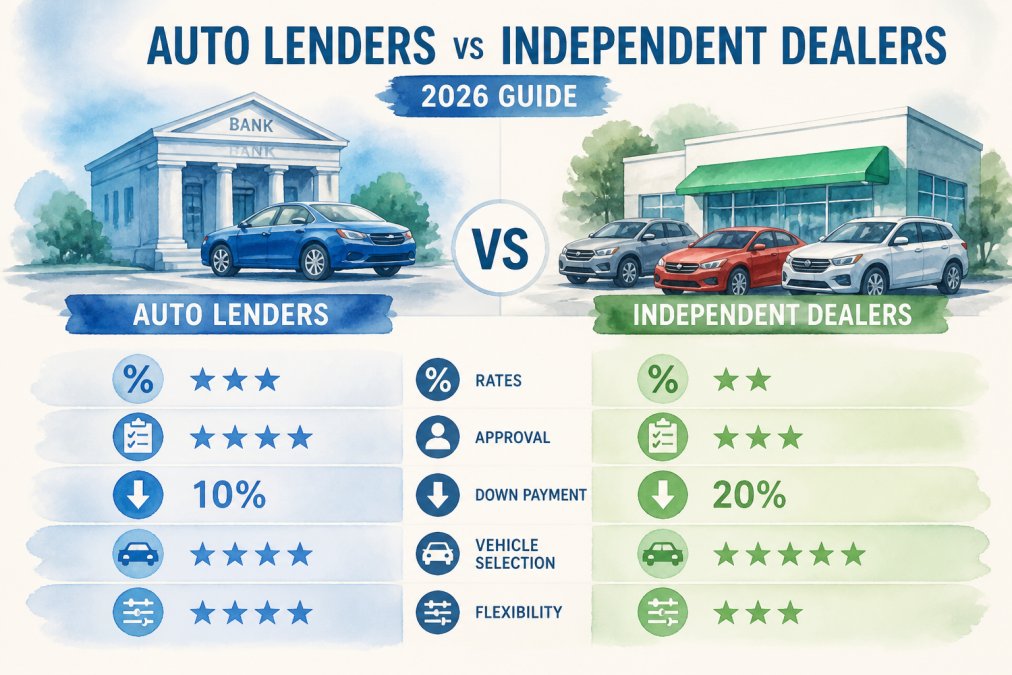
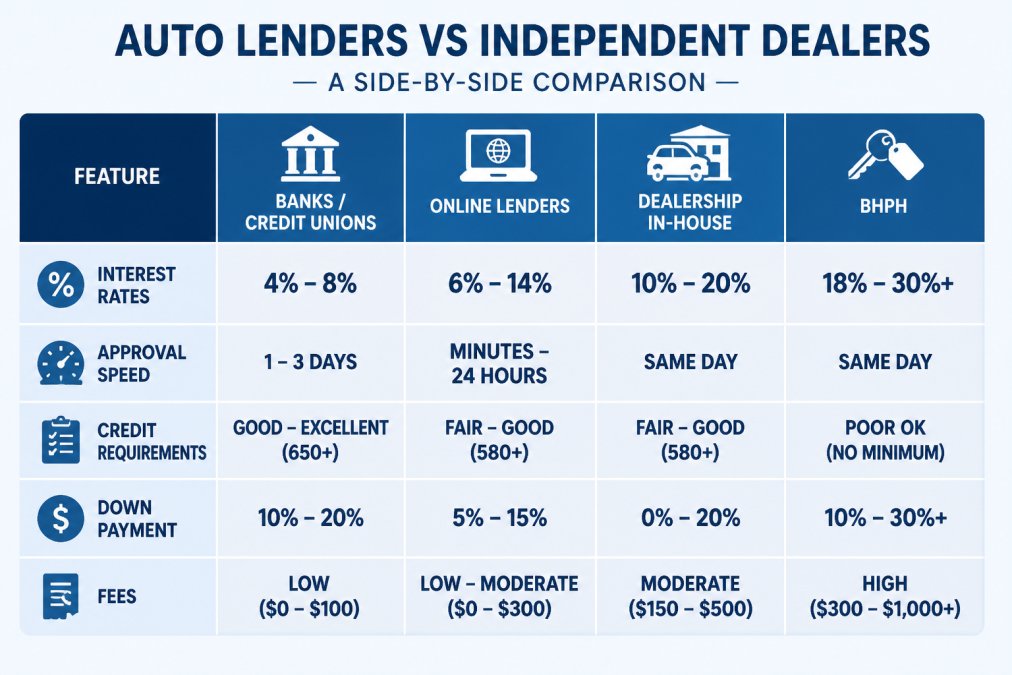
Auto lenders are financial institutions, banks, credit unions, and online marketplaces that issue vehicle loans directly to borrowers, while independent dealers sell used vehicles from their own inventory and may arrange financing through third-party lenders or in-house. The two serve different roles, and knowing where each fits saves money. This guide from This guide breaks down how to shop both sides without getting squeezed in the middle.
The core tension is simple: a lender approves you before you shop, so you negotiate as a cash buyer. A dealer controls the car and often the financing, so you negotiate both at once. Most buyers do it backwards, and that ordering mistake is where dealer markup hides.
| Financing Source | Typical Rate Range | Approval Speed | Credit Requirements | Down Payment | Fee Structure |
|---|---|---|---|---|---|
| Banks / Credit Unions | Lower range | 1-3 business days | Good to excellent credit | Often required | Origination fee possible |
| Online Lenders (marketplace) | Competitive, varies | Minutes to hours | Broad, score-dependent | Varies by lender | Free to use; multiple inquiries |
| Dealership In-House | Higher range | Same day | Flexible | Often required | May include markup |
| Buy Here Pay Here | Highest range | Same day | Minimal or no check | Usually required | Built into price |
Dealership Financing vs Bank Loan: Key Differences
The biggest difference is who sets your rate. A bank or credit union sets one rate based on your credit profile. A dealership can shop your application across a lender network, but it may also add markup on top of the rate the lender approved you for.
Dealership financing wins on convenience: you sign in one place, often the same day. A bank loan wins on transparency, because you see the rate, term, and origination fee before you commit to a vehicle.
A common mistake is comparing only the monthly payment. A longer loan term lowers the payment but raises the total interest you pay. Always compare the APR and the loan term together, never the payment alone.
How to Get Pre-Approved for a Car Loan
Pre-approval is a lender's conditional commitment to fund your auto loan up to a set amount before you pick a vehicle. It is not a final loan, the lender still has to approve the specific car, the mileage, and the sale price, but it tells you your real budget and turns you into a cash buyer at the negotiating table. That shift in leverage is the whole point.
Here is the process, start to finish:
- Check your credit reports at AnnualCreditReport.com and dispute any errors before you apply
- Gather proof of income, government ID, proof of address, and your insurance information
- Apply with your bank or credit union, many will pre-approve existing members in a day
- Compare at least two online lender offers side by side
- Review the APR, loan term, origination fee, and any prepayment penalty
- Accept the best offer and get your pre-approval letter in writing
- Shop vehicles within your approved amount, and bring the letter to the lot
Tools like Capital One Auto Navigator and myAutoLoan's rate estimator let you see offers before you visit a lot. A credit union you already belong to is often the fastest path, because it can verify your deposit history and income directly.
What the letter should contain. A usable pre-approval letter states the maximum amount financed, the APR or rate range, the maximum term, the expiration date, and whether the offer is contingent on the vehicle passing an inspection. Most pre-approvals last 30 to 60 days. If yours expires before you buy, ask for a refresh rather than starting over, a re-pull within the same shopping window usually does not cost you a second inquiry.
How to use it at the dealership. Tell the finance manager you are paying with outside financing and show the letter. The dealer can still try to beat it, sometimes a manufacturer's captive lender has a promotional rate your bank cannot match, so let them compete, but only against the number you already hold. If the dealer's offer is lower APR and the same term, take it. If it is higher, decline and use your pre-approval.
The one thing pre-approval does not lock. The lender approves you for an amount, not a specific car. A vehicle that is too old, has too many miles, or has a branded title may fall outside the lender's collateral rules. Confirm the year, mileage, and title status limits before you fall in love with a car.
Benefits of Buying from Independent Dealers
Independent dealers often offer competitive pricing for the same model year. Their sourcing methods and lower overhead can contribute to competitive pricing.
Other real advantages:
- A diverse inventory mix across many makes, not one brand
- Potential for negotiation on price
- Efficient trade-in processes, with appraisal and closing often completed quickly
- Access to various lending options, which can be beneficial for buyers with diverse credit profiles
The trade-off is variability. Inspection quality and vehicle history disclosure differ from lot to lot, so ask for the NMVTIS vehicle history report and an independent pre-purchase inspection before you sign.
Understanding Dealer Markup and In-House Financing
Dealer markup is the difference between the interest rate a lender approves you for, the buy rate, and the rate the dealership actually writes into your contract, the contract rate. The dealer keeps the spread, and it is paid by the lender as compensation for originating the loan. It is legal in most states, but it must be disclosed in your contract terms, and a handful of states cap how much markup a dealer can add.
How the mechanism works. You apply at the dealership. The finance manager submits your application to a lender network. A lender comes back with an approval at, say, a buy rate. The dealer can then present you a higher contract rate and keep the difference. On a long loan term, a small rate bump compounds into a meaningful amount of extra interest, and because it is baked into the monthly payment, it never shows up as a line item you can see.
How to catch it. Ask the finance manager one direct question: "Is this the lender's buy rate, or does it include dealer markup?" If they cannot answer clearly, that is your signal to use your pre-approval instead. You can also ask which lender approved the loan and call that lender directly to confirm the rate they issued. A lender will usually tell you the buy rate it quoted the dealer.
How to unwind it. If you already signed a contract with markup and you have a better pre-approval in hand, you can often refinance the loan within the first 30 to 90 days. Refinancing replaces the dealer's contract rate with your lender's rate, and the dealer's markup disappears. Check whether your original contract has a prepayment penalty first, most auto loans do not, but confirm before you refinance.
In-house financing works differently. Here the dealer acts as the lender, holds the loan, and sets the rate and terms directly. That flexibility helps buyers who cannot get approved elsewhere, but it usually comes with a higher rate and a shorter loan term. Because the dealer is both the seller and the lender, there is no separate buy rate to compare against, which is exactly why in-house deals are the hardest to benchmark.
Buy Here Pay Here vs Traditional Financing
Buy Here Pay Here (BHPH) dealers finance the vehicle themselves and require payment at the lot, often weekly or biweekly. Traditional financing routes your loan through a bank, credit union, or online lender that holds the contract.
BHPH exists for buyers with damaged credit or no credit history. Approval is fast and credit checks are minimal. The cost is steep: higher rates, larger down payments, and vehicles priced above market to offset default risk. Many BHPH lots also use payment-tracking devices.
Traditional financing rewards a stronger credit profile with lower rates and flexible terms. If your credit is borderline, a credit union or an online marketplace like LendingTree's auto loan marketplace will usually beat a BHPH rate. Reserve BHPH for when every other door has closed, and read the contract terms carefully.
Total Cost of Ownership: Beyond the Monthly Payment
Total cost of ownership (TCO) is the full cost of the vehicle over the time you own it: loan interest, depreciation, insurance, fuel, maintenance, and repairs. The monthly payment is only one line in that equation.
Two loans with the same payment can cost very different amounts. A longer loan term lowers the payment but raises total interest and leaves you with negative equity longer, meaning you owe more than the car is worth. A larger down payment cuts both the principal balance and the interest you pay over the life of the loan.
Before you commit, add up the real numbers:
- Loan interest across the full term
- Insurance premiums for that specific model
- Estimated fuel and maintenance costs
- Expected depreciation over your ownership period
A used vehicle with a clean history and a fair price usually wins on TCO, even if a newer model has a lower promotional rate. Run the full math before you let a low monthly payment make the decision for you.
Frequently Asked Questions
Do banks give better auto loans than dealerships?
Banks and credit unions often offer lower interest rates than dealership financing, especially for borrowers with good credit. However, dealerships may provide more flexible approval criteria for those with subprime credit. Getting pre-approved by a bank or credit union gives you a baseline to compare against dealer offers. Remember that dealer markup can increase the rate, so always negotiate the out-the-door price separately from financing.
What is the $3,000 rule for cars?
The $3,000 rule is a guideline suggesting you should spend no more than $3,000 on a used car if you want to minimize depreciation and maintenance costs. It's often cited for buyers seeking basic transportation with low upfront cost. However, in today's market, $3,000 may only buy a high-mileage vehicle needing repairs. Consider total cost of ownership, including insurance, taxes, and potential repairs, before applying this rule.
What is the red flag rule for car dealers?
The Red Flags Rule, enforced by the FTC, requires auto dealers to implement identity theft prevention programs. For consumers, it means dealers must verify your identity and watch for suspicious activity. When shopping, be wary of dealers who don't ask for proper identification or pressure you to provide sensitive information without explanation. You should also watch for red flags like refusing to provide a vehicle history report or adding unexpected fees.
What should you never reveal to the dealer when negotiating?
Never reveal your maximum monthly payment or that you have a pre-approved loan amount before agreeing on the vehicle price. If the dealer knows your budget, they may focus on monthly payments rather than the total cost, making it easier to hide markup. Also avoid discussing your credit score or down payment until you've settled on the out-the-door price. Keep financing and price negotiations separate to maintain leverage.
How does dealership financing differ from direct lender financing?
Dealership financing involves the dealer acting as an intermediary, submitting your application to a lender network and often adding a markup to the interest rate. Direct lender financing means you apply directly with a bank, credit union, or online lender, receiving funds to pay the dealer. Direct lending typically offers more transparency and potentially lower rates, while dealership financing can be convenient and may help those with challenged credit.
Financing a used vehicle comes down to leverage, and leverage comes from being approved before you shop. AutoSport USA helps buyers in Toms River get there with online financing tools, transparent pricing, and trade-in valuations, so you can walk onto any lot as a cash buyer. Browse our inventory, get a trade-in value, and apply online to start your approval today.