 ultimate-guide
Avoiding Hidden Fees on Used Cars: A 2026 Guide
Table of Contents
- Why the Final Price Always Exceeds the Sticker
- The Negotiable Dealership Fees List You Need
- How to Read a Car Purchase Agreement Line by Line
- Common Used Car Dealer Add-Ons to Reject
- Mandatory Fees vs. Junk Fees: The Real Difference
- Pre-Approved Financing vs. Dealer Financing: Which Protects You?
- How to Counter F&I Office Tactics
- Your Out-the-Door Price Checklist
- Frequently Asked Questions
Last Updated: September 7, 2026
Why the Final Price Always Exceeds the Sticker
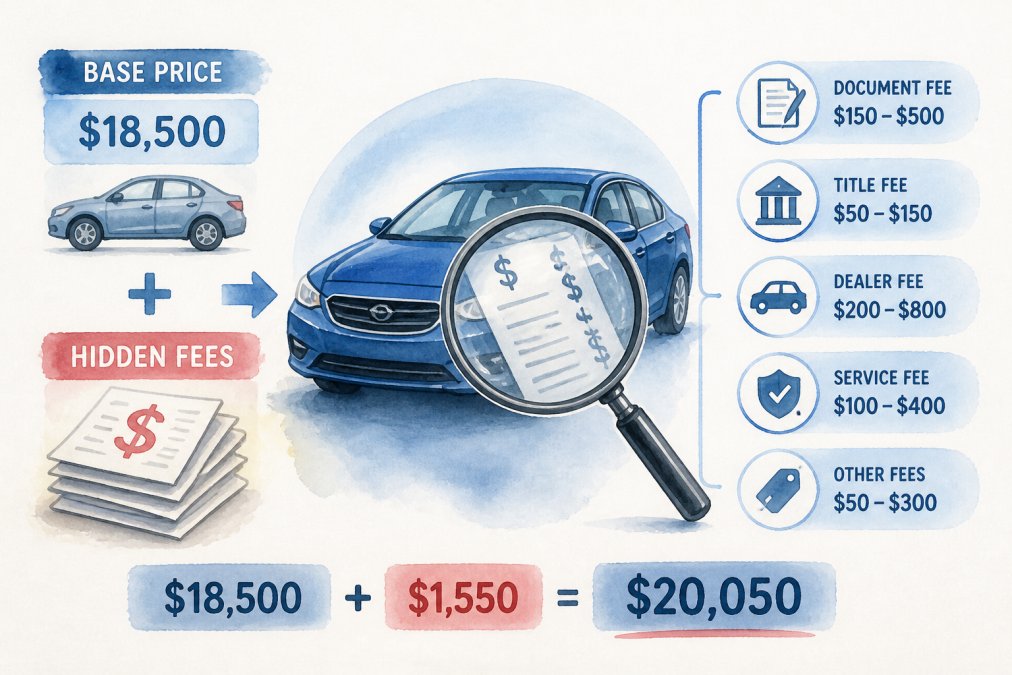
The advertised price on a used car is rarely the amount you write on the check. Avoiding hidden fees used cars dealers add starts with understanding that the sticker price is a starting point, not a final number.
Dealerships build profit into several line items beyond the vehicle itself, including the dealer documentation fee, destination charges, prep fees, and optional add-ons presented as necessities. The finance and insurance (F&I) office is where most of these extras appear, and it is designed to move quickly so you feel pressured to say yes.
We believe transparent pricing builds trust, which is why we encourage buyers to understand every line before signing. This guide walks through the negotiable dealership fees list you need, how to read the paperwork, and the exact tactics used to pad your total. Most of these fees are negotiable, and the ones that are not are clearly regulated.
The Negotiable Dealership Fees List You Need
A negotiable dealership fees list typically includes documentation fees, prep fees, and most dealer add-ons. Mandatory fees, such as sales tax, title transfer, and registration fees, are set by your state and cannot be negotiated away.
The dealer documentation fee, or doc fee, covers the dealership's paperwork costs. Many buyers assume this is fixed, but in most states it is negotiable, and dealers often expect you to push back. Destination charges apply to new cars, but on used vehicles a "reconditioning" or "prep" fee often appears instead.
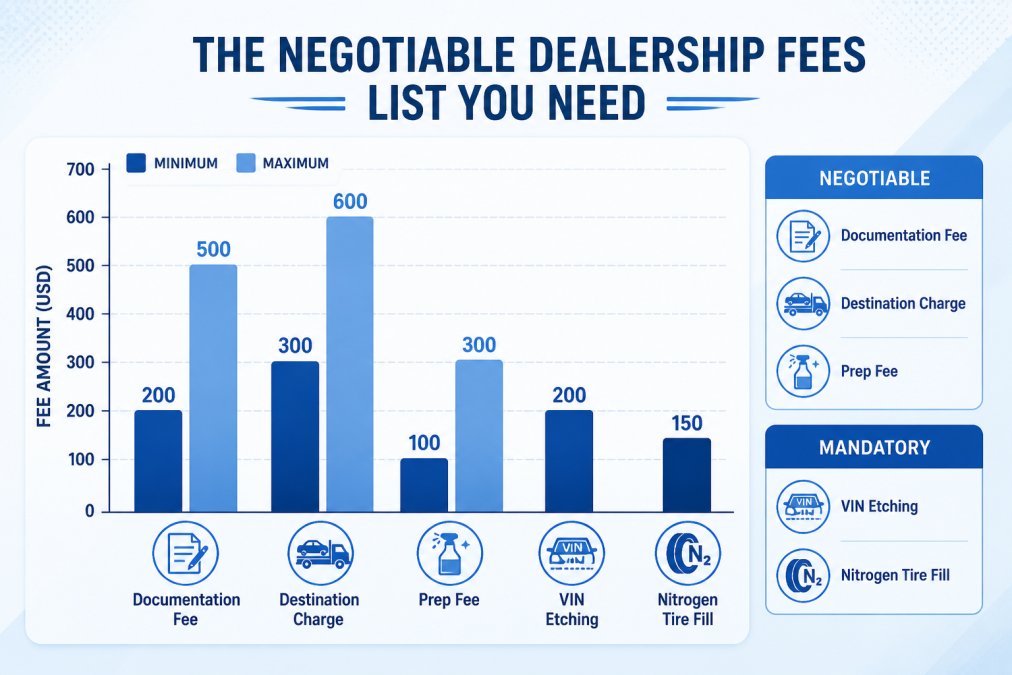
Fees that are purely dealer profit include VIN etching, nitrogen tire inflation, fabric protection, and paint sealant. These are almost always negotiable or should be removed entirely. According to consumer guidance from the Federal Trade Commission on car buying, you have the right to question any fee and ask for an itemized explanation before you sign.
How to Read a Car Purchase Agreement Line by Line
Most guides tell you to read the contract, but they rarely show you what a problematic one looks like. To truly avoid hidden fees, compare your contract against a known baseline. Below is a side-by-side breakdown of a typical padded contract versus a fair one.
Anatomy of a Padded Contract vs. a Fair Contract
| Line Item | Padded Contract (Red Flags) | Fair Contract (What to Expect) |
|---|---|---|
| Vehicle Price | $18,500 (matches sticker, not the negotiated price) | $17,200 (matches the agreed-upon price) |
| Documentation Fee | $899 (listed as 'non-negotiable administrative cost') | $250 (a reasonable, itemized processing cost) |
| Dealer Prep / Reconditioning | $495 (vague 'dealer services' charge) | $0 (included in the vehicle price) |
| VIN Etching | $299 (listed as a 'required theft deterrent') | $0 (declined by buyer) |
| Market Adjustment | $1,500 (listed as 'ADM' or 'Market Value Adjustment') | $0 (never a legitimate fee on a used car) |
| Nitrogen Tire Fill | $149 (listed as 'Tire Protection Package') | $0 (declined by buyer) |
| Total Out-the-Door Price | $21,842 | $17,450 |
The 'Miscellaneous' Trap
A key red flag is any line that says 'miscellaneous,' 'other,' 'admin,' or 'dealer services.' These are catch-all categories designed to hide profit. If you see one, ask the finance manager to write out exactly what service or product that fee covers. If they cannot provide a specific, tangible answer in writing, that fee is junk and should be removed.
The Trade-In Shell Game
Another common tactic involves the trade-in value. The dealer might offer you $1,000 more for your trade-in but simultaneously add a $1,000 'reconditioning fee' to the new car's price. Always negotiate the price of the new car and the value of your trade-in as two separate, independent transactions, and get the final trade-in offer in writing before negotiating the car's price.
The 'Payment' Misdirection
Finally, never let the conversation shift to the monthly payment until you have agreed on the out-the-door price. A dealer can make a $40,000 car fit a $400 monthly payment by stretching the loan to 84 months, burying thousands in interest and fees. Use a simple calculator to determine your expected payment based on the agreed price, down payment, and pre-approved rate, and ask for an itemized breakdown if the dealer's quote is significantly higher.
Common Used Car Dealer Add-Ons to Reject
Common used car dealer add-ons are optional products packaged to look mandatory. Rejecting them outright is the fastest way to reduce your final price, and most dealers will remove them without argument if you stay firm.
The most frequent add-ons include extended warranties, gap insurance, service contracts, and appearance packages like paint protection and interior sealant. VIN etching and theft deterrent systems cost the dealer very little to install, and nitrogen tire inflation is another favorite despite standard air containing roughly 78% nitrogen already.
Extended warranties and gap insurance are not inherently bad products, but they are rarely a good deal at the F&I desk. You can almost always purchase them later at a competitive rate. A useful comparison:
| Add-On | Typical Pitch | Reality | Best Move |
|---|---|---|---|
| VIN Etching | "Protects against theft" | Low cost to dealer, high markup | Decline |
| Nitrogen Tires | "Better fuel economy" | Minimal real-world benefit | Decline |
| Extended Warranty | "Peace of mind" | Often cheaper third-party | Research later |
| Gap Insurance | "Covers the loan gap" | Check your auto insurer first | Compare pricing |
| Paint Sealant | "Protects resale value" | Overpriced for what it does | Decline |
Mandatory Fees vs. Junk Fees: The Real Difference
Mandatory fees are required by law or by the lender, while junk fees are pure dealer profit with no tangible service behind them. Knowing the difference separates a fair deal from an inflated one.
Sales tax, title transfer, and registration fees are mandatory and set by your state. Your lender may also require certain services, such as a vehicle history report or a specific level of insurance coverage. These are legitimate costs that will appear on any purchase.
Junk fees, by contrast, include market adjustments, dealer markup on the interest rate, and any vaguely named "administrative" charge that lacks a clear explanation, these are the hidden fees used cars buyers most often miss. A market adjustment is particularly common on popular models and is entirely negotiable. If a dealer insists on a junk fee, ask them to remove it or walk away.
Pre-Approved Financing vs. Dealer Financing: Which Protects You?
Pre-approved financing from a bank or credit union protects you from dealer markup on your interest rate. Dealer financing is convenient but often includes a markup that increases your total cost over the life of the loan.
When a dealer arranges your loan, they act as a middleman. The lender approves you at one rate, and the dealer can add a percentage point or more as profit, a practice known as a rate markup. Pre-approval locks in your rate before you step onto the lot, giving you a clear baseline to compare against any dealer offer.
That said, dealer financing is not always a bad deal. Manufacturers and dealerships occasionally run promotions with rates below what your bank offers. The key is to arrive with a pre-approval and only accept dealer financing if the rate and terms beat your existing offer.
How to Counter F&I Office Tactics
The finance and insurance (F&I) office is a pressure cooker designed to separate you from your money. The tactics are psychological, not mathematical, built to make you feel rushed, confused, or obligated. Here is how to counter them with specific scripts and a clear mindset.
Tactic 1: The 'Four-Square' Method
This is a classic grid on a piece of paper with four boxes: Trade-In Value, Down Payment, Monthly Payment, and Vehicle Price. The salesperson moves numbers around in all four boxes simultaneously, making it impossible to see the actual cost of the car. The goal is to get you to agree to a monthly payment without ever agreeing on a final price.
The Counter: Refuse to negotiate on the grid. Say, "I'm not negotiating a monthly payment right now. Let's agree on the out-the-door price of the car first. Once we have that number, we can talk about financing." If they keep pushing the grid, take out your own piece of paper and write down the single number you are negotiating: the out-the-door price.
Tactic 2: The 'Penny-a-Day' Pitch
The F&I manager will frame an add-on like an extended warranty or paint protection as costing "just pennies a day." For example, a $1,500 warranty over a 60-month loan sounds like "less than a dollar a day," making a large sum of money feel trivial.
The Counter: Do the math out loud. Say, "That's $1,500 added to my loan. With interest, over five years, I'll be paying closer to $1,800. That's not a penny a day; that's a significant amount of money. I'll pass." Always ask for the total cost of any product over the full life of the loan, not the daily or monthly equivalent.
Tactic 3: The 'Good Cop, Bad Cop' Routine
The salesperson you've been friendly with will suddenly become your ally, saying things like, "I'm on your side, but my manager is insisting on this fee. Can you help me out?" This is a scripted routine to make you feel like you're doing the salesperson a favor by accepting a bad deal.
The Counter: Recognize that the salesperson's job is to sell you the car and its add-ons. They are not your friend in this transaction. Respond with, "I understand your position, but I'm not comfortable with that fee. If your manager can't remove it, I'm prepared to walk away. Here is my number, feel free to call me if something changes." Then, stand up and start to leave. This is the single most powerful negotiating tool you have.
Tactic 4: The 'Expiring Offer' Pressure
"This 0.9% APR financing is only available if you sign today." Or, "This is the last one at this price; the rebate expires at the end of the month." This creates artificial urgency to force a quick decision.
The Counter: Time pressure is a lie. Say, "If that's the case, I'll have to let the offer expire. I'm not making a decision on a multi-thousand-dollar purchase under this kind of pressure. If the deal is still available tomorrow, great. If not, I'll find another car." In nearly all cases, the offer will be 'extended' or 'reinstated' when you return.
Tactic 5: The 'Sign Here' Blur
The F&I manager will flip through a stack of documents quickly, pointing at signature lines and saying, "Initial here, sign here, and here," banking on you not reading the fine print.
The Counter: Slow the process down. Say, "I need to read every page of this contract before I sign anything. Please give me a few minutes to review it in full." If they hover, ask for a private moment to review the documents. You have the right to read everything. If they refuse to give you time, that is the ultimate red flag. Walk away.
Your Out-the-Door Price Checklist
Use this checklist to confirm every number before signing and to keep avoiding hidden fees on used cars a straightforward process.
- Confirm the vehicle price matches the agreed amount, not the sticker
- Verify sales tax is calculated correctly for your state
- Confirm title transfer and registration fees match state schedules
- Question the documentation fee and ask for it to be reduced or waived
- Decline all dealer add-ons unless you genuinely want them
- Review the purchase agreement line by line before entering the F&I office
- Compare the dealer's financing rate against your pre-approval
- Ask for the total cost over the full loan term, not the monthly payment
- Request an itemized list of every fee and charge on the contract
- Walk away if any fee cannot be clearly explained in writing
Researching state-specific registration fees ahead of time is easier than most buyers expect. Your state's DMV website publishes the current fee schedules, and a quick lookup before you visit the dealership removes any guesswork (dmv.org). The National Highway Traffic Safety Administration also provides resources on vehicle history and safety recalls, which helps you verify the car itself before you worry about the fees.
The psychological pressure in the F&I office is real, but preparation neutralizes it. When you arrive with a pre-approval, a clear understanding of mandatory versus optional fees, and the willingness to walk away, the negotiation shifts in your favor. Dealers respond to informed buyers, and most junk fees will quietly disappear when challenged.
Frequently Asked Questions
Which dealership fees are actually negotiable?
Most are negotiable, including the documentation fee, prep fee, and many add-ons. While the doc fee is a fixed amount in some states, dealers often have room to adjust the vehicle price to offset it. The key is to negotiate the out-the-door price, not the individual fees. Focus on the total number on the bottom line, and ask for an itemized list to see exactly where your money is going.
What is a 'doc fee' and can it be waived?
A documentation fee covers the dealer's cost of processing your paperwork, like title transfer and registration. Dealers often present it as non-negotiable, but its purpose is often to pad profit. Some states regulate the maximum amount. You can ask to have it reduced or waived, but the dealer may simply adjust the vehicle price instead. Always compare the total out-the-door price, which includes the doc fee.
How do you spot junk fees on a used car purchase agreement?
Look for vague line items like 'prep fee,' 'dealer addendum,' or charges for services you didn't request. Common junk fees include VIN etching, nitrogen tire inflation, and fabric protection. To read a car purchase agreement correctly, compare the itemized list against your negotiated deal. If a fee wasn't discussed, question it. A reputable dealer will remove it or explain its purpose without pressure.
Are dealer prep fees mandatory?
No, a dealer prep fee is almost always negotiable. This fee is meant to cover the cost of cleaning and inspecting the vehicle before sale, which is a standard cost of doing business for a dealer. It is not a government-mandated charge. Treat it as a negotiable dealership fee and ask for it to be removed or for the vehicle price to be lowered by a corresponding amount.
Buying a used car should not feel like a game of financial defense. At AutoSport USA, we keep the process transparent with an online financing tool, trade-in valuations, and a team that answers your pricing questions directly. Get started with AutoSport USA and drive away knowing your out-the-door price is the real total. Apply Online today.