 ultimate-guide
Getting Approved for Car Loans in Toms River: A Guide
Table of Contents
- How the Car Loan Approval Process Works at a Dealership
- Pre-Qualification vs Pre-Approval for Auto Loans: Know the Difference
- Documents Needed for Car Financing: A Simple Checklist
- Used Car Financing for Bad Credit: Your Realistic Options
- Local Credit Unions vs. National Banks vs. Dealership Financing
- How Loan Terms Impact Your Monthly Payments
- Conclusion: Your Path to Getting Approved for Car Loans
- Frequently Asked Questions
Last Updated: September 5, 2026
Getting approved for car loans in Toms River doesn't have to mean spending weeks bouncing between bank branches and dealership finance offices. Most buyers who struggle with approval share one thing in common: they don't understand how the process actually works before they walk in. This guide from AutoSport USA breaks down the real steps, the documentation, and the financing strategies that get you behind the wheel.
Auto financing is a secured loan, meaning the vehicle itself serves as collateral. That security makes lenders more willing to work with you, even if your credit history has some rough patches. What matters is how well you prepare your application, your down payment, and your understanding of the loan terms.
How the Car Loan Approval Process Works at a Dealership
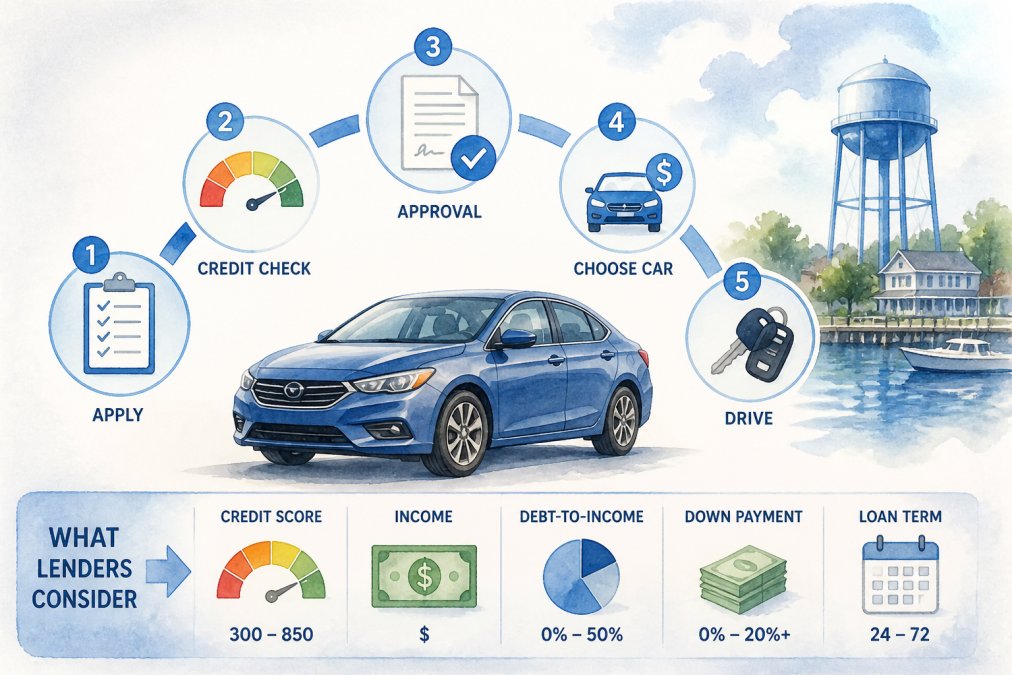
Most dealership finance pages describe the process in three vague steps: apply, get matched, and sign. But the real mechanism is more specific, and understanding it is the difference between an approval you can plan around and a rejection that wastes your afternoon.
Step 1: The Application Triggers a 'Shotgun' to Multiple Lenders
When you submit a credit application through a dealership, the finance manager submits your file electronically to a network of lenders, often 10 to 20 at once, through a platform like Dealertrack or RouteOne. This is called a 'shotgun' or 'indirect lending' approach.
The critical detail: this process is designed to generate a single credit pull shared among those lenders, so you shop multiple rates without multiple hard inquiries. However, this only works if the dealership is reputable. Ask the finance manager directly: 'Will you be submitting my application to multiple lenders simultaneously under one credit pull?' A straightforward 'yes' is a good sign.
Step 2: The Lender's 'Scorecard' Determines Your Tier
Once your application is received, the lender runs it through an automated underwriting system. This is not a single credit score check. It is a proprietary scorecard that weighs your FICO score, your debt-to-income (DTI) ratio, your employment stability (typically two years at the same job is ideal), and the loan-to-value (LTV) ratio of the vehicle.
LTV is the number most buyers never hear about until it's a problem. If you want to finance a $25,000 car with no down payment, the LTV is 100%. Many lenders cap LTV at 110% to 120% for used cars, meaning the vehicle's book value must cover the loan amount plus taxes and fees. If the car is priced above book value, you will be asked for a larger down payment, even if your credit is excellent.
Step 3: The 'Indirect' Offer Comes Back with Conditions
When a lender approves you, the offer is not a blank check. It comes back with conditions, often called 'stips' (short for stipulations). Common stips include:
- Proof of income: Two recent pay stubs, or a bank statement if you are self-employed.
- Proof of residence: A utility bill or lease agreement.
- Proof of insurance: A current declarations page, not just an ID card.
- A telephone verification of employment: The lender calls your employer to confirm you work there.
These stips are the number one reason an approval falls through at the last minute. The finance manager will tell you 'you're approved,' but that approval is conditional until the stips are cleared. If you arrive without your pay stubs, the deal stalls; if you bring them, it closes the same day.
Step 4: The 'Finance Manager' Presents the Deal, and This Is Where You Have Leverage
The finance manager's job is to present the lender's offer in the most profitable way for the dealership. They may offer you a higher APR than the lender approved, keeping the difference as profit. This is called 'dealer markup.' On a 60-month loan, even a 1% markup can mean hundreds of dollars in extra profit.
The way to counter this is not to argue, it's to bring your own pre-approval from a credit union or bank. When you have a written offer at 6% APR, the finance manager knows they must beat it or match it to earn your business.
The Unique Angle: The 'One-Pull' Guarantee
Most dealership pages will not tell you that you have the right to ask how your credit is being pulled. Under the Fair Credit Reporting Act, you are entitled to know who has accessed your credit report. Before you sign the application, ask the finance manager to confirm in writing that they will submit your application to their lender network in a single batch within a 14-day window. This protects your credit score and ensures you are not penalized for shopping around.
Pre-Qualification vs Pre-Approval for Auto Loans: Know the Difference
Pre-qualification and pre-approval are not the same thing. Pre-qualification is a quick estimate based on self-reported information; it gives you a general sense of what you might qualify for, but it carries no weight with a dealer or lender. Pre-approval, by contrast, involves a formal credit application and a verified review of your financial documents.
Pre-approval is the stronger position. When you arrive at a dealership with pre-approval from a bank or credit union, you know your exact budget, your interest rate, and your loan eligibility before you ever test drive a vehicle. This gives you negotiating power and prevents the finance office from steering you into a higher APR.
That said, dealership financing can still beat your pre-approved rate. Dealers often have relationships with lenders that offer promotional APR on specific vehicles. The best approach is to secure pre-approval as your baseline, then let the dealership try to beat it. According to Experian's State of the Automotive Finance Market report, the majority of new and used vehicle loans are financed through dealerships rather than direct lenders, which reflects the convenience and competitive rates dealers can access.
Documents Needed for Car Financing: A Simple Checklist
Every dealership page lists the same five documents: ID, pay stubs, proof of residence, insurance, and references. What they do not tell you is why each document exists and what happens when one is missing. Lenders are verifying three things: your identity, your income stability, and your residence stability. If any of those three pillars is unverifiable, the loan is denied, regardless of your credit score. Here is the full checklist with the 'why' behind each item, plus documents for less common situations.
The Core Five: What Lenders Actually Verify
1. Proof of Identity A valid, unexpired driver's license or state-issued ID. Lenders run this through a fraud detection database to confirm you are who you say you are. A passport works, but a driver's license is preferred because it also confirms your address.
2. Proof of Income For employed buyers: your two most recent pay stubs. Lenders look at your gross income and your year-to-date earnings to confirm you have been steadily employed. If you started a new job within the last 90 days, bring an offer letter or a recent bank statement showing the direct deposit from your new employer.
For self-employed buyers: this is where most applications stall. Lenders want two years of personal tax returns (1040s) and, in many cases, a profit-and-loss statement for the current year. If you are a 1099 contractor, bring your most recent 1099 forms and bank statements showing consistent deposits. The rule of thumb: the more irregular your income looks, the more documentation you need.
3. Proof of Residence A utility bill, lease agreement, or mortgage statement dated within the last 60 days. Lenders use this to confirm you live where you say you live, which is a fraud-prevention measure. A post office box does not count. If you recently moved, bring your new lease plus a change-of-address confirmation from the USPS.
4. Proof of Insurance Your current auto insurance card is not enough. Lenders want a declarations page that shows your policy number, your name, and the vehicle's VIN once you have selected it. If you do not currently have insurance, get a quote from a provider before you go to the dealership. The lender will not fund a loan without proof that the vehicle will be insured from day one.
5. References Most lenders ask for two to four personal references with phone numbers. These are not credit checks on your friends, they are a fallback contact method if the lender cannot reach you. Choose people who know you are applying for a car loan and will answer an unknown number.
The Documents Most Buyers Forget (and Why It Costs Them the Deal)
Trade-in documents: If you are trading in a vehicle, bring the title and your current registration. If you still owe money on the trade-in, bring your most recent payoff statement from the lender. Without it, they will estimate the payoff, which can be wrong and delay your deal by days.
Down payment proof: If you are putting down cash, bring a bank statement showing the funds. Lenders are required to verify the source of large cash deposits under anti-money-laundering rules. A $3,000 cash down payment is fine, but you will need to explain where it came from if it was not in your account for at least 60 days.
Gap insurance or extended warranty paperwork: If you are purchasing these products, bring your own quotes. The dealership will offer theirs, but having a competing quote gives you negotiating leverage.
The 'Missing Document' Cascade: Why One Item Stalls Everything
Here is the mechanism most buyers do not understand: when you apply for financing, the lender's approval is conditional on receiving all stips (stipulations) within a specific window, often 48 to 72 hours. If you leave the dealership without your pay stubs, the finance manager cannot clear the stip. The approval expires, and you have to start over, which means another credit pull and another round of waiting. This is why the single most effective thing you can do is bring every document on this list on your first visit.
Used Car Financing for Bad Credit: Your Realistic Options
Used car financing for bad credit is more accessible than most people assume, but it requires a different strategy than a prime credit application. Subprime lenders specialize in borrowers with credit scores below 620, and they focus heavily on your income stability and down payment rather than your credit history alone.
Your realistic options fall into three categories:
- Buy-here-pay-here lots: These dealers finance in-house and rarely report to credit bureaus. The interest rates are high and the vehicle selection is limited, but approval is almost guaranteed.
- Subprime auto lenders: These are specialized lenders who work through dealerships. Rates are higher than prime, but they do report your payments, which helps rebuild your credit.
- Credit unions: Many local credit unions offer more flexible underwriting than national banks. They consider your banking relationship and may approve loans that big banks reject.
The key is to work with a dealership that has relationships with subprime lenders. A dedicated finance team can submit your application to multiple lenders who actually serve this segment, rather than wasting your time with banks that will automatically decline you.
Local Credit Unions vs. National Banks vs. Dealership Financing
Where you secure your loan matters as much as your credit score. Each option has distinct trade-offs, and the right choice depends on your specific situation.
| Financing Source | Best For | Typical APR Range | Approval Speed | Key Drawback |
|---|---|---|---|---|
| Local Credit Union | Members with established relationships | Lower rates | 1-3 business days | Requires membership |
| National Bank | Existing customers | Competitive rates | 1-2 business days | Strict credit requirements |
| Dealership Financing | One-stop shopping, bad credit | Varies by lender | Same day | May have higher rates |
Credit unions are often the hidden gem for car buyers. Because they are member-owned, they tend to offer lower interest rates and more personalized service. A Consumer Financial Protection Bureau overview of auto loans explains that credit unions frequently provide more favorable terms to their members than traditional banks. However, you need to be a member, which typically requires opening an account and meeting eligibility criteria.
National banks offer convenience if you already bank with them, but their underwriting standards are often rigid. A thin credit file or a few late payments can result in denial, regardless of your income. Dealership financing bridges this gap because the dealer's lending partners are auto-focused and understand vehicle valuation and collateral risk better than general-purpose banks.
How Loan Terms Impact Your Monthly Payments
The loan term you choose has a bigger impact on your total cost than almost any other decision. A 72-month loan lowers your monthly payment but stretches your interest payments across six years. A 36-month loan costs more per month but saves you thousands in interest.
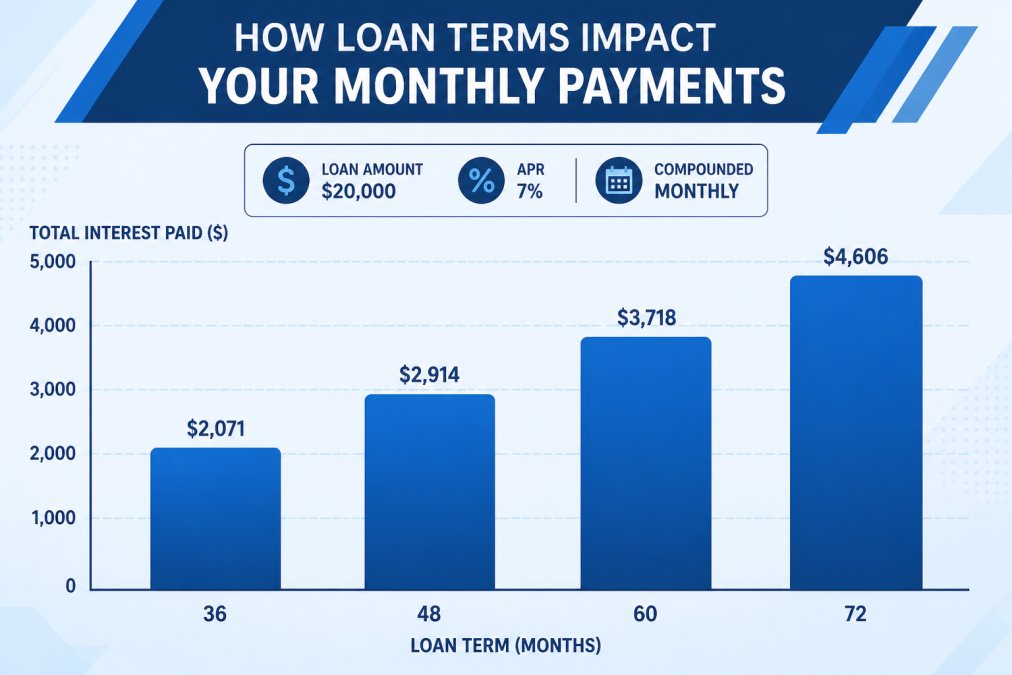
Let's look at a concrete example. On a $20,000 loan at a fixed 7% APR, the differences are substantial across common loan terms. A 36-month term carries higher monthly payments but minimizes the interest you pay over the life of the loan. A 72-month term cuts the monthly payment nearly in half but more than doubles the total interest. The Federal Trade Commission guide on auto loan shopping recommends comparing total cost, not just the monthly payment, when evaluating loan offers.
The practical takeaway: choose the shortest loan term you can comfortably afford. If you need a longer term to make the payment work, plan to make extra principal payments when possible. This reduces the principal balance faster and shortens the effective loan term, saving you interest without locking you into a higher monthly payment you can't handle.
Conclusion: Your Path to Getting Approved for Car Loans
Getting approved for car loans in Toms River comes down to preparation, not luck. Bring your documents, understand the difference between pre-qualification and pre-approval, and know what your credit profile realistically supports. The buyers who walk out with keys are the ones who went in with a clear picture of their budget and financing options.
At AutoSport USA, our finance team works with lenders across the credit spectrum, and our online financing tools let you start the credit application from home. We also offer trade-in valuations so you know your vehicle's worth before you visit. Whether you have strong credit or a history of setbacks, we'll help you find financing that fits your budget.
Frequently Asked Questions
What is the easiest car lender to get approved for?
Credit unions and online lenders that specialize in subprime financing are often the easiest for car loans. They look at your whole financial picture, not just your credit score. A dealership's finance center also has relationships with multiple lenders, including those that work with bad credit. Applying online with a local dealer can match you with a lender suited to your specific credit history.
What credit score is needed to get a car loan?
There is no single cutoff. Lenders work with scores across the spectrum. A score above 660 typically gets the best rates, but used car financing for bad credit exists for scores below 600. Be prepared for a higher APR and a larger down payment. Your income and debt-to-income ratio matter just as much as the number, so focus on showing stable employment.
What documents do I need to bring to a dealership for financing?
Bring proof of identity (driver's license), proof of income (recent pay stubs or tax returns), proof of residency (utility bill), and your current auto insurance card. If you have a trade-in, bring the title and registration. Having these ready speeds up the approval process and shows the loan specialist you are serious.
Can I get a car loan with bad credit?
Yes. Many lenders specialize in used car financing for bad credit. Expect to pay a higher interest rate and provide a larger down payment. To improve your chances, apply with a co-signer or work with a dealership that has relationships with multiple subprime lenders. Avoid applying to many banks at once, as each inquiry can lower your score slightly.
Getting approved doesn't have to be a struggle when you have the right team and the right preparation on your side. Start your application online with AutoSport USA and get a clear answer on your financing options today.
This article was written using GrandRanker