 comparison
Is It Better to Buy a Used Car From a Dealer or Private Seller?
Last Updated: October 25, 2026
Quick Summary
Whether is it better to buy a used car from a dealer or private seller depends on your budget, timeline, and tolerance for risk. A private sale usually costs less upfront, while a dealer bundles in inspection, paperwork, financing, and warranty recourse when something goes wrong.
- Dealers typically recondition and inspect vehicles before listing, while private sellers sell the car as it sits.
- Private-party sales are still taxable in most states, so a lower price doesn't always mean a lower tax bill.
- A pre-purchase inspection by an independent mechanic is the highest-value step on either route.
- The buyer's guide window form states whether a dealer-sold used car is as-is or carries a warranty.
- Private sellers usually have more negotiating room because they carry no overhead or reconditioning costs.
Table of Contents
- Used Car Dealer vs Private Seller: The Core Trade-Off
- Total Cost Comparison: Purchase Price, Fees, and Repairs
- Vehicle Selection, Condition, and Inspection Standards
- How to Inspect a Used Car Before Buying
- Warranties, Legal Protections, and As-Is Sales
- Questions to Ask When Buying a Used Car
- Negotiating a Used Car Price With a Dealer or Private Owner
- Which Route Fits Your Situation? A Buyer Decision Framework
- Frequently Asked Questions
Used Car Dealer vs Private Seller: The Core Trade-Off
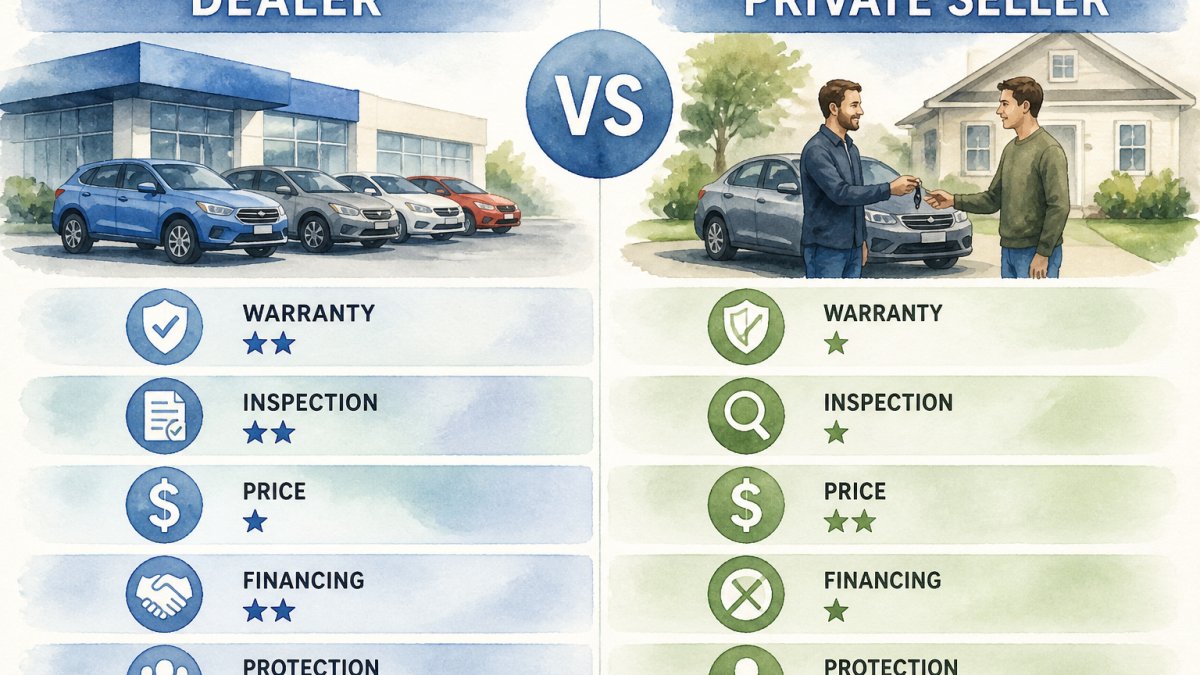
When asking is it better to buy a used car from a dealer or private seller, the answer comes down to one trade-off: a private sale usually costs less upfront, while a dealer bundles in inspection, paperwork, financing, and recourse when something goes wrong.
The used car dealer vs private seller decision isn't about which channel is "honest", it's about how much risk and legwork you'll absorb to save money.
AutoTrader's used car buying guide notes that private sellers often offer more negotiating use, but buyers take on extra time, paperwork, and risk. Dealers charge more for the convenience and services they provide.
Side-by-Side Comparison Table
| Factor | Dealer | Private Seller |
|---|---|---|
| Upfront price | Higher | Lower |
| Negotiating use | Moderate | Strong |
| Vehicle selection | Broad, one lot | One car at a time |
| Inspection and reconditioning | Usually performed before listing | Buyer's responsibility |
| Financing | In-house or lender network | Cash or your own loan |
| Paperwork and title transfer | Handled for you | You handle it |
| Warranty | Often available | Typically as-is |
| Recourse if something fails | Contract and warranty | Limited |
Total Cost Comparison: Purchase Price, Fees, and Repairs
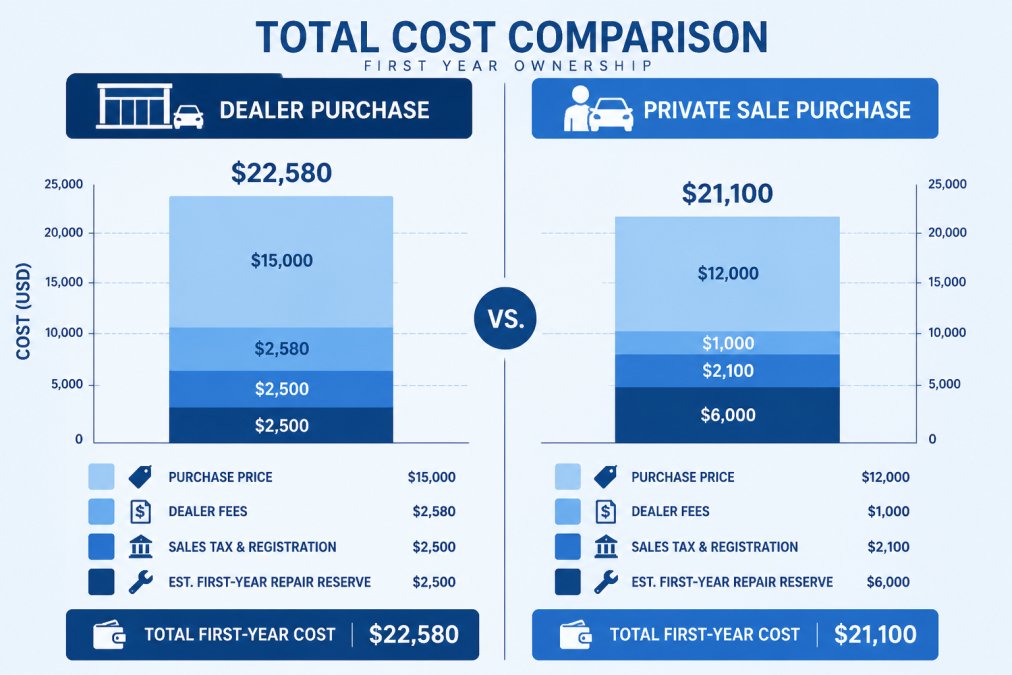
The sticker price is the least reliable number in this decision. A dealer purchase adds documented fees, sales tax, and registration, but the car has usually been reconditioned and inspected.
What most guides miss is that the private-sale savings estimate is just that, an estimate. MotorTrend's dealer vs private seller guide points out that dealerships often source used vehicles at auction, where prices run below retail.
Build the Out-the-Door Number First
Before you compare anything, get the out-the-door total in writing from each seller: on a dealer lot, the negotiated price plus every finance-office line item; from a private seller, the agreed price plus what you'll pay to transfer and register the car yourself.
Budget for these line items on both routes:
- Purchase price or negotiated price
- Dealer documentation and preparation fees, where applicable. These are set by the dealer, not by law, and vary widely. Ask for the itemized list before you negotiate the price.
- Sales tax and registration, required either way. Private-party sales are still taxable in most states, usually based on the purchase price or a state valuation table, so a lower private price doesn't always mean a lower tax bill.
Why the Private-Sale Discount Shrinks
A common mistake is comparing a private seller's asking price against a dealer's listed price and calling it a win. Run the math in the right order and the gap often narrows fast:
- Start with the dealer's out-the-door number, not the advertised price. Documentation fees, add-ons, and taxes can add a meaningful amount before you discuss financing.
- Subtract the private seller's asking price from that number. This is your gross savings.
- Subtract the private car's known needs. If the inspection found worn tires, brakes, or a fluid service, price those at a local shop before you decide the private car is cheaper.
- Subtract a repair reserve for the private car, because it has no warranty. Even a modest reserve can erase a small discount.
- Add back the value of the dealer's warranty and inspection records, if those matter to you. A limited warranty or CPO coverage has a real dollar value and is part of what you're buying.
If the private car still wins after steps 1 through 5, the discount is real. If it does not, you were comparing a sticker to a sticker.
Financing Changes the Math
Cash buyers and financed buyers aren't comparing the same numbers. A dealer can arrange financing on the spot, and the interest rate is part of your total cost. A private seller usually expects cash or a cashier's check, so if you need a loan, arrange it yourself through a bank or credit union before you shop.
Before you visit a dealer, it helps to know which fees are legitimate and how to avoid hidden charges.
Vehicle Selection, Condition, and Inspection Standards
Condition standards differ too. Dealers typically recondition before listing and can show you what was done. Private sellers sell the car as it sits. Neither guarantees perfection, but one comes with a paper trail.
Verifying history is your job on both routes. Our guide to CARFAX vs AutoCheck accident history reports explains how the two services differ so you can read the results with clear eyes.
How to Inspect a Used Car Before Buying
A pre-purchase inspection by an independent mechanic is the single highest-value step in either route, and it costs far less than the repairs it prevents. The mechanic checks the engine, transmission, brakes, suspension, and frame, and scans for stored fault codes.
Watch out: skipping the inspection because the seller seems trustworthy is the most expensive shortcut in used car buying. A friendly seller and a failing transmission are not mutually exclusive.
The Due-Diligence Checklist for Both Routes
Run this list regardless of who holds the title:
- Confirm the vehicle identification number on the dash matches the title and the listing
- Pull a vehicle history report and review accidents, title brands, and odometer readings
- Check for an outstanding lien before paying anything
For a printable version to bring along, use our used car inspection checklist for buyers.
Warranties, Legal Protections, and As-Is Sales
A warranty is the clearest structural difference between the two routes, but "dealer warranty" is not one thing. Buyers who treat every dealer purchase as covered make expensive assumptions. The four arrangements below are legally and financially different, and the paperwork you sign tells you which one you're getting.
The Four Coverage Arrangements
- As-is sale. The seller makes no promise about future repairs. You buy the car in its current condition, and your ability to recover money if something fails is limited. Private sales are almost always as-is, and some dealer sales of older or higher-mileage vehicles are too. "As-is" is a legal term describing who bears the risk after the sale, and in an as-is sale, that's you.
- Limited dealer warranty. The dealer promises to cover specific components for a specific period or mileage, often with a deductible and exclusions. Read the exclusions before you sign, a warranty covering the powertrain but not seals, gaskets, or electronics is narrower than it sounds.
- Service contract (often called an extended warranty). This isn't a manufacturer warranty; it's a contract you buy, usually from the dealer or a third party, that pays for certain repairs under stated terms. It has its own price, deductible, claim process, and exclusions. It can be worth it, but price it separately and compare it against setting aside the same money as a repair reserve.
What the Paperwork Tells You
The buyer's guide window form required on used cars sold by dealers states whether the vehicle is sold as-is or with a warranty, and lists the warranty terms if any. Read it before you negotiate, not at signing. If it says as-is, no conversation with the salesperson changes that; if it lists a warranty, confirm what's excluded and who honors the coverage.
Legal Protections Are Local
Consumer protection law varies by state, and some states impose specific disclosure duties on sellers, title-branding rules, and cooling-off rights that other states do not. Check your state attorney general's office for the rules that apply where you live. USA.gov consumer protection resources is a reasonable starting point for finding your state's consumer affairs office.
Dealers also carry licensing obligations that private sellers don't, which gives you a formal channel for complaints through the state dealer licensing agency. That's not a guarantee of a perfect outcome, but it's recourse a private sale rarely provides.
Questions to Ask When Buying a Used Car
Ask the same core questions on both routes, and listen for hesitation. Vague answers about maintenance or title status are a signal to walk.
- Why are you selling the vehicle?
- How long have you owned it, and how many miles have you put on it?
- Do you have maintenance records, and can I see them?
On a dealer lot, add: what does the warranty cover, what's the out-the-door price, and can I see the inspection and reconditioning records? Those three answers tell you more than any sales pitch.
Negotiating a Used Car Price With a Dealer or Private Owner
Private sellers usually have more room to move, because there's no floor plan, overhead, or reconditioning cost baked into the price.
Come with data: the vehicle history report, the inspection findings, and comparable listings. A specific, evidence-backed offer lands better than a round number pulled from the air.
When you're ready to make an offer, our step-by-step guide on how to negotiate a used car price like a pro walks through the timing, phrasing, and walk-away points that actually work.
Which Route Fits Your Situation? A Buyer Decision Framework
Buy from a dealer if you want selection, financing, inspection records, and a warranty, and you're willing to pay for that bundle.
Best for a dealer: first-time buyers, anyone with credit challenges who needs financing, and shoppers who want one stop for trade-in, paperwork, and coverage. If you're leaning toward a dealer but want to see what else is out there, review the alternatives to buying from private sellers before you commit.
Best for a private seller: cash buyers who know what they're looking at and want the lowest possible price.
The honest challenge in this decision isn't finding a car. It's finding one you can trust without spending three weekends driving around.
Frequently Asked Questions
Is it cheaper to buy a used car from a private seller?
Usually yes on the sticker price. Private sellers do not carry the overhead of a dealership, and guides on this topic estimate private-sale prices can run roughly 10-15% below dealer retail. That gap shrinks once you add sales tax and registration, an independent pre-purchase inspection, and any reconditioning the car needs. A private sale with no maintenance records and worn tires can erase the savings quickly. Compare the out-the-door total, not just the asking price, before deciding which route is cheaper for you.
Do used car dealers offer warranties or return periods?
Many do, but the terms vary widely, so ask for the warranty in writing before you sign. A used car dealer may include a limited warranty on certain models, and certified pre-owned programs typically add a manufacturer-backed inspection and coverage. Private sales are almost always as-is, meaning once you pay, the car is yours with no recourse if something fails. Read the buyer's guide sticker on the window and confirm what is covered, for how long, and which parts are excluded.
What are the red flags to avoid when buying a used car?
Walk away if the seller refuses an independent pre-purchase inspection, cannot produce a clean title in their name, or asks to meet only in a parking lot with no address. Other warnings: an odometer reading that conflicts with the vehicle history report, a title branded as salvage or flood, fresh paint on one panel, or a seller who pushes you to pay in cash or gift cards. At a dealership, red flags include pressure to sign before you see an itemized out-the-door price.
Can I negotiate the price of a used car with a dealer?
Yes. Dealer prices carry margin, and negotiating a used car price is expected. Research the fair market value for the exact year, trim, and mileage, get pre-approved financing so you negotiate as a cash-equivalent buyer, and ask for the out-the-door number rather than the monthly payment. Dealer fees such as documentation charges are often negotiable too. Private sellers usually have more room to move because they set their own price, but they also have fewer cars to fall back on.
What should I check before buying a used car from a private seller?
Confirm the title is in the seller's name and free of liens, then run a vehicle history report and match the vehicle identification number on the dash, door jamb, and title. Ask for maintenance records and a pre-purchase inspection at a shop you choose. Test drive on the highway, check for warning lights, and verify the odometer against the report. Finally, complete the title transfer and registration at your state motor vehicle agency the same day, and get a signed bill of sale.