 ultimate-guide
Benefits of Trading In a Car for a New Model in 2026
Table of Contents
- Trade-In vs. Private Sale: A Side-by-Side Comparison
- Does Trading In a Car Lower Sales Tax?
- How to Get a Trade-In Appraisal Online
- How to Prepare Your Car for Trade-In
- Managing Negative Equity and Hidden Costs
- The Financial and Convenience Benefits of Trading In a Car
- Frequently Asked Questions
Last Updated: September 21, 2026
Trade-In vs. Private Sale: A Side-by-Side Comparison
Trading in a car is the practice of selling your current vehicle to a dealership and applying its value toward the purchase of another car. This guide from AutoSport USA walks through the real math behind that decision, because the benefits of trading in a car for a new model are financial as well as practical, and most dealership blogs only tell half the story.
Here is the part they skip: a private sale usually produces a higher headline number, while a trade-in produces a faster, cleaner transaction with tax advantages that narrow or erase that gap. Which one wins depends on your equity position, your timeline, and how much risk you want to absorb.
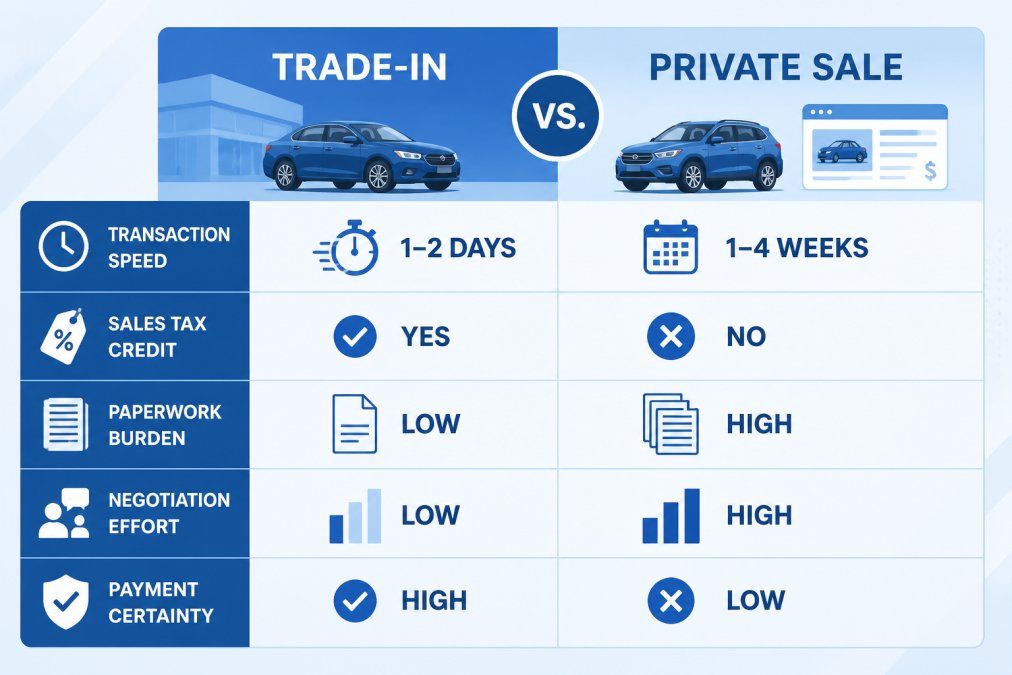
| Factor | Dealer Trade-In | Private Party Sale |
|---|---|---|
| Time to close | Same day | Days to weeks |
| Sales tax credit | Applied to new purchase in most states | Not available |
| Paperwork | Dealer handles title transfer | Seller handles title and bill of sale |
| Negotiation | One conversation | Multiple buyers, repeated showings |
| Payment certainty | Guaranteed by dealer | Depends on buyer financing |
| Price ceiling | Wholesale value | Retail fair market value |
The trade-off is straightforward. You give up some price in exchange for speed, legal protection, and a tax credit. Whether that trade is worth it comes down to your numbers, not to a slogan.
Does Trading In a Car Lower Sales Tax?
Yes, in most states. When you trade in a car, the dealer typically subtracts the trade-in allowance from the purchase price before calculating sales tax, which lowers your sales tax liability on the new vehicle.
This is the single most misunderstood benefit of trading in a car for a new model, and it is why a slightly lower trade-in offer can still beat a higher private-party offer.
How to Get a Trade-In Appraisal Online
An online trade-in appraisal is an estimated value range for your vehicle, generated from your VIN, mileage, condition, and current market data, and it takes only a few minutes to request.
Here is how to get the most accurate number:
- Have your VIN and current odometer reading ready
- Disclose condition honestly, including prior paintwork or warning lights
- Upload photos of all four corners, the interior, and the odometer
- Note any accident history or rebuilt title status upfront
- Compare the range against at least two independent sources
How to Prepare Your Car for Trade-In
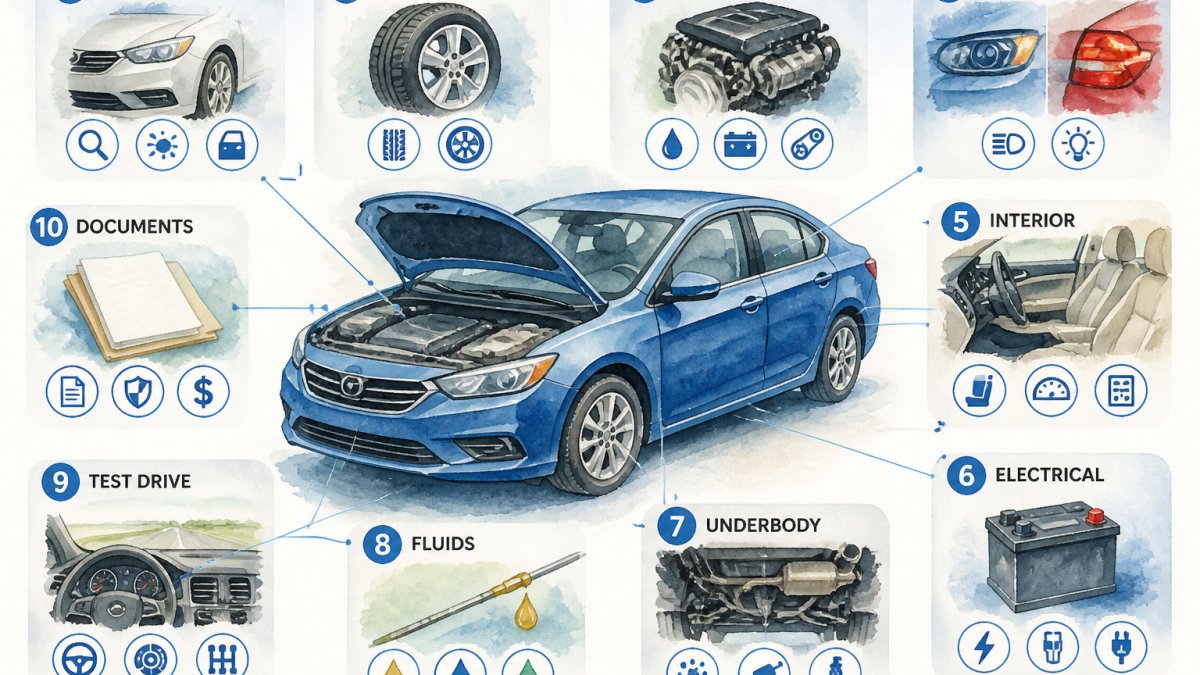
Preparation is where most sellers leave money on the table. A clean, documented vehicle with a complete service history consistently appraises higher than an identical car with no records.
Work through this checklist before your inspection:
- Gather all keys, including spares and the valet key
- Collect service records, repair invoices, and warranty paperwork
- Remove personal items, toll transponders, and phone mounts
- Wash and vacuum the interior; clean the engine bay
- Check tire tread depth and top off all fluids
- Address cheap fixes: burned-out bulbs, wiper blades, cabin filter
- Confirm the lienholder payoff amount in writing if you still owe
- Locate the title or note that it is held electronically
Managing Negative Equity and Hidden Costs
Negative equity, often called being upside-down or underwater, means you owe more on your auto loan than the vehicle is worth. Trading in an upside-down car does not erase that gap. The dealer pays off your lienholder, and the shortfall gets rolled into your new financing terms.
Step-by-step: working through negative equity before you shop
- Get your exact payoff amount from your lienholder in writing, including any per-diem interest and early-payoff fees. A phone quote is not enough.
- Get a realistic trade value, not a retail listing price. Use an online appraisal and cross-check it against at least two independent sources.
- Subtract the payoff from the trade value. That difference is your equity position. If it is negative, that is the number you must absorb.
- Ask the dealer what LTV cap their lenders will accept on the specific model you want. This tells you how much negative equity can actually be rolled in.
- Decide whether to pay down the gap in cash, choose a vehicle with stronger resale value, or wait.
How the sales tax credit interacts with negative equity
Options ranked by cost
- Pay the gap in cash. Cleanest outcome. You start the new loan with positive equity.
- Wait and pay down the loan. If your payoff is within a few thousand dollars of the appraisal value, a few months of payments can close the gap without a cash outlay.
- Choose a slower-depreciating model. Vehicles with strong resale value (many trucks and certain SUVs) hold value better, which shortens the time you stay underwater on the next loan.
- Refinance after the purchase. If rates have dropped or your credit has improved, refinancing the new loan can lower the rate on the rolled-in balance. There is usually no waiting period, but check whether your lender charges a prepayment penalty.
- Roll it in and accept the risk. This is the most expensive path. You are financing a depreciating asset plus a prior loss, and you will likely be upside-down again for a longer period.
Hidden costs beyond negative equity
The Financial and Convenience Benefits of Trading In a Car
The convenience factor is genuine, but it is the financial mechanics that most often decide the trade. When you trade in a car, the dealer assumes the legal work: title transfer, lienholder payoff, and paperwork you would otherwise handle yourself.
Financial benefits
- Sales tax credit. In most states that levy a sales tax on vehicle purchases, the trade-in allowance is subtracted from the purchase price before tax is calculated. On a $30,000 new car with a $10,000 trade, you pay tax on $20,000. At a 6% rate, that is $600 saved. A handful of states do not offer this credit and tax the full purchase price regardless of trade-in. Rules also differ for leased vehicles and for trades where a lienholder still holds the title.
- Immediate payment certainty. A dealer pays on the spot. A private buyer may promise a bank check that clears in three days, or may never close at all.
- Reduced down payment requirement. Positive equity counts toward your down payment, which can lower the amount financed and sometimes the interest rate.
- Negotiation leverage when sequenced correctly. Negotiate the new car price first, then introduce the trade. Dealers who know your trade number before the vehicle price have room to blur the two figures together.
Convenience benefits
- Hassle-free transaction completed in a single visit
- No strangers visiting your home for test drives
- No risk of a bounced check or a buyer who disappears mid-transfer
- Transaction speed measured in hours, not weeks
The balanced view: what you give up
Hidden costs of trade-ins
- Dealer margin. The dealer buys at wholesale and resells at retail. That spread is the dealer's profit, and it is built into the trade allowance.
- Low-ball appraisals. Some dealers quote a low initial number, expecting you to negotiate up. Getting an independent online appraisal first gives you a floor.
- Market timing. Appraisal values move with wholesale auction results. A trade quoted in a strong market may not hold if you delay the purchase.
- Add-on bundling. Documentation fees, dealer prep, and protection packages can quietly offset the tax credit if you do not review the itemized agreement.
Which states offer the trade-in sales tax credit
Frequently Asked Questions
Is it a good idea to trade in your car for a new car?
Trading in a car is often a good idea if you value convenience and sales tax savings. In most states, the trade-in allowance reduces the taxable amount of your new purchase. You avoid the hassle of listing, showing, and negotiating with private buyers. However, a private party sale can sometimes yield a higher price. Weigh the time and effort against the potential extra cash.
How does a trade-in affect my sales tax liability?
In most states, the trade-in allowance is subtracted from the new vehicle's purchase price before sales tax is calculated. For example, if you buy a $30,000 car and get $10,000 for your trade, you pay sales tax on $20,000. This can save you hundreds or even thousands of dollars. Tax laws vary by state, so check your local rules to confirm the benefit applies.
When is it better to keep your car instead of trading it in?
Keeping your car may be better if it is paid off, reliable, and you have no need for a new model. If your vehicle has high mileage but runs well, maintaining it often costs less than monthly payments on a new car. Also, if you are upside-down on your loan, keeping the car and paying it down can avoid rolling negative equity into a new loan.
What is the $3,000 rule for cars?
The $3,000 rule is a general guideline suggesting that if a repair costs less than $3,000, it is usually worth fixing rather than trading in. This is not a hard rule. Compare the repair cost to the cost of a new car and your trade-in value. If the repair is minor and the car is otherwise sound, keeping it may be more economical than a new purchase.