 comparison
Lester Glenn vs Independent Dealerships: 2026 Comparison
Table of Contents
- Lester Glenn vs Independent Dealerships: Quick Comparison
- Used Car Dealership Transparency: Fees, Pricing, and What They Hide
- Financing Options at Independent vs Franchise Dealers
- Inventory and Vehicle Selection: Franchise Group vs Independent Lot
- What to Look for in a Used Car Dealership
- Total Cost of Ownership: Where the Real Difference Shows
- Warranty Coverage and Vehicle History: What Buyers Miss
- Making Your Choice: Lester Glenn or an Independent Dealer?
- Frequently Asked Questions
Last Updated: September 18, 2026
Lester Glenn vs Independent Dealerships: Quick Comparison
Shopping for a used car in Toms River often comes down to a single question: do you buy from a large franchise group like Lester Glenn, or from an independent dealership? The honest answer is that both models can serve you well, and the right pick depends on what you value most. This guide from AutoSport USA breaks down the real differences in fees, financing, inventory, and long-term cost so you can walk onto any lot with clear eyes.
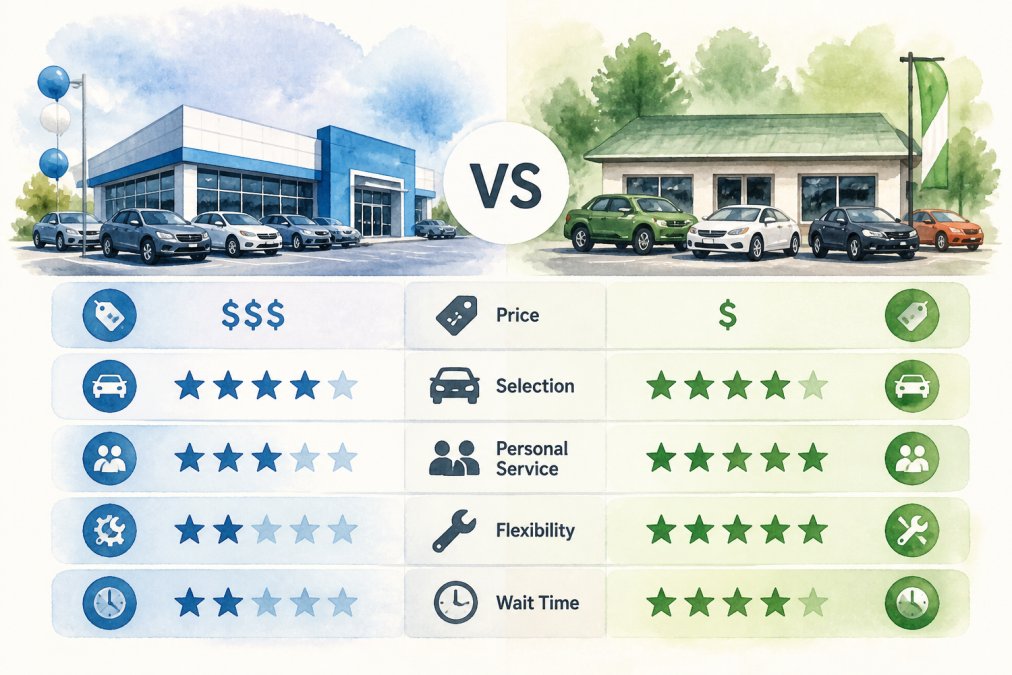
Lester Glenn vs independent dealerships is really a comparison of scale versus specialization. Lester Glenn Auto Group runs multiple locations and carries several automotive brands, with a flat $749 documentation fee and a market-based pricing model that avoids teaser rates. Independent dealerships, by contrast, tend to run leaner operations with a curated used inventory and a more personal buying process.
Here's the part most shoppers miss: the sticker price is rarely where the deal is won or lost. Fees, financing terms, and warranty coverage usually decide who gets the better outcome.
| Factor | Lester Glenn Auto Group | Independent Dealerships |
|---|---|---|
| Documentation fee | Flat $749 across inventory | Varies by store |
| Pricing model | Market-based, no teaser rates | Often negotiable per unit |
| Financing programs | New Start Credit Program | Varies; often lender networks |
| Inventory size | Large, 12 brands | Smaller, curated used stock |
| Transparency grade | Grade A (per CarEdge) | Mixed; verify per dealer |
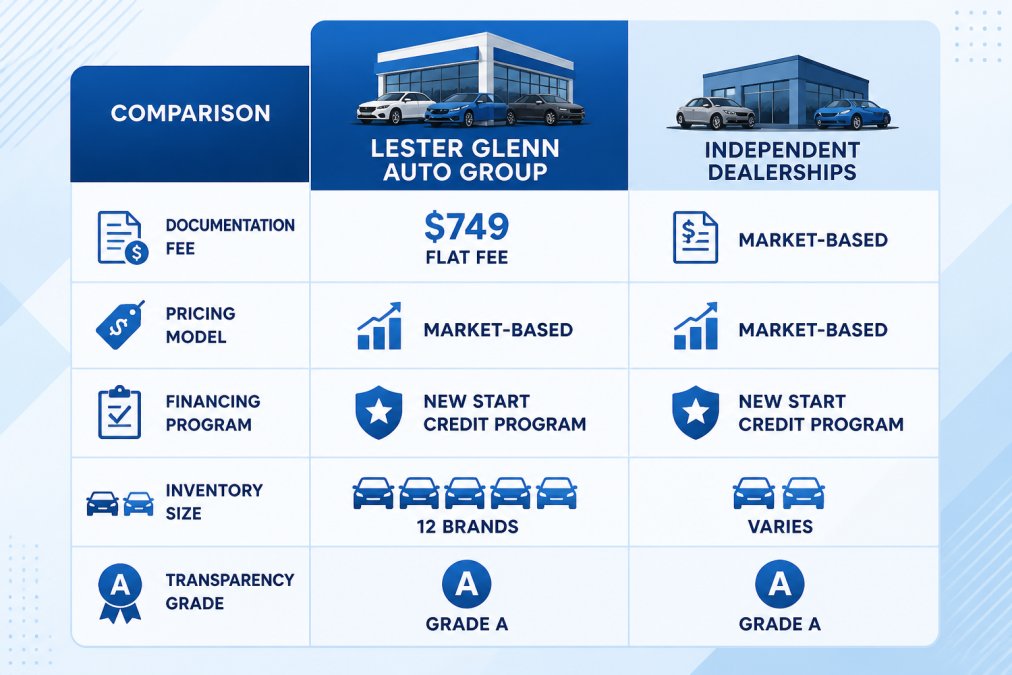
Used Car Dealership Transparency: Fees, Pricing, and What They Hide
Used car dealership transparency comes down to one thing: whether the out-the-door price you're quoted is the price you actually pay. Lester Glenn earns a Grade A transparency rating from CarEdge's dealer transparency grading system for standardized fees and market-based pricing. That's a meaningful signal, because fee games are where most buyers lose money.
Watch for these common add-ons:
- Documentation fees that appear only at signing
- Addendum stickers listing aftermarket accessories you didn't request
- Dealer markups layered on top of MSRP
- Registration and sales tax estimates that don't match the final contract
A common mistake is negotiating the vehicle price and ignoring the fee sheet. Ask for the out-the-door price in writing before you discuss monthly payments. Independent lots aren't automatically worse here, but the burden of verification falls on you.
Financing Options at Independent vs Franchise Dealers
Financing options at independent vs franchise dealers differ less in the paperwork than in who actually funds the loan and how much room the store has to mark it up.
What actually changes your outcome:
- Get pre-approved by your own bank or credit union before you shop. A direct loan from your credit union is priced independently of any dealer markup.
- Ask each store, in writing, for the annual percentage rate, the term in months, and the total finance charge, not the monthly payment.
- Ask whether the quoted rate includes a dealer reserve or markup, and whether a lower buy rate is available.
- Compare the out-the-door price and the APR separately. A lower price with a marked-up rate can cost more than a higher price with a clean rate.
Neither model is automatically cheaper. The franchise route tends to win on standardized, sometimes subvented rates; the independent route tends to win on approval odds for bruised credit. Your job is to price both before you commit.
Inventory and Vehicle Selection: Franchise Group vs Independent Lot
- Against a franchise group: pricing is often market-based and set centrally, so the salesperson has limited room on the vehicle price. Your leverage lives in the trade-in appraisal, the financing rate, and the add-on menu, not the sticker. Ask for the out-the-door number and compare it to the market, then push on the trade and the rate.
- Against an independent lot: pricing is usually set per unit by the owner, so there is real room on the vehicle price. Your leverage lives in the sticker and in the absence of a factory warranty. Use a third-party valuation, a mechanic's inspection, and the missing warranty as negotiating points, and be ready to walk.
What to verify regardless of model:
- The vehicle history report, reviewed by you, not summarized by the salesperson
- A pre-purchase inspection by your own mechanic on any used unit
- Whether the warranty is factory-backed and portable or dealer-limited to the selling store
- The out-the-door price in writing before you discuss monthly payments
Neither model guarantees a better vehicle. What matters is the inspection behind each unit and the warranty that travels with it.
What to Look for in a Used Car Dealership
What to look for in a used car dealership comes down to proof: verified history, documented inspection, and fees disclosed before you commit. Any dealer worth your time will hand these over without a fight.
Use this checklist when evaluating any lot:
- Vehicle history report from a recognized provider, reviewed by you
- Independent mechanical inspection or a detailed dealer inspection report
- Written out-the-door price including documentation fees, sales tax, and registration fees
- Warranty coverage terms spelled out in the contract
- Trade-in value offer in writing, with the appraisal method explained
- Clear return or cancellation policy
Total Cost of Ownership: Where the Real Difference Shows
Total cost of ownership is the number most buyers never calculate, and it's where franchise and independent purchases can end up closer than expected. Purchase price is only the first line. Add financing interest, sales tax, registration fees, insurance, fuel, and maintenance over your ownership period.
Two factors swing the math most:
- Warranty coverage. Certified pre-owned vehicles from a franchise group often include extended factory-backed coverage. Independent purchases may come with a limited dealer warranty or none at all, leaving you to buy a service contract separately.
- Service department access. A large group typically has in-house service departments, which can simplify warranty repairs. Independent buyers often use their own mechanic, which can be cheaper but requires more legwork.
Warranty Coverage and Vehicle History: What Buyers Miss
Warranty coverage and vehicle history are the two details buyers skip when they're excited about a car. Both are verifiable, and both change the real cost of ownership.
Making Your Choice: Lester Glenn or an Independent Dealer?
Neither model wins outright. Lester Glenn offers scale, standardized fees, and a wide new and used inventory, which suits buyers who want selection and predictable pricing. Independent dealerships offer a curated used inventory, flexible financing through lender networks, and a more personal buying experience.
Frequently Asked Questions
What are the primary differences between Lester Glenn and independent dealerships?
Lester Glenn is a large multi-brand group with multiple locations and a flat $749 documentation fee, while independent dealerships like AutoSport USA offer a smaller, curated inventory and personalized service. Lester Glenn provides access to various automotive brands and programs like New Start Credit, whereas independents often specialize in used vehicles and local customer relationships. Both can offer fair deals, but the fee structure, inventory volume, and financing flexibility differ significantly.
Do independent dealerships offer the same financing options as large auto groups?
Independent dealerships typically work with a network of lenders and can offer flexible financing, including options for credit-challenged buyers. Large groups like Lester Glenn may have factory-backed programs such as New Start Credit. The key difference is that independents may have more discretion to tailor loans, while franchise groups may have standardized rates. Always get a pre-approval and compare interest rates and terms from at least two sources.
What should I look for when comparing dealership transparency and fees?
Ask for the out-the-door price in writing, including documentation fees, sales tax, and registration. Lester Glenn charges a flat $749 doc fee, while independent dealers may charge less or more. Check if the dealer provides a vehicle history report and a warranty. Use tools like CarEdge or KBB to verify fair market value. Transparency means no surprise add-ons after you agree on a price.
Are there benefits to choosing a local independent dealership for used vehicle purchases?
Independent dealerships often provide a more personalized experience, with staff who know their inventory and can focus on your specific needs. They may offer competitive pricing on used vehicles and flexible negotiation. For buyers in Toms River, a local independent like AutoSport USA can simplify the process with online financing tools and trade-in valuations. The smaller scale means you are not just a number, but inventory is limited.
How do I verify a used car's history and warranty coverage?
Request a vehicle history report from the dealer, and cross-check it with the National Motor Vehicle Title Information System (NMVTIS). For warranty, ask if the vehicle is certified pre-owned (CPO) or if any factory coverage remains. Independent dealers may offer limited powertrain warranties, while franchise groups may have CPO programs. Always get warranty terms in writing and understand what is covered and for how long.
The real challenge in buying a used car isn't choosing between a franchise group and an independent lot. It's getting every number, fee, and warranty term in writing before you commit. AutoSport USA makes that easier with online financing applications, trade-in valuations you can start from home, and a curated inventory of used vehicles chosen for daily driving. Apply online with AutoSport USA and get a clear answer on financing before you ever leave the house.